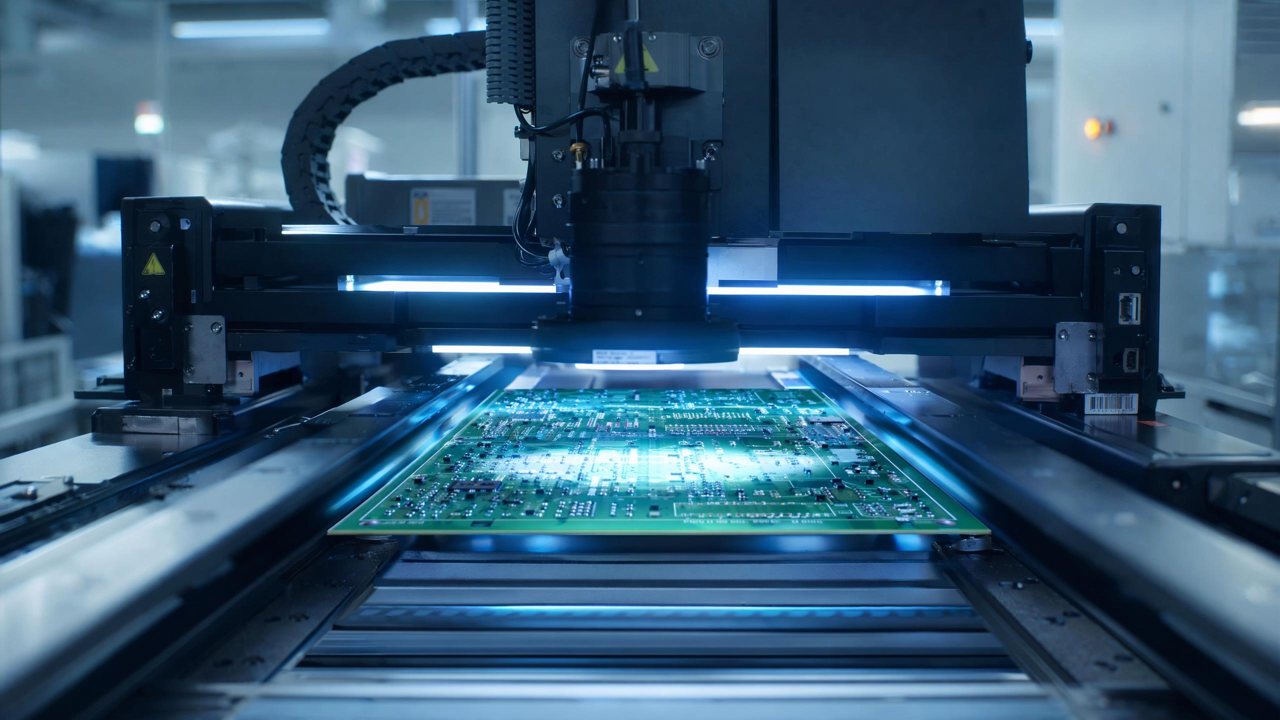
In the electronics manufacturing industry, the quality of SMT solder joints directly affects product performance and stability. WeLinkirt's 2D AI AOI equipment provides reliable support for SMT solder joint inspection with its unique technological advantages.
In the electronics/PCBA industry, SMT (Surface Mount Technology), as a key electronic assembly process, is widely used in the production of various electronic products. The quality of SMT solder joints plays a decisive role in the performance and stability of products. The SMT production line of a leading electronics manufacturing company is mainly responsible for producing various PCBA (Printed Circuit Board Assembly) products. After the SMT placement process is completed, the solder joints on the PCB board need to be strictly inspected. The inspection objects cover a variety of SMT solder joint defects such as cold solder joints, bridging, and insufficient solder. These defects may cause unstable product performance or even malfunctions during use, so the requirements for solder joint quality inspection are extremely high.
Pain Points: Why Is It Difficult?
Traditional SMT solder joint inspection methods have many quantitative difficulties. Firstly, a relatively high miss rate is a prominent problem. According to statistics, the miss rate of traditional methods reaches about 2%, and some minor defects such as cold solder joints and insufficient solder are easily overlooked. This is because traditional inspection technologies have limitations in resolution and feature recognition ability, making it difficult to capture subtle changes and defect features of solder joints. For example, a minor cold solder joint may only show extremely slight poor contact between the solder joint and the pin. The imaging accuracy and algorithm of traditional equipment cannot accurately identify such subtle differences, resulting in missed detections and the risk of defective products entering the market.
Secondly, serious false alarms are also a major drawback of traditional inspection methods. The false alarm rate is about 30%. A large number of false alarms not only increase the workload of manual re-inspection but also reduce the production efficiency of the production line. Traditional inspection methods often rely on preset fixed rules and thresholds for judgment. However, the actual solder joints in production are complex and diverse, affected by various factors such as the soldering process and environmental factors. As a result, many solder joints that meet the quality requirements are misjudged as defective, resulting in a large number of false alarms.
In addition, traditional inspection methods require a large amount of time for programming and debugging when changing product models, and the model-changing time is as long as 30 minutes. This is because the programming of traditional equipment requires professional personnel to perform complex parameter settings and rule writing according to different product models and solder joint layouts. Moreover, during the debugging process, continuous testing and adjustment are required to ensure the accuracy of inspection. This seriously affects the production flexibility and cannot quickly respond to changes in market demand.
Technical Principle
WeLinkirt's 2D AI AOI equipment uses high-resolution 2D imaging technology. The high-resolution camera it is equipped with can capture the subtle features of solder joints, providing clear and accurate image data for subsequent defect analysis. Compared with traditional imaging technology, high-resolution 2D imaging technology has a higher pixel density and a wider dynamic range, which can clearly present the surface morphology and internal structure of solder joints. Even minor defects can be clearly seen.
In terms of image processing, a deep-learning algorithm is used for secondary image judgment. Through learning and training on a large number of solder joint images, the model can accurately identify different types of solder joint defects. This algorithm is effective because it can learn the differences between the normal features and defect features of solder joints. For example, for cold solder joint defects, the model can learn the differences in grayscale values, shapes, etc., between cold solder joints and normal solder joints in the image. In contrast, traditional detection algorithms often can only make judgments based on fixed rules and cannot adapt to complex and changeable solder joint situations.
At the same time, the semantic false-alarm filtering algorithm can effectively filter out false alarms based on the semantic information of solder joints, reducing unnecessary manual re-inspection. This algorithm analyzes the semantic information such as the position, function, and relationship with surrounding components of solder joints on the PCB board to determine whether the detection result is a false alarm. Traditional methods lack this semantic analysis ability and can only make simple threshold judgments on detection results, which easily leads to a large number of false alarms.
Typical Application Scenarios
- Cold Solder Joint Detection: Cold solder joints are one of the common defects in SMT solder joints, manifested as unstable electrical connections between solder joints and pins. WeLinkirt's 2D AI AOI equipment captures the subtle morphological changes of solder joints through high-resolution 2D imaging technology and uses a deep-learning algorithm to analyze the grayscale values and shape features of solder joints to accurately identify cold solder joint defects. The difficulty lies in that the features of cold solder joints are often very subtle, and traditional inspection methods are prone to missed detections.
- Bridging Detection: Bridging refers to the situation where there is a tin bridge connection between adjacent solder joints, which can cause short-circuits in the circuit. The equipment clearly shows the connection state between solder joints through high-resolution images, and the deep-learning algorithm can accurately determine whether there is bridging. The difficulty lies in that the forms and degrees of bridging vary, and the algorithm needs to have strong adaptability and recognition ability.
- Insufficient Solder Detection: Insufficient solder can affect the mechanical strength and electrical performance of solder joints. The equipment judges whether the solder volume of solder joints is sufficient by analyzing the grayscale values and areas of solder joints. The difficulty lies in that it is difficult to accurately quantify the degree of insufficient solder, and the algorithm needs to be able to accurately distinguish between normal solder joints and those with insufficient solder.
- Solder Ball Detection: Solder balls are excess tin balls generated during the soldering process, which may cause short-circuits or other failures. The equipment clearly captures the position and size of solder balls through high-resolution 2D imaging technology, and the deep-learning algorithm can accurately identify and mark solder balls. The difficulty lies in that the sizes and shapes of solder balls vary, and the algorithm needs to have high recognition accuracy.
Implementation Case
A large-scale electronics manufacturing enterprise has multiple SMT production lines and produces a large number of PCBA products every day. Before introducing WeLinkirt's 2D AI AOI equipment, the enterprise used traditional SMT solder joint inspection methods and faced problems such as high miss rates, serious false alarms, and long model-changing times. During the implementation process, WeLinkirt's technical team conducted in - depth research on the enterprise's production process and inspection requirements, installed and debugged the equipment, and trained the operators. After a period of trial operation and optimization, the equipment was officially put into use.
After introducing WeLinkirt's 2D AI AOI equipment, the quality and efficiency of the enterprise's SMT solder joint inspection have been significantly improved.
Before the implementation, the solder joint defect detection rate of the enterprise was about 98%, the miss rate was about 2%, the false alarm rate was about 30%, and the model-changing time was as long as 30 minutes. After the implementation, the solder joint defect detection rate increased to 99.4%, the miss rate decreased to <0.6%, the false alarm rate decreased by -63%, from about 30% to about 11.1%, and the model-changing time was shortened from 30 minutes to 5 minutes.
WeLinkirt's Solution and Products
Centered around the 2D AI AOI equipment, WeLinkirt provides a complete SMT solder joint inspection solution. The equipment has the ability of high-speed online full inspection and can inspect solder joints with micron-level accuracy, ensuring that no minor defects are missed. In terms of programming, paired with the DaoAI AI AOI software system, zero-code automatic programming can be completed in only 5 minutes for a good product, greatly shortening the model-changing time. At the same time, the APDT positive-sample/few-sample learning function only requires 1-20 good products to complete model training, improving the efficiency of establishing the detection model. In addition, the semantic false-alarm filtering function further reduces the false alarm rate and improves the accuracy of inspection.
Quantitative Results
After adopting WeLinkirt's solution, significant quantitative results have been achieved. Firstly, the solder joint defect detection rate has increased from about 98% to 99.4%, and the miss rate has decreased to <0.6%. Secondly, the false alarm rate has decreased by -63%, from about 30% to about 11.1%, greatly reducing the workload of manual re-inspection. In addition, the model-changing time has been shortened from 30 minutes to 5 minutes, improving the production flexibility and efficiency of the production line.
FAQ
What problems of traditional SMT solder joint inspection can WeLinkirt's 2D AI AOI equipment solve?
WeLinkirt's 2D AI AOI equipment can solve the problems of high miss rate, serious false alarms, and long model-changing time in traditional inspection. It increases the detection rate to 99.4%, reduces the false alarm rate by 63%, and shortens the model-changing time to 5 minutes, effectively improving the inspection quality and production efficiency.
What is the technical principle of WeLinkirt's 2D AI AOI equipment?
The equipment uses high-resolution 2D imaging technology and is equipped with a high-resolution camera to capture the details of solder joints. It uses a deep-learning algorithm for secondary image judgment and a semantic false-alarm filtering algorithm to filter out false alarms based on semantic information, improving the accuracy and efficiency of inspection.
How are the quantitative results of WeLinkirt's solution reflected?
After adopting WeLinkirt's solution, the solder joint defect detection rate has increased from about 98% to 99.4%, the miss rate has decreased to <0.6%, the false alarm rate has decreased by 63%, and the model-changing time has been shortened from 30 minutes to 5 minutes, significantly improving the performance of the production line.
This article was generated by AI. Customer cases are simulated scenarios based on real product capabilities and figures are illustrative; see product pages for official benchmarks.