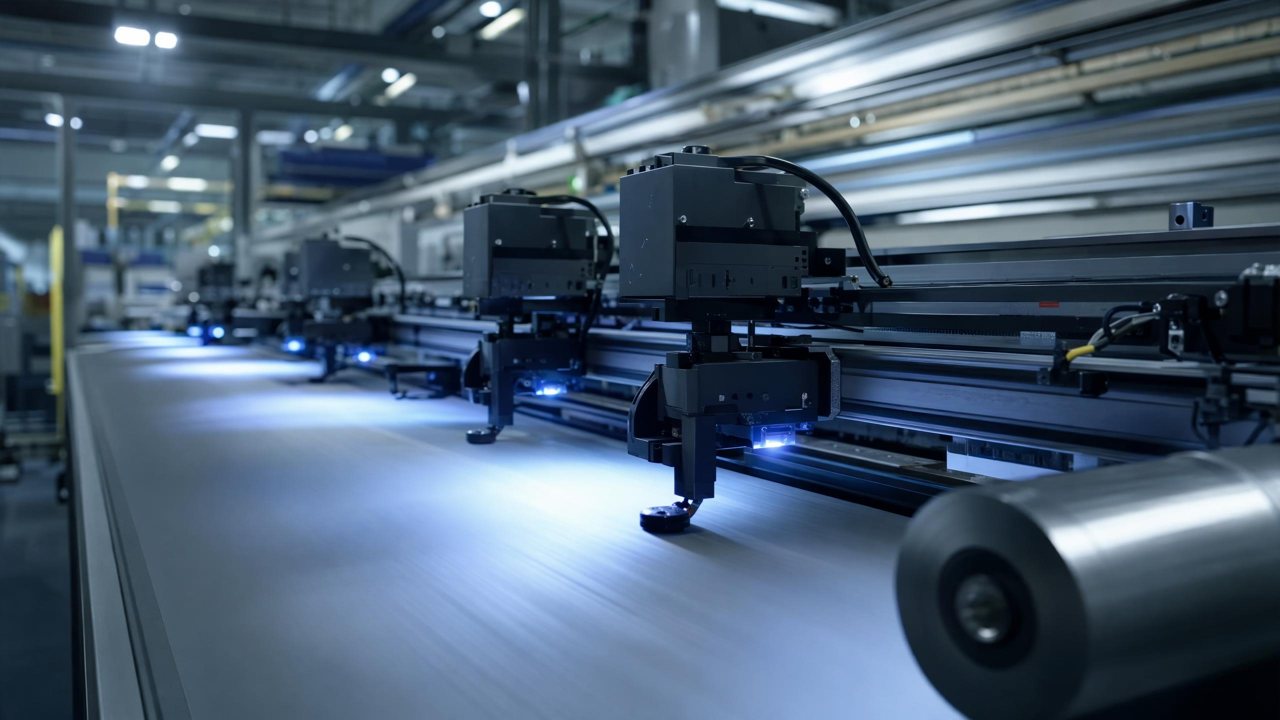
WeLinkirt's 2D AI AOI equipment demonstrates excellent performance in the field of paper defect detection with advanced technology, effectively solving the pain points of traditional inspection methods.
Industry Background and User Scenario: In the chemical/materials industry, paper, as an important industrial product and packaging material, its quality directly affects the quality and user experience of downstream products. A leading manufacturer in the chemical/materials industry has large-scale paper production lines, and its main products include various types of industrial paper and packaging paper. In the finished product inspection process of the paper production line, strict inspection of paper surface defects is required to ensure that the products meet the quality standards. These defects include holes, scratches, stains, wrinkles, etc. Any minor defect may affect the performance of the paper and even lead to product scrapping.
Pain Points: Why It's Difficult
Traditional paper defect detection methods mainly rely on manual visual inspection and simple optical inspection equipment, which have many problems. From the efficiency dimension, manual visual inspection is extremely inefficient. On the large-scale paper production line, workers need to concentrate on observing the paper surface for a long time, and the number of papers they can inspect per hour is limited. Moreover, as the working time prolongs, workers are prone to fatigue and inattention, resulting in a further decline in the inspection speed and seriously affecting the production progress. From the accuracy dimension, the miss-detection rate of manual visual inspection is as high as 5%. This is because human visual ability is limited, and it is difficult to accurately detect some tiny defects, such as micron-level holes and scratches, during the rapid inspection process. At the same time, long-term work will reduce the visual sensitivity of workers, increasing the possibility of miss-detection. Simple optical inspection equipment, although improving the inspection efficiency to a certain extent, has a false-alarm rate of up to 30%. This is because the imaging accuracy and algorithms of these equipment are not advanced enough to accurately distinguish real defects from interferences caused by paper texture and light changes, resulting in a large number of false alarms. From the cost dimension, manual visual inspection requires a large amount of manpower, resulting in high labor costs. Due to miss-detection and false alarms, a large amount of manual re-inspection is required, further increasing the time and labor costs. In addition, with the gradual application of industrial AI in the manufacturing industry, the manufacturer also realizes that traditional detection methods can no longer meet the increasingly high requirements for production efficiency and product quality, and urgently needs to introduce more advanced technologies.
The root cause of the difficulty of these traditional detection methods lies in the limitations of their technical basis. Manual visual inspection mainly relies on human vision and experience, and human physiological and psychological factors have a great impact on the detection results, making it impossible to ensure the stability and accuracy of the detection. Simple optical inspection equipment lacks advanced imaging technology and intelligent algorithms, and cannot accurately analyze and judge complex paper surface conditions.
Technical Principle
WeLinkirt's 2D AI AOI equipment uses high-resolution 2D imaging technology, with the core being advanced optical sensors and image processing algorithms. The optical sensor can precisely control the capture and transmission of light, clearly imaging the tiny details of the paper surface. Through precise light control, the equipment can reduce the impact of light reflection and scattering on image quality, improving the clarity and contrast of the image. In terms of image processing, the algorithm performs enhancement processing on the collected original image, highlighting the features of defects to make subsequent analysis more accurate.
During the detection process, the equipment uses a deep-learning secondary image-judging algorithm to analyze the collected images. This algorithm learns the features and patterns of various types of defects through a large number of sample trainings. When a new image is detected, the algorithm first conducts a preliminary analysis of the image to identify the possible defect areas. Then, it conducts a secondary image-judging, conducting a more in - depth analysis and judgment of these suspected defect areas, accurately identifying real defects, and classifying and positioning them. This deep-learning method enables the equipment to continuously optimize the detection model, improving the accuracy and stability of the detection. Compared with traditional simple optical inspection equipment, the deep-learning algorithm can handle more complex situations, is not affected by paper texture and light changes, and greatly improves the detection accuracy.
The semantic false-alarm filtering function is another highlight of the equipment. By analyzing the semantic features of defects, it can accurately determine whether a suspected defect area is a real defect or a false alarm caused by environmental factors and paper's own characteristics. For example, the natural texture of the paper may present features similar to defects in the image, but the semantic false-alarm filtering function can filter them out by analyzing the regularity and features of the texture, reducing the occurrence of false alarms. This function further improves the detection accuracy and efficiency, and reduces the workload of manual re-inspection.
Typical Application Scenarios
- Hole Detection: In the paper production process, holes are a common type of defect. The 2D AI AOI equipment can clearly capture micron-level holes through high-resolution imaging technology. The difficulty in detection is that some tiny holes may be similar to the natural texture of the paper, prone to misjudgment. The equipment learns the features of holes through a deep-learning algorithm by training a large number of hole samples, accurately identifying the characteristics of holes and distinguishing real holes from texture interferences.
- Scratch Detection: Scratches on the paper surface may affect its appearance and strength. When detecting scratches, the equipment uses image processing algorithms to enhance the contrast of scratches, making them more obvious. The difficulty lies in that some shallow scratches may be unclear in the image and are prone to being missed. The deep-learning secondary image-judging algorithm improves the detection ability of shallow scratches by learning different depths and lengths of scratches.
- Stain Detection: Stains have different colors and shapes, which brings certain difficulties to detection. The equipment accurately identifies stains by analyzing their color, brightness, and texture features. At the same time, the semantic false-alarm filtering function can filter out false alarms caused by paper color changes and uneven lighting.
- Wrinkle Detection: Wrinkles can cause the paper surface to be uneven, affecting its performance. The equipment captures the three-dimensional information of the paper surface through high-resolution imaging technology to determine whether there are wrinkles. The difficulty is that some slight wrinkles may not be obvious in the image, and the equipment needs to accurately analyze the features of wrinkles through a deep-learning algorithm to improve the detection accuracy.
Implementation Case
A leading manufacturer in the chemical/materials industry has multiple large-scale paper production lines, with a daily output of thousands of tons. Before introducing WeLinkirt's 2D AI AOI equipment, the manufacturer used traditional manual visual inspection and simple optical inspection equipment for paper defect detection, facing problems such as low efficiency, high miss-detection rate, and high false-alarm rate. During the implementation process, WeLinkirt's technical team first conducted a detailed investigation on the manufacturer's production environment and detection requirements, and customized a suitable detection plan. Then, the equipment was installed and debugged, and the operators were trained. The entire implementation process was smooth, and the equipment could quickly adapt to the rhythm of the production line.
After using WeLinkirt's 2D AI AOI equipment, the paper defect detection effect has been significantly improved, bringing huge economic benefits to the enterprise.
WeLinkirt's Solution and Product
Centered on the 2D AI AOI equipment, WeLinkirt provides a complete paper defect detection solution. The equipment can achieve high-speed online full inspection, detecting thousands of papers per hour, meeting the needs of large-scale production. It has micron-level detection accuracy, capable of detecting tiny defects and ensuring product quality. During the implementation process, in combination with the DaoAI AI AOI software system, using the feature recognition ability of its visual basic model, only 1-20 good paper samples are needed to achieve 5-minute zero-code automatic programming. This greatly shortens the model-changing time and improves the flexibility and efficiency of production.
Quantitative Results
After using the 2D AI AOI equipment, the detection rate of paper defects reaches 98%, the miss-detection rate is reduced to <2%, greatly improving the product quality. The false-alarm rate is reduced by -75%, reducing the workload of manual re-inspection. The model-changing time is shortened from the original 30 minutes to 5 minutes, improving the production efficiency. These quantitative results fully prove the excellent performance and significant advantages of WeLinkirt's 2D AI AOI equipment in paper defect detection.
FAQ
How small paper defects can the 2D AI AOI equipment detect?
The equipment has micron-level detection accuracy and can detect tiny defects such as micron-level holes, scratches, and stains. Through high-resolution imaging technology and advanced algorithms, it can accurately capture these subtle defects to ensure paper quality.
How much can the model-changing time be shortened after using the equipment?
In combination with the DaoAI AI AOI software system, only 1-20 good paper samples are needed to achieve 5-minute zero-code automatic programming. The model-changing time is shortened from the original 30 minutes to 5 minutes, greatly improving production efficiency.
To what extent can the false-alarm rate of the equipment be reduced?
Through the semantic false-alarm filtering function, the false-alarm rate of the equipment is reduced by -75%. This function can analyze the semantic features of defects and filter out false alarms caused by environmental and paper's own factors, reducing the workload of manual re-inspection and improving detection efficiency.
This article was generated by AI. Customer cases are simulated scenarios based on real product capabilities and figures are illustrative; see product pages for official benchmarks.