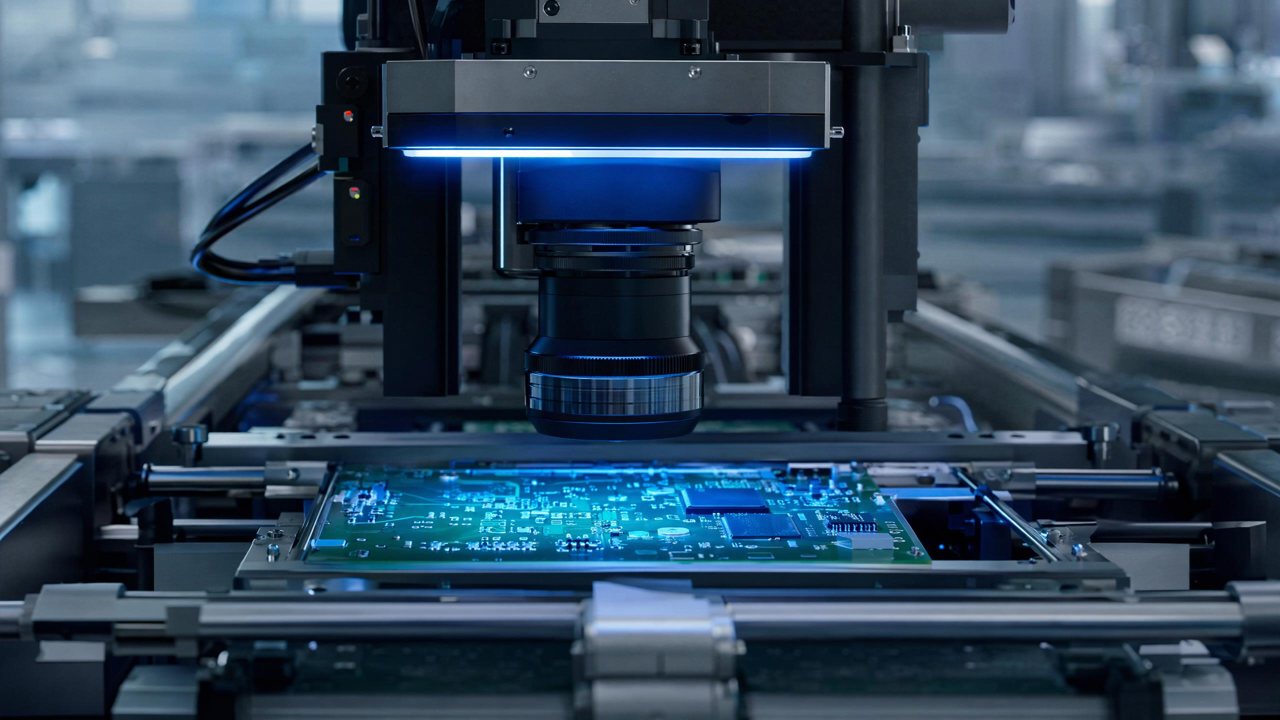
Board - level silk screening and OCR characters are key elements for product information and function recognition, and their quality inspection cannot be ignored in the electronics/PCBA industrial production. WeLinkirt's 2D AI AOI equipment brings new breakthroughs to this field with advanced technology.
In the electronics/PCBA industry, board-level silk screening and OCR characters are key elements for product information transmission and function recognition. They are widely present on various circuit boards, such as PCBs in smartphones, computers, and smart home appliances. In the PCBA production line of a leading electronics manufacturing company, after the board-level silk-screening process, the silk-screening content and OCR characters on the products must be strictly inspected. The inspection objects cover various marks, texts, and numbers on the circuit boards. These information not only affects the normal use of the products but also impacts the brand image and market competitiveness of the products.
Pain Points: Why Is It Difficult?
Traditional detection methods face many difficulties in the general trend of combining industrial vision quality inspection with intelligent manufacturing. Firstly, in terms of efficiency, manual detection is extremely inefficient. The detection time for each circuit board is as long as several minutes or even longer, resulting in a slow production line rhythm. Taking this leading manufacturer as an example, thousands of circuit boards are produced every day, and manual detection requires a large amount of manpower input, making the labor cost remain high. Secondly, in terms of accuracy, the manual missed-detection rate is as high as 3%, and the false-alarm rate is about 20%. This is because manual detection is easily affected by factors such as the fatigue and inattention of the inspectors, and it is difficult for humans to accurately identify some tiny defects and fuzzy characters. Finally, during the production line change-over, the traditional method faces huge challenges. It takes as long as 30 minutes to readjust the detection standards and processes, during which the production line is in a standstill state, seriously affecting the production efficiency.
The root cause of these pain points is that traditional detection methods lack intelligence and automation. Manual detection relies on human subjective judgment, lacking unified standards and stability. Moreover, manual detection cannot process a large amount of image data quickly, making it difficult to meet the needs of large-scale production. In addition, traditional detection equipment also has deficiencies in imaging accuracy and algorithm processing capabilities, and cannot accurately identify silk-screening and character defects in complex environments.
Technical Principle
WeLinkirt's 2D AI AOI equipment uses high-resolution 2D imaging technology. Its hardware is equipped with high-precision industrial cameras, which have features such as high pixels and high frame rates, and can capture clear images of silk-screening and characters on the circuit boards. During the imaging process, the cameras can automatically adjust according to different lighting conditions and the materials of the circuit boards to ensure the image quality. The deep-learning secondary image-judging algorithm is the core of the equipment. It builds a visual basic model through a large number of positive-sample learning (1-20 good samples). During the detection, it first conducts a preliminary analysis of the image, extracts the feature information of the silk-screening and characters, and then uses the model for secondary image-judging to accurately identify the defects of the silk-screening and characters. The semantic false-alarm filtering function is based on the understanding of the image semantics. It analyzes the meaning and context relationship of the silk-screening and characters in the image, and filters out false alarms caused by factors such as the environment and lighting.
Compared with traditional methods, the effective combination of this algorithm and imaging principle has significant advantages. The deep-learning algorithm can continuously learn and optimize to adapt to different silk-screening and character features, while high-resolution imaging provides accurate data for the algorithm. Traditional methods often can only detect based on fixed rules and cannot accurately identify some complex defects and changing silk-screening features. The 2D AI AOI equipment can achieve high-precision detection in various complex environments through continuous learning and adaptive adjustment.
Typical Application Scenarios
- Missing - printing detection: Missing - printing refers to the situation where part of the silk-screening content is missing. The 2D AI AOI equipment uses high-resolution 2D imaging to obtain clear images, and then analyzes the integrity of the silk-screening in the image through the deep-learning secondary image-judging algorithm. The difficulty lies in that some tiny missing-printing may be easily ignored, and the equipment needs to have high-sensitivity detection ability.
- Incorrect - printing detection: Incorrect - printing includes character errors, mark errors, etc. The equipment extracts the features of the silk-screening and characters in the image and compares them with the model to judge whether there is incorrect-printing. The difficulty lies in the distinction between some similar characters and marks, and the algorithm needs to have high-precision recognition ability.
- Blurry - printing detection: Blurry silk-screening and characters will affect the reading of information. The equipment analyzes the clarity and contrast of the image to identify blurry areas. The difficulty lies in how to accurately judge the degree of blurriness and avoid excessive false judgments.
- Inconsistent - character-size detection: Different silk-screening characters may have inconsistent sizes. The equipment measures the size and proportion of the characters to judge whether they meet the standards. The difficulty lies in that the position and angle of the characters may affect the accuracy of the measurement, and precise image correction is required.
Implementation Case
A large-scale electronics manufacturing enterprise has multiple PCBA production lines and produces a large number of circuit boards every day. Before introducing WeLinkirt's 2D AI AOI equipment, the enterprise used the traditional manual detection method and faced problems such as low efficiency, high missed-detection rate, and high false-alarm rate. During the implementation process, WeLinkirt's technical team first conducted a detailed investigation and analysis of the enterprise's production line to determine the detection requirements and standards. Then, they used the DaoAI AI AOI software system for programming, and completed the 0-code automatic programming in 5 minutes with only one good sample. With the APDT positive-sample/few-sample learning function, the model training was completed using 1-20 good samples. After the implementation, the enterprise's detection effect was significantly improved.
WeLinkirt's 2D AI AOI equipment makes electronic manufacturing detection more efficient and accurate.
WeLinkirt's Solution and Product
The solution centered on the 2D AI AOI equipment provides an efficient quality control means for board-level silk-screening/OCR character detection. The equipment has the ability of high-speed online full-inspection and can detect defects such as missing-printing, incorrect-printing, and blurry-printing of silk-screening and characters with micron-level accuracy. In the implementation process, using the DaoAI AI AOI software system for programming, only 5 minutes are needed to complete the 0-code automatic programming for one good sample, greatly shortening the programming time. At the same time, with the APDT positive-sample/few-sample learning function, only 1-20 good samples are needed to complete the model training and quickly adapt to different product change-overs.
Quantitative results: After using the 2D AI AOI equipment, the detection rate is increased to 99.2%, the missed-detection rate is reduced to <0.8%, effectively ensuring the product quality. The false-alarm rate is reduced by -75%, reducing unnecessary re-inspection work. The production line change-over time is shortened from 30 minutes to 5 minutes, greatly improving the production efficiency.
FAQ
What types of board-level silk-screening/OCR character defects can the 2D AI AOI equipment detect?
The equipment can detect various types of board-level silk-screening/OCR character defects, such as missing-printing, incorrect-printing, and blurry-printing. It uses high-resolution 2D imaging technology to obtain clear images and then analyzes the image features through the deep-learning secondary image-judging algorithm to achieve high-precision detection and effectively identify various common defects.
Is it convenient and fast to change the production line after using the 2D AI AOI equipment?
It is very convenient and fast. With the DaoAI AI AOI software system, 0-code automatic programming can be completed in 5 minutes for one good sample. Using the APDT positive-sample/few-sample learning function, the model training can be completed with 1-20 good samples, and the change-over only takes 5 minutes, greatly improving the production efficiency.
How does the 2D AI AOI equipment reduce the false-alarm rate?
The equipment uses the semantic false-alarm filtering function, which is based on the understanding of the image semantics. It analyzes the meaning and context relationship of the silk-screening and characters. It can effectively filter out false alarms caused by factors such as the environment and lighting, reducing the false-alarm rate by -75% and reducing unnecessary re-inspection work.
This article was generated by AI. Customer cases are simulated scenarios based on real product capabilities and figures are illustrative; see product pages for official benchmarks.