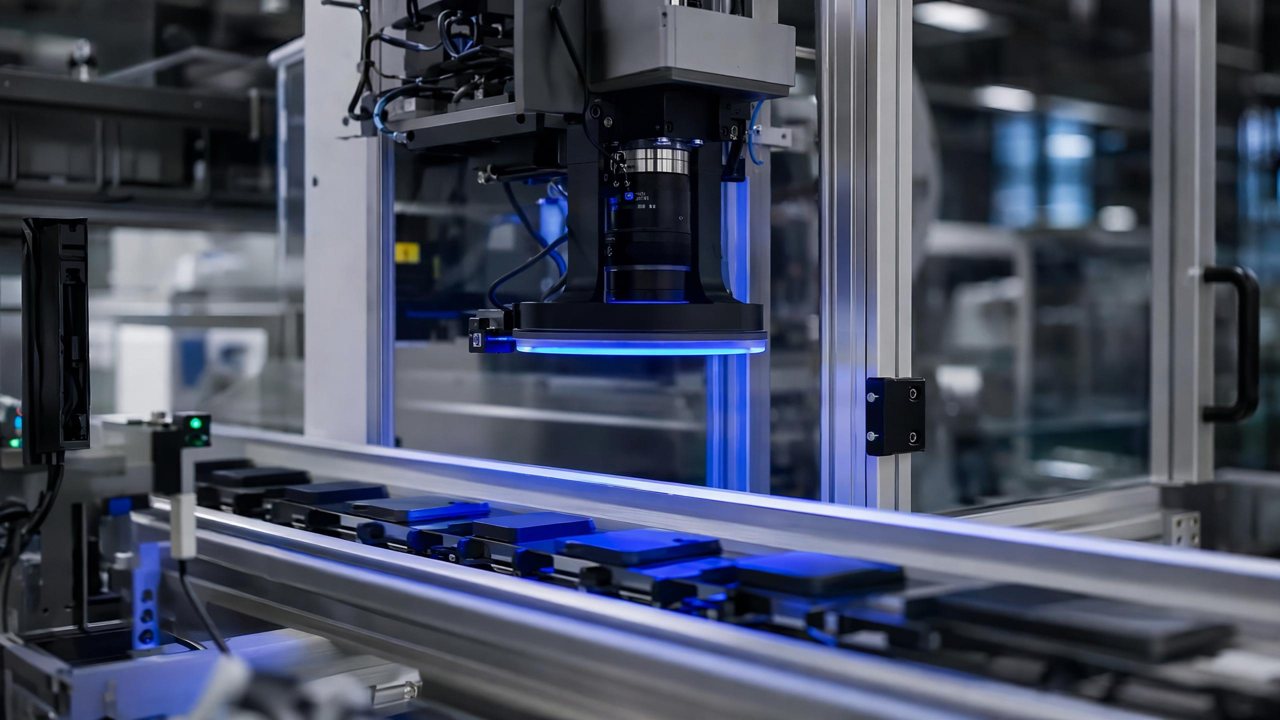
As machine tools enter the 'computational era', the application of industrial AI in the field of industrial visual quality inspection is becoming increasingly important. WeLinkirt's 2D AI AOI equipment has brought new breakthroughs to the inspection of body logos and silk-screen printing in the consumer goods industry with its advanced technology.
In today's rapidly developing manufacturing industry, machine tools are entering the 'computational era', which is continuously improving the level of industrial automation and intelligence. In the consumer goods industry, the appearance quality of products is one of the important factors to attract consumers, especially the printing quality of body logos and silk-screen printing. On the production line of a leading consumer goods manufacturer, after the body logo/silk-screen printing process, a comprehensive quality inspection of the product logo and silk-screen printing is required. The manufacturer's product range is rich, covering various consumer electronic products, daily necessities, etc. The inspection objects are mainly planar elements such as logo patterns and text silk-screen printing on the product surface. The quality of these elements directly affects the overall image and brand reputation of the product.
Pain Points: Why Is It Difficult?
Traditional inspection methods are facing numerous difficulties in the 'computational era' of machine tools. In terms of efficiency, manual inspection is extremely inefficient, with only about 200 products being inspected per hour. This is because manual inspection requires inspectors to concentrate on observing the subtle details of products for a long time, which is prone to visual fatigue and slows down the inspection speed. Moreover, manual inspection is limited by human physiological and psychological factors and cannot maintain a high-efficiency working state continuously.
In terms of the missed-detection rate, the missed-detection rate of traditional inspection methods is as high as 3%. This is because it is difficult for manual inspection to accurately identify small defects. For some extremely small scratches, incomplete characters and other defects, inspectors may miss the judgment due to visual errors or negligence. At the same time, when the number of products is large and the inspection task is heavy, the inspectors' attention will be distracted, further increasing the possibility of missed detections.
The false-alarm rate is also a major pain point of traditional inspection methods, reaching 15%. This is mainly due to the influence of environmental factors such as image noise and uneven illumination, which makes it difficult for inspectors to accurately judge whether the pattern is normal. Once a false alarm occurs, a large number of products need to be re-inspected, which not only increases labor costs but also prolongs the inspection time and seriously affects production efficiency. In addition, when changing the product model, traditional inspection equipment needs to be re-adjusted, and the adjustment time is as long as 30 minutes. This is because the inspection parameters and standards of traditional equipment are fixed, and manual adjustment is required for different products. The process is cumbersome and error-prone, seriously affecting the production rhythm.
Technical Principle
WeLinkirt's 2D AI AOI equipment adopts the advanced high-resolution 2D imaging technology. Its hardware is equipped with high-precision industrial cameras, which have extremely high resolution and can achieve micron-level image acquisition. Through this high-precision image acquisition, the equipment can clearly capture the subtle features of logos and silk-screen printing, ensuring that small defects are clearly visible. Compared with traditional imaging technology, high-resolution 2D imaging technology is not affected by image noise and uneven illumination and can provide clearer and more accurate image information.
In terms of algorithms, the equipment uses the deep-learning secondary image-judging technology. Through learning from a large number of positive samples, the system can build an accurate defect-recognition model. The deep-learning algorithm has strong feature-extraction and classification capabilities. It can automatically extract key features from images and accurately distinguish normal patterns from defective patterns. This is different from traditional rule-based detection algorithms. Traditional algorithms require manual setting of complex rules and are difficult to adapt to diverse defect types and complex image environments. The deep-learning algorithm can automatically learn and adapt to different situations, effectively avoiding misjudgments caused by factors such as image noise and uneven illumination.
In addition, the equipment also has a semantic false-alarm filtering function. Based on the understanding of defect semantics, this function analyzes the defect features and context information in the image and eliminates false-alarm information that does not conform to the actual defect features. For example, some false signals generated due to accidental factors in the image-acquisition process will be identified and excluded by the semantic false-alarm filtering function, further improving the accuracy of detection.
Typical Application Scenarios
- Surface scratch detection: During the printing process of logos and silk-screen printing, scratches may appear on the product surface. The 2D AI AOI equipment uses high-resolution 2D imaging technology to clearly capture the surface image and analyzes the line features in the image through the deep-learning algorithm to determine whether there are scratches. The difficulty lies in that some small scratches may be similar to normal pattern lines, which is prone to misjudgment. However, the semantic false-alarm filtering function can effectively reduce this misjudgment rate.
- Ink unevenness detection: Uneven ink will cause the color of logos and silk-screen printing to vary in depth. The equipment collects images through high-precision industrial cameras and analyzes the color distribution in the images. The deep-learning algorithm can learn the normal color-distribution pattern and determine the areas that do not conform to this pattern as ink unevenness. The difficulty lies in how to distinguish normal color gradients from ink unevenness, which requires a large number of sample learnings and precise algorithm adjustments.
- Incomplete character detection: For text silk-screen printing, there may be incomplete characters. The equipment uses deep-learning secondary image-judging technology to analyze the shape and structure of characters. By comparing with the normal character model, incomplete characters are identified. The difficulty lies in that some slight incompleteness may be difficult to distinguish from normal font deformation, and the algorithm needs to have high sensitivity and accuracy.
- Pattern offset detection: Pattern offset will affect the overall aesthetics of logos and silk-screen printing. The equipment uses high-resolution 2D imaging technology to obtain the position information of the pattern and uses the algorithm to calculate the deviation between the actual position of the pattern and the standard position. When the deviation exceeds a certain threshold, it is determined as a pattern offset. The difficulty lies in accurately determining the standard position of the pattern and identifying small offset amounts.
Implementation Case
A large-scale consumer goods manufacturing enterprise, whose products cover a variety of consumer electronic products and daily necessities, has a large production scale and needs to inspect a large number of products every day. Before introducing WeLinkirt's 2D AI AOI equipment, the enterprise used the traditional manual inspection method and faced problems such as low inspection efficiency, high missed-detection rate, high false-alarm rate and long model-changing time. During the implementation process, WeLinkirt's technical team first conducted a detailed investigation and analysis of the enterprise's production line to determine the installation position and parameter settings of the equipment. Then, using the APDT positive-sample/few-sample learning function of the DaoAI AI AOI software system, the model training was completed with only 1-20 good products. After a period of debugging and optimization, the equipment was officially put into use.
After the introduction of WeLinkirt's 2D AI AOI equipment, the enterprise's inspection efficiency and quality have been significantly improved.
WeLinkirt's Solution and Products
WeLinkirt takes the 2D AI AOI equipment as the core to provide a comprehensive solution for the inspection of consumer goods logos and silk-screen printing. The equipment has the ability of high-speed online full inspection and can complete the inspection when products pass through the production line quickly without affecting the production rhythm. Its micron-level inspection accuracy can detect small defects in logos and silk-screen printing, ensuring product quality. Combined with the DaoAI AI AOI software system, automatic programming without code can be realized for a good product in 5 minutes, greatly improving the programming efficiency. The APDT positive-sample/few-sample learning function can complete model training with only 1-20 good products, effectively shortening the model-changing time. On the production line, the 2D AI AOI equipment is installed after the logo/silk-screen printing process. When products pass through the equipment on the conveyor belt, the equipment automatically collects images and conducts inspections, and the inspection results are fed back in real-time, facilitating the enterprise to process defective products in time.
Quantitative Results
After the introduction of the 2D AI AOI equipment, the enterprise's inspection results are remarkable. The inspection efficiency has been greatly improved, with about 800 products being inspected per hour, which is 4 times that of traditional manual inspection. The detection rate reaches 99.2%, and the missed-detection rate is reduced to <0.8%, effectively preventing defective products from entering the market and improving the overall product quality. At the same time, the false-alarm rate has been reduced by -65%, greatly reducing the re-inspection workload and lowering labor costs and time costs. The model-changing time has been shortened from 30 minutes to 5 minutes, improving the production flexibility and efficiency and enabling the enterprise to respond to market demands more quickly.
FAQ
What types of logo/silk-screen printing defects can the 2D AI AOI equipment detect?
The equipment can detect planar defects such as surface scratches, uneven ink, incomplete characters, and pattern offsets. Using high-resolution 2D imaging technology, high-precision industrial cameras collect micron-level images to ensure that small defects are clearly visible. Combined with deep-learning algorithms, various types of defects are accurately identified. The semantic false-alarm filtering function can also improve the detection accuracy.
How long does it take to change the equipment model?
Combined with the DaoAI AI AOI software system, automatic programming without code can be completed in 5 minutes. The APDT positive-sample/few-sample learning function is powerful. Only 1-20 good products are needed to complete model training, making the model-changing more efficient and not affecting the production rhythm.
To what extent can the false-alarm rate of the equipment be reduced?
Through the semantic false-alarm filtering function, the false-alarm rate of the equipment can be reduced by -65%. This function is based on the understanding of defect semantics and eliminates false-alarm information, effectively reducing the re-inspection workload and greatly improving the detection efficiency.
This article was generated by AI. Customer cases are simulated scenarios based on real product capabilities and figures are illustrative; see product pages for official benchmarks.