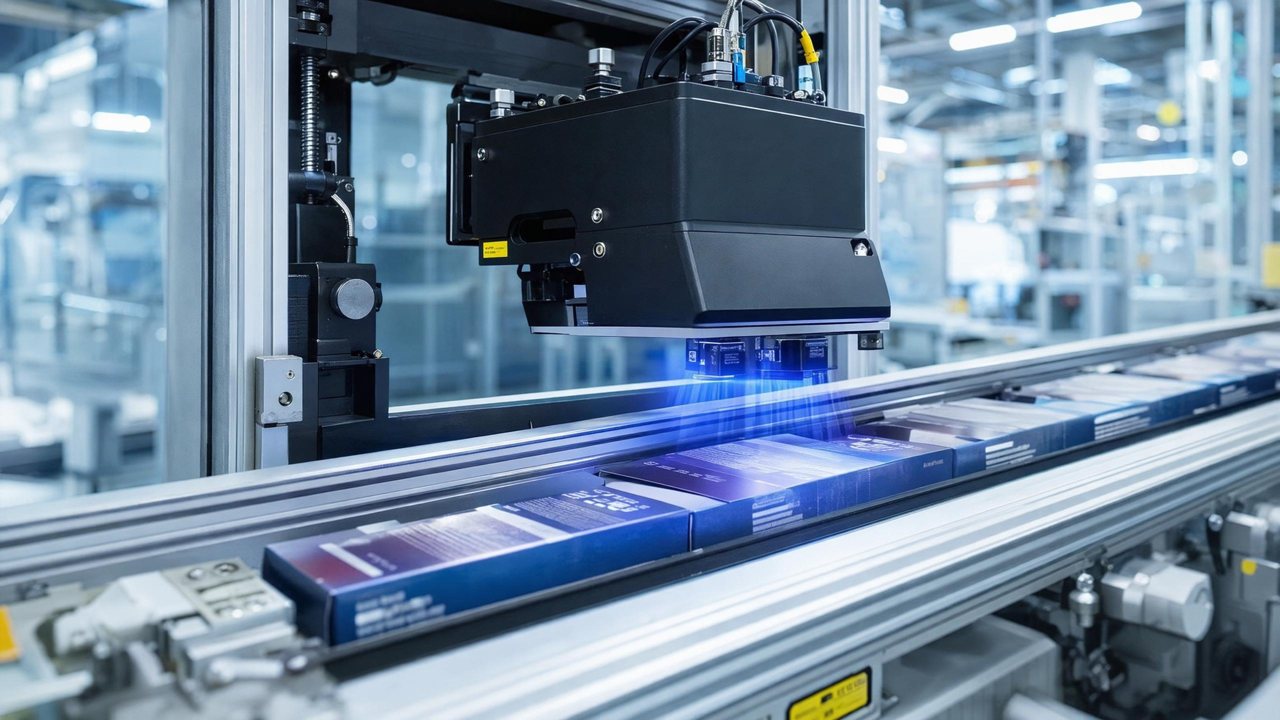
Industrial vision quality inspection is迎来 a new opportunity in the packaging box printing process. WeLinkirt's 2D AI AOI equipment effectively solves the problem of printing defect detection with its advanced technological advantages.
In the consumer goods industry, packaging boxes are not only containers for products but also important display windows for brand images. Exquisite packaging box printing can attract consumers' attention and enhance the market competitiveness of products. A leading consumer goods manufacturer's packaging box printing production line is mainly responsible for producing various types of exquisite packaging boxes. The printing on these packaging boxes contains rich information such as brand logos, patterns, and texts. However, during the printing process, various defects are prone to occur on the surface of the packaging boxes, such as blurred printing, missing characters, and pattern offsets. These defects not only affect the appearance of the products but also may have a negative impact on the brand image. Therefore, it is crucial to accurately and efficiently detect the printing content of the packaging boxes.
Pain Points: Why Is It Difficult?
Traditional packaging box printing detection methods have many quantitative dilemmas. In terms of the missed detection rate, it is about 3%, which means that a considerable number of defective products may flow into the market. Once these defective products are discovered by consumers, it will seriously affect the brand reputation, leading to a decline in consumers' trust in the brand and thus affecting product sales. For example, if the brand logo on the packaging box is printed blurred, consumers may question the quality of the product and thus give up buying it.
In terms of the false alarm rate, the traditional detection method reaches 20%. This causes a large number of qualified products to be misjudged as defective, greatly increasing the re-inspection workload and labor costs. In the production line, workers need to re-detect these misjudged products, which not only wastes time and energy but also reduces production efficiency. Moreover, frequent false alarms will also make workers feel fatigued and annoyed, affecting work quality.
Traditional detection methods rely on manual labor, which has high labor costs and low efficiency. Manual detection requires workers to concentrate for a long time, which is prone to visual fatigue, resulting in an increase in missed and false detections. In addition, the speed of manual detection is relatively slow, which cannot meet the needs of large-scale production. With the frequent product model changes, the disadvantages of traditional detection methods are more prominent. The long model change time, about 30 minutes, seriously affects the production rhythm and reduces the flexibility and efficiency of production. In the new scientific and intelligent system, traditional algorithms are difficult to meet the requirements of efficient detection of complex printing defects because they lack the ability to deeply learn and understand image features and cannot accurately distinguish real defects from normal image interference.
Technical Principle
WeLinkirt's 2D AI AOI equipment uses high-resolution 2D imaging technology and deep-learning secondary image-judging algorithm. The high-resolution 2D imaging technology can clearly capture the tiny details of the packaging box printing surface. Its micron-level accuracy can detect subtle defects such as blurred printing and missing characters. Compared with traditional imaging technology, high-resolution 2D imaging technology has higher resolution and clearer image quality, providing a more accurate basis for subsequent analysis.
The deep-learning secondary image-judging algorithm uses a large number of printing defect samples for training, allowing the model to learn the characteristics of different types of defects. When detecting, the device first conducts a preliminary analysis of the image and then uses the deep-learning model for secondary image-judging to further confirm the authenticity of the defect. This algorithm combines the global and local details of the image and can accurately distinguish real defects from normal image interference. Compared with traditional algorithms, the deep-learning secondary image-judging algorithm has stronger feature recognition ability and adaptability, and can better handle complex printing defect detection tasks. In addition, the device also has a semantic false-alarm filtering function, which can filter out some false-alarm situations according to the semantic information of the defect, further improving the detection accuracy.
Typical Application Scenarios
- Blurred printing detection: When the text or pattern on the packaging box appears blurred, the high-resolution 2D imaging technology can clearly capture the characteristics of the blurred area. Through the deep-learning secondary image-judging algorithm, the characteristics of the blurred area are compared with those of normal printing to accurately determine whether there is a blurred printing defect. The difficulty lies in that the degree of blurred printing may vary, and the model needs to have strong adaptability.
- Missing character detection: For the characters on the packaging box, the high-resolution 2D imaging technology can accurately identify the shape and position of each character. The deep-learning secondary image-judging algorithm analyzes the integrity of the characters. If a character is found to be missing, an alarm will be issued in time. The difficulty lies in that the size, font, and color of the characters may be different, and the model needs to be able to accurately identify various characters.
- Pattern offset detection: When the pattern on the packaging box is offset, the high-resolution 2D imaging technology records the actual position of the pattern. The deep-learning secondary image-judging algorithm compares the actual position with the standard position to determine whether the pattern is offset. The difficulty lies in that the shape and complexity of the pattern may be different, and the model needs to be able to accurately calculate the offset of the pattern.
- Assembly missing detection: If there is an assembly missing in the packaging box, the high-resolution 2D imaging technology can clearly show all parts of the packaging box. The deep-learning secondary image-judging algorithm checks the assembly situation to determine whether there is a missing. The difficulty lies in that the assembled parts may be small, and the model needs to have high precision.
Implementation Case
A leading consumer goods manufacturer has a large-scale packaging box printing production line and needs to produce a large number of packaging boxes every day. Before introducing WeLinkirt's 2D AI AOI equipment, the manufacturer used the traditional manual detection method and faced problems such as high missed detection rate, high false alarm rate, and long model change time. During the implementation process, the WeLinkirt team installed and debugged the equipment and trained the staff. After a period of operation, the equipment gradually became stable. Before the implementation, the missed detection rate was about 3%, the false alarm rate reached 20%, and the model change time was about 30 minutes. After the implementation, the detection rate increased to 99%, the missed detection rate decreased to <1%, the false alarm rate decreased by -75%, and the model change time was shortened to 5 minutes.
WeLinkirt's 2D AI AOI equipment brings an efficient and accurate solution to the detection of packaging box printing defects, significantly improving production efficiency and product quality.
WeLinkirt's Solution and Product
Centered around the 2D AI AOI equipment, it has the ability of high-speed online full inspection and can comprehensively detect the packaging boxes without affecting the production rhythm. Its micron-level detection accuracy can meet the requirements of detecting packaging box printing defects. During the implementation process, combined with the DaoAI AI AOI software system, using the feature recognition ability of its visual basic model, only 1/10 of good samples are needed, and 0-code automatic programming can be completed within 5 minutes. At the same time, the semantic false-alarm filtering function further reduces the false alarm rate. In addition, the DaoAI World model, as a unified base, provides capabilities such as semantic understanding and cross-scenario generalization, and supports local private deployment without data leaving the factory, ensuring the security and privacy of data.
Quantitative results: After using WeLinkirt's 2D AI AOI equipment, the detection rate increased to 99%, the missed detection rate decreased to <1%, greatly reducing the risk of defective products flowing into the market. The false alarm rate decreased by -75%, effectively reducing the re-inspection workload and labor costs. The model change time was shortened to 5 minutes, improving the flexibility and efficiency of production.
FAQ
What kinds of packaging box printing defects can the 2D AI AOI equipment detect?
The equipment can detect planar defects such as surface, printing, character OCR, and assembly missing, like blurred printing, missing characters, and pattern offsets. Its micron-level accuracy can capture subtle flaws. Through high-resolution 2D imaging and deep-learning secondary image-judging algorithm, it can accurately identify various defects.
Why can the model change time be significantly shortened after using this equipment?
Combined with the DaoAI AI AOI software system, using the feature recognition of the visual basic model, only a small number of good samples are needed, and 0-code automatic programming can be completed within 5 minutes. There is no need for complex manual settings, thus achieving rapid model change and improving production flexibility.
How does the equipment reduce the false alarm rate?
It uses the deep-learning secondary image-judging and semantic false-alarm filtering functions, combining the global and local features of the image to accurately distinguish defects from interference. The deep-learning model is trained with a large number of samples and can accurately identify defect features. The semantic filtering can eliminate false-alarm situations.
This article was generated by AI. Customer cases are simulated scenarios based on real product capabilities and figures are illustrative; see product pages for official benchmarks.