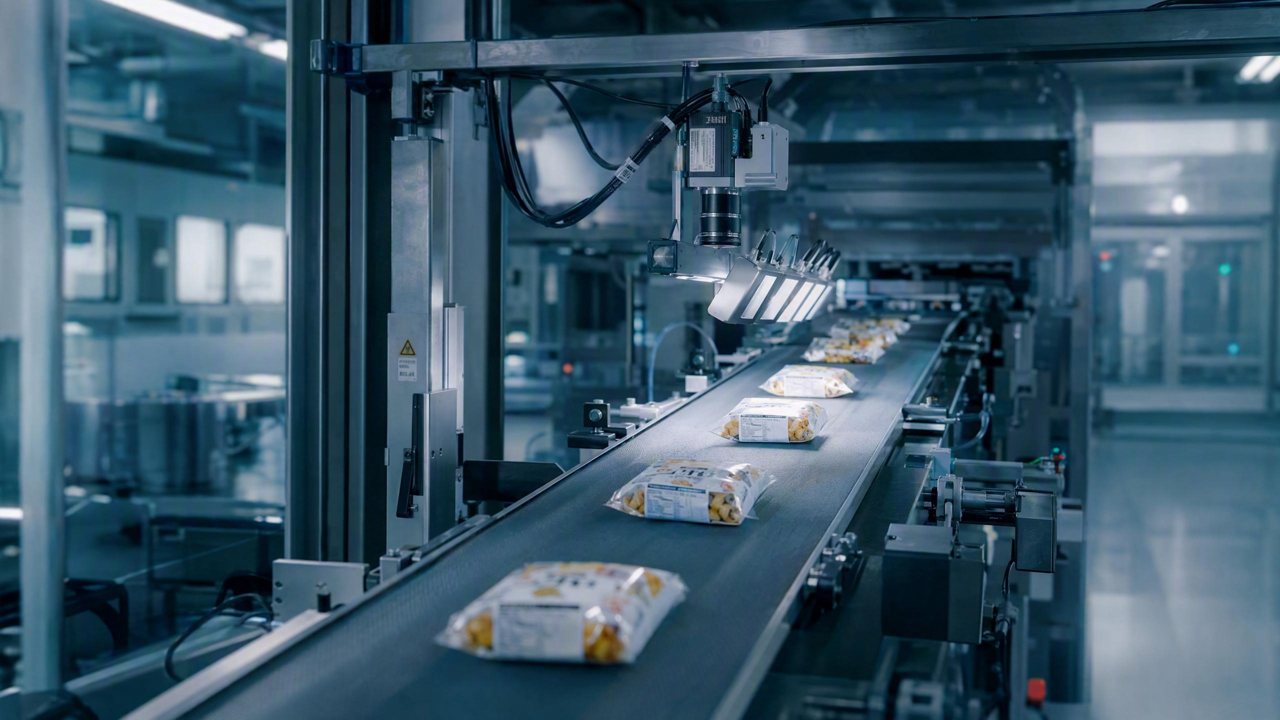
DaoAI 2D AI AOI equipment (high-resolution 2D imaging + deep learning secondary judgment, addressing surface/print/OCR/assembly defects, high-speed online full inspection, micron-level, semantic false positive filtering) significantly enhances flexibility and efficiency in multi-variety, small-batch food production by offering 'zero-code rapid changeover' capability, reducing production line downtime due to product changeovers from an average of 60 minutes to less than 5 minutes.
In the increasingly competitive food and agriculture market, growing consumer demand for product diversity is driving a rapid shift in production models from large-scale single products to multi-variety, small-batch manufacturing. This shift places extremely high demands on production line flexibility, especially in critical stages such as packaging sealing, label application, and inkjet coding. Traditional quality inspection solutions, whether manual visual inspection or rule-based machine vision systems, struggle to adapt to these frequent changeover requirements. Each adjustment in product variety or packaging specification entails complex parameter reconfiguration, model retraining, or even hardware calibration, leading to prolonged production line downtime and inefficient operations, severely limiting enterprises' market response speed. DaoAI 2D AI AOI equipment is specifically designed to address this core pain point, utilizing advanced visual foundation models and few-shot learning capabilities to achieve rapid deployment and switching of inspection models, ensuring food packaging quality while significantly enhancing production line operational efficiency.
Pain Points: Why This Hurdle Is Difficult to Overcome
The “multi-variety, small-batch” production model in the food packaging industry faces multiple pain points in packaging sealing, labeling, and inkjet coding inspection: Firstly, **long changeover downtime**. Traditional rule-based vision systems typically require 60–90 minutes for parameter adjustment during each changeover, leading to a significant −15% to −20% drop in Overall Equipment Effectiveness (OEE). Secondly, **coexistence of high false positive and false negative rates**. Due to variations in glossiness and texture across different batches and packaging materials, as well as subtle changes in inkjet ink, traditional vision solutions lack robustness in identifying subtle defects. False positive rates often reach 8–12%, while false negative rates for more concealed defects like incomplete seals or incorrect codes remain at 0.8–1.5%. Thirdly, **heavy manual re-inspection burden**. High false positive rates directly result in a large number of good products being misidentified, requiring additional human resources for re-inspection, which increases operational costs by 20–30%. The root cause of these difficulties lies in the diversity and complexity of food packaging. For example, transparent film seals can cause unstable imaging due to reflections, printing deviations on different colored labels are hard to standardize, and high-speed inkjet codes show varying adhesion effects on different materials. These factors make traditional inspection methods based on fixed thresholds and features difficult to generalize, requiring frequent and time-consuming manual intervention, severely hindering production line efficiency and contradicting the adaptive capabilities sought by current embodied intelligent robots transitioning from simulated to real-world environments, highlighting the adaptive challenges of existing automation solutions in complex and variable industrial scenarios.
Technical Principles
The core advantage of DaoAI 2D AI AOI equipment lies in its combination of high-resolution 2D imaging and advanced deep learning secondary judgment technology. At the imaging level, we utilize industrial-grade high-resolution cameras paired with customized lighting systems to capture micron-level details of packaging seals, label printing, and inkjet characters, effectively overcoming the imaging challenges of traditional vision systems on complex surfaces (e.g., reflections, uneven textures). The key is its embedded DaoAI AI AOI software system, which, based on visual foundation models for feature recognition, possesses powerful cross-scene generalization capabilities. Unlike traditional rule-based machine vision that relies on predefined geometric features and color thresholds, the deep learning model employed by DaoAI 2D AI AOI can learn the intrinsic distribution patterns of 'good products' from a small number of positive samples and identify anomalies that deviate from these patterns. For instance, for wrinkles or incomplete seals on packaging, the model can accurately identify even subtle, irregular abnormal deformations by learning the texture features of numerous normal seals. This defect recognition capability, based on semantic understanding, enables DaoAI 2D AI AOI to achieve a defect detection rate of over 99.5% in complex and varied food packaging scenarios, while reducing the false positive rate by more than −85%, far surpassing traditional methods.
Compared to traditional machine vision systems, the advantages of DaoAI 2D AI AOI are: firstly, **stronger adaptability**. Traditional methods require manually writing complex rule codes for each product and defect type, which is time-consuming and difficult to maintain; whereas DaoAI's deep learning model can quickly establish detection models through APDT positive/few-shot learning (requiring only 1–20 good samples), without manual rule intervention. Secondly, **higher robustness**. Traditional rules are sensitive to environmental factors such as lighting changes, product placement angles, and material color differences, easily leading to false positives or missed detections; DaoAI 2D AI AOI's deep learning model possesses powerful feature extraction and generalization capabilities, effectively filtering out these interference factors to achieve more stable detection. Thirdly, **semantic false positive filtering**. The DaoAI system can understand contextual information in images, distinguishing true defects from harmless background noise, thereby significantly reducing the burden of manual re-inspection, lowering re-inspection volume by more than −70%, and greatly improving production efficiency and quality control.
Typical Application Scenarios
- **Packaging Seal Integrity Inspection:** Detects defects such as incomplete seals, unsealed areas, wrinkles, or foreign matter trapped in food packaging bags and boxes. The challenge lies in the significant optical property differences of various packaging materials (e.g., transparent film, aluminum foil, composite film) and the potentially subtle and irregular nature of seal defects. DaoAI 2D AI AOI, through high-resolution imaging and deep learning models, learns the texture and edge characteristics of normal seals to precisely identify various seal anomalies, ensuring product integrity.
- **Label Position and Print Quality Inspection:** Checks for misaligned, warped, damaged, blurry, color-shifted, missing, or unreadable barcodes/QR codes on food labels. The difficulty is the high precision required for label positioning on high-speed production lines and subtle fluctuations in print quality across different batches. The DaoAI system uses OCR and image comparison techniques to real-time calibrate label positions and perform high-quality recognition and defect judgment on printed characters and patterns.
- **Inkjet Code Integrity and Accuracy Inspection:** Used to detect missing, blurry, double-imaged, misaligned, or incorrect characters in inkjet codes (e.g., production dates, batch numbers, expiration dates) on food packaging. Challenges include small character sizes, varying ink adhesion on different materials, and potential jitter from high-speed inkjetting. DaoAI 2D AI AOI's high-resolution imaging combined with deep learning character recognition models accurately identifies various inkjet defects, ensuring product information accuracy and compliance.
- **Missing Contents or Foreign Object Detection (Visibly Flat):** For transparent or translucent packaging, detects missing products, insufficient quantities, or visible foreign objects within the package. Difficulties arise from complex backgrounds and uneven light transmission. The DaoAI system, through optimized lighting and image enhancement techniques, combined with deep learning object recognition, achieves accurate judgment of internal content status.
Case Study
A leading food manufacturer, with multiple production lines and dozens of SKUs covering snacks, seasonings, and more, faced frequent packaging changeovers due to rapid market demand shifts. Previously, this manufacturer relied on traditional rule-based machine vision systems for packaging seal, label, and inkjet code inspection. Each changeover required at least 60 minutes of downtime for engineers to manually adjust light sources, camera parameters, and write detection rules. As product lines expanded and flexible production demands increased, changeover downtime became a critical bottleneck limiting production capacity and market response speed, resulting in millions of lost product units annually. To address this pain point, the manufacturer introduced DaoAI 2D AI AOI equipment. During the implementation, the DaoAI technical team completed equipment deployment and integration in less than one day. For model training, engineers only needed to upload 5–10 good product images via the DaoAI AI AOI software system, and the system automatically completed model training and deployment within 5 minutes, achieving 'zero-code rapid changeover'.
DaoAI 2D AI AOI's 'zero-code rapid changeover' capability reduced downtime on multi-variety food packaging lines from 60 minutes to less than 5 minutes, significantly boosting flexible production efficiency and lowering the false negative rate to <0.4%.
After implementation, the manufacturer's production line efficiency significantly improved. Under the traditional solution, changeovers took 60 minutes, while the DaoAI 2D AI AOI system reduced this to less than 5 minutes, **decreasing changeover downtime by over −90%**. Concurrently, due to the robustness of the deep learning model, the accuracy of detecting complex packaging defects greatly increased, with the false negative rate dropping from 1.2% to <0.4%, and the false positive rate also decreasing by −80% from 9% to approximately 1.8%, significantly reducing the workload of manual re-inspection. This successful implementation not only helped the client overcome current production bottlenecks but also laid a solid foundation for their future expansion into more diversified product lines.
DaoAI Solutions and Products
DaoAI 2D AI AOI equipment addresses the pain points of packaging seal, label, and inkjet code inspection in the food/agriculture industry, providing an efficient, flexible, and easy-to-deploy solution. Its core is the DaoAI AI AOI software system, which features a built-in visual foundation model for 'zero-code automatic programming'. Users do not need specialized programming knowledge; they simply upload good product samples through an intuitive graphical interface, and the system automatically builds the inspection model within 5 minutes. This feature greatly simplifies the introduction process for new products or defect types, enabling production line engineers to independently perform model switching and optimization, eliminating reliance on external technical support. For data modeling, DaoAI employs APDT positive/few-shot learning technology, requiring only 1–20 good product images for efficient training, significantly shortening the model development cycle and reducing the need for large quantities of defect samples. Furthermore, the system includes semantic false positive filtering, effectively distinguishing true defects from background noise, reducing unnecessary downtime and manual re-inspection. For deployment, DaoAI offers various integration methods such as SDK/API/Docker, supporting 100% local private deployment to ensure customer data security remains on-site, meeting the stringent data compliance requirements of the food industry. By integrating with the unified DaoAI World model foundation, DaoAI 2D AI AOI can also achieve cross-scene generalization and continuous learning from production line feedback, constantly optimizing inspection performance.
The implementation of DaoAI 2D AI AOI equipment has brought significant quantitative results and business value to customers. Through 'zero-code rapid changeover' and few-shot learning, changeover downtime was reduced to less than 5 minutes, **increasing Overall Equipment Effectiveness (OEE) by at least 10%**. High-resolution 2D imaging combined with deep learning secondary judgment ensures precise detection of micron-level defects, driving the false negative rate down to <0.4%, significantly enhancing product quality compliance. Concurrently, the semantic false positive filtering mechanism reduced the false positive rate by −80%, **cutting manual re-inspection workload by 70%**, greatly lowering operational costs. These improvements not only ensure food safety and brand reputation but also help customers maintain strong market competitiveness in multi-variety, small-batch production, achieving a dual uplift in production efficiency and quality control.
FAQ
How does DaoAI 2D AI AOI's 'zero-code rapid changeover' specifically work?
DaoAI 2D AI AOI's 'zero-code rapid changeover' is primarily enabled by the DaoAI AI AOI software system. This system features a built-in visual foundation model. Users simply upload 1–20 good product images via a graphical interface, and the system automatically trains and deploys a new inspection model within 5 minutes, without any coding required. This significantly simplifies the changeover process for multi-variety production lines, enhancing line flexibility.
Compared to traditional machine vision, what are the advantages of DaoAI 2D AI AOI in detection accuracy and false positive rates?
DaoAI 2D AI AOI combines high-resolution 2D imaging with deep learning secondary judgment to achieve micron-level defect detection, with a detection rate exceeding 99.5%. Compared to traditional rule-based machine vision, its deep learning model possesses powerful feature extraction and semantic understanding capabilities, effectively filtering background noise, reducing false positive rates by over −80%, and significantly decreasing the burden of manual re-inspection.
What is the budget required to deploy DaoAI 2D AI AOI equipment, and what is the typical payback period?
The deployment budget for DaoAI 2D AI AOI varies based on the specific production line scale, inspection requirements, and integration complexity. Factors include camera configuration, lighting choices, software functional modules, and whether custom development is needed. Typically, due to its significant improvements in production efficiency, reduced false negatives/positives, and decreased labor costs, many clients achieve ROI within 6–18 months. We recommend contacting our technical experts for a detailed quote and payback analysis tailored to your specific scenario.
This article was generated by AI. Customer cases are simulated scenarios based on real product capabilities and figures are illustrative; see product pages for official benchmarks.