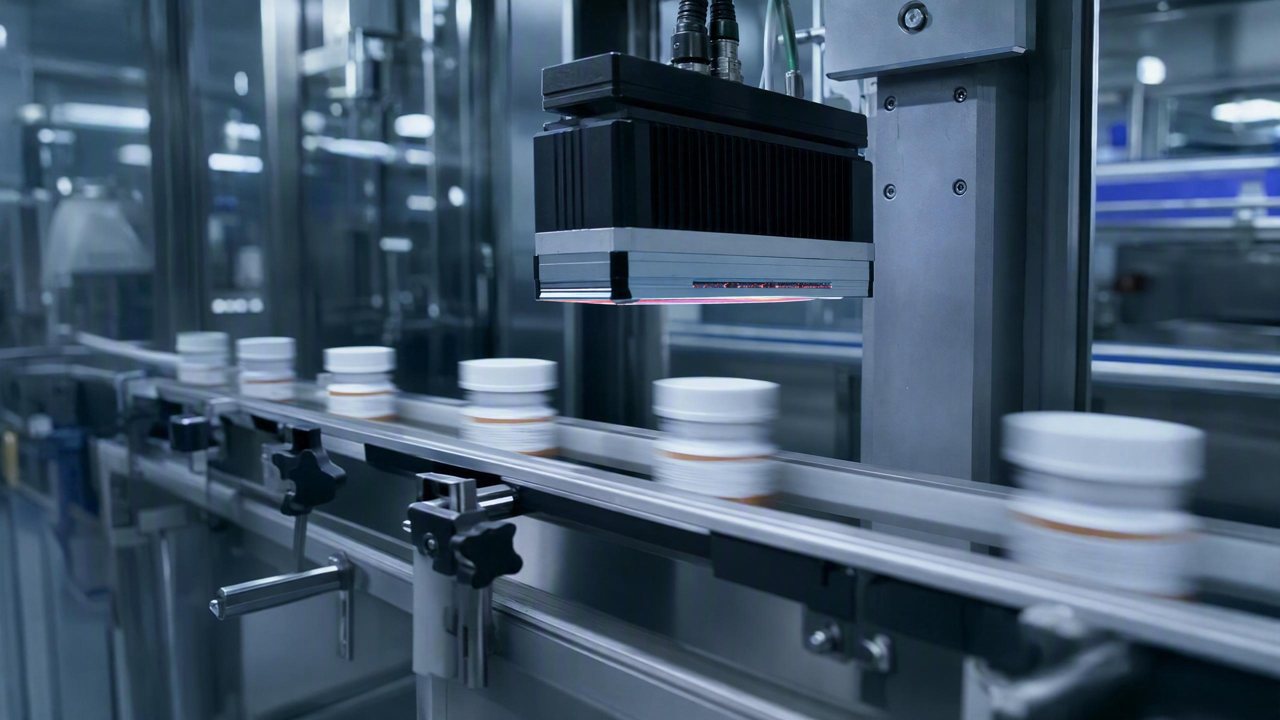
The pharmaceutical industry demands extremely high standards for data security and compliance, especially concerning label OCR and serial code inspection during production. DaoAI 2D AI AOI equipment (high-resolution 2D imaging + deep learning re-inspection, targeting surface/print/character OCR/assembly defects, high-speed online full inspection, micron-level, semantic false positive filtering) addresses pharmaceutical companies' deep concerns regarding critical production data security while pursuing accelerated production cycles and compliant traceability. This capability reduces project delays due to data security concerns by over −90%.
In the online label OCR/serial code inspection for pharmaceutical manufacturing, DaoAI 2D AI AOI equipment (high-resolution 2D imaging + deep learning re-inspection, targeting surface/print/character OCR/assembly defects, high-speed online full inspection, micron-level, semantic false positive filtering) addresses pharmaceutical companies' deep concerns regarding critical production data security while pursuing accelerated production cycles and compliant traceability, by offering 100% on-premise private deployment capabilities. This reduces project delays due to data security concerns by over −90%. The pharmaceutical industry is one of the most strictly regulated sectors globally, with every step of its production process required to comply with stringent GMP standards. Especially crucial are the label details on drug packaging, including drug name, batch number, expiry date, and serial codes, which not only identify the product but are also key to achieving full lifecycle traceability and ensuring patient medication safety. As global drug traceability regulations become increasingly strict (e.g., China NMPA's traceability system requirements, US DSCSA Act), pharmaceutical companies face immense compliance pressure. Online label OCR/serial code full inspection on the production line has become a core component for ensuring information accuracy, improving production efficiency, and meeting compliance requirements. However, traditional inspection methods struggle to cope with high-speed production lines, complex print quality, and the growing demand for data security.
Pain Points: Why This Hurdle Is Difficult to Overcome
Online OCR/serial code inspection of pharmaceutical labels faces multiple challenges that traditional methods struggle to overcome. First is [Data Security and Sovereignty]. Many advanced AI vision solutions rely on cloud computing power or data transmission, which is an unacceptable compliance red line for pharmaceutical companies that view data as their lifeline. Any production data, especially sensitive information related to drug batches, production processes, and serial codes, if it leaves the local environment, can lead to significant data leakage risks and regulatory penalties. Second is [Detection Accuracy and False Positive Rate]. On high-speed production lines (e.g., hundreds of bottles per minute), label printing may have tiny ink spots, scratches, blurriness, character deformation, or background interference. These subtle defects can easily lead to high false positives in traditional rule-based AOI systems, resulting in a large number of good products being rejected, increasing manual re-inspection costs up to ¥694/min, and severely slowing down the production pace. Third is [Compliance and Traceability Challenges]. The uniqueness and correctness of serial codes are central to drug traceability. Any misread or missed serial code can render an entire batch untraceable, risking recalls. Traditional OCR algorithms struggle to achieve over 99.9% recognition rates required by the industry when dealing with complex fonts, reflective materials, or slightly damaged labels, leading to high rates of missed defects.
The root cause of these pain points lies in the unique nature of the pharmaceutical production environment. High-speed, continuous production cycles demand that inspection systems make high-precision judgments in extremely short periods; the diversity of pharmaceutical packaging materials (glass bottles, plastic bottles, ampoules, aluminum-plastic blister packs, etc.) and surface characteristics (reflective, curved, transparent) pose severe challenges to imaging systems; and most critically, the pharmaceutical industry's 'zero tolerance' attitude towards data security and compliance means that any solution relying on external networks or cloud-based data processing is difficult to adopt.
Technical Principles
DaoAI 2D AI AOI equipment addresses the challenges of online OCR/serial code inspection for pharmaceutical labels by employing a core technical combination of 'high-resolution 2D imaging + deep learning re-inspection + on-premise private deployment.' First, its integrated high-resolution 2D imaging system captures micron-level label details, ensuring clear, high-contrast image data even with poor print quality or blurred character edges. For reflective or curved bottles, DaoAI effectively suppresses optical interference through multi-angle light source control and image enhancement algorithms, ensuring stable image quality. Second, after image acquisition, data is directly fed into the locally deployed DaoAI AI AOI software system. This system incorporates DaoAI's self-developed deep learning models, particularly its APDT positive/few-shot learning capability, which requires only 1–20 good sample images to quickly train high-precision inspection models, drastically reducing changeover time to under 5min. The model uses Convolutional Neural Networks (CNNs) for character feature extraction and recognition, offering robustness far superior to traditional rule-based OCR algorithms. It effectively handles complex situations like font deformation, background interference, and partial occlusion, boosting character recognition accuracy to over 99.9%. Most crucially, DaoAI 2D AI AOI equipment supports 100% on-premise private deployment; all data acquisition, model training, and inference are conducted within the customer's internal network environment, ensuring data never leaves the factory, thereby fundamentally eliminating data security risks. The deep learning model possesses powerful semantic false positive filtering capabilities, distinguishing true defects from non-critical visual noise (e.g., label textures, minor dust), significantly reducing false positive rates and preventing good products from being rejected, thus reducing manual re-inspection volume by over −85%.
Compared to traditional rule-based AOI, the greatest advantage of DaoAI 2D AI AOI equipment lies in its deep learning-based adaptability and anti-interference capabilities. Traditional rule-based AOI requires engineers to manually write numerous rules for character recognition, which is time-consuming and labor-intensive when facing print variations or new defect types, leading to frequent rule base updates and high false positive rates. In contrast, DaoAI's deep learning models autonomously learn character features and defect patterns from extensive data, offering stronger generalization capabilities. Compared to cloud-dependent AI solutions, DaoAI 2D AI AOI's on-premise deployment thoroughly resolves the data security and compliance issues most critical to the pharmaceutical industry, ensuring enterprises maintain absolute control over their core production data.
Typical Application Scenarios
- **Pharmaceutical Bottle Label OCR Recognition and Content Verification:** Real-time OCR recognition of critical characters such as batch number, expiry date, production date, and drug name on bottles after high-speed filling lines. DaoAI 2D AI AOI equipment, through high-resolution imaging and deep learning models, accurately recognizes characters across various fonts, colors, and backgrounds, and verifies them against a database to ensure information accuracy, preventing mislabeling, missing labels, or incorrect information.
- **Serial Code/Traceability Code Full Inspection and Uniqueness Verification:** High-speed full inspection of serial codes, QR codes, and barcodes printed on pharmaceutical packaging boxes or bottles. DaoAI 2D AI AOI equipment precisely reads micron-level serial codes and performs uniqueness and integrity verification, preventing duplicate, missing, or damaged codes from entering the market, thereby meeting global drug traceability regulations.
- **Label Print Quality Defect Detection:** In addition to character recognition, DaoAI 2D AI AOI equipment simultaneously detects printing defects on labels, such as ink spots, scratches, smudges, color unevenness, misregistration, label damage, or wrinkles. With its micron-level detection precision and semantic false positive filtering, it effectively distinguishes printing flaws from normal textures, reducing misjudgments.
- **Anti-counterfeiting Mark and Special Symbol Recognition:** Recognition and verification of anti-counterfeiting marks, special symbols, and Braille on drug packaging. DaoAI 2D AI AOI's deep learning models can learn the features of these complex patterns, ensuring the correctness and integrity of anti-counterfeiting information, enhancing product security.
- **Packaging Box Print Character and Pattern Consistency Detection:** Before folding and sealing pharmaceutical packaging boxes, all printed content (text, logos, patterns) on the box is inspected for consistency, ensuring a perfect match with standard samples to prevent batch mixing or printing errors.
Case Study
A leading domestic pharmaceutical manufacturer faced severe label OCR recognition challenges on its high-speed oral liquid filling line. Their existing rule-based AOI system, when dealing with variations in label print quality across different batches and slight vibrations at high production speeds, generated false positive rates exceeding 15%. This necessitated an additional 3–4 quality inspectors for manual re-inspection daily, severely slowing down the production line and incurring significant labor costs. More critically, the company had an almost obsessive requirement for data security, making any cloud-based AI solution unable to pass internal compliance reviews. Upon introducing DaoAI 2D AI AOI equipment, we provided a 100% on-premise private deployment solution. During the initial rollout, the DaoAI engineering team utilized the APDT few-shot learning function, training OCR models for various bottle labels in just 30 minutes using only 15 good sample images. In actual operation, DaoAI 2D AI AOI equipment, with its high-resolution imaging and deep learning re-inspection capabilities, stably improved label OCR detection rates to over 99.8% while reducing false positive rates to below 0.5%, resulting in a −95% reduction in manual re-inspection volume. The production line's takt time increased from 280 bottles/minute to 320 bottles/minute, an overall efficiency improvement of over 14%. Most satisfying to the client was that all production data, image data, and model inference were completed on internal enterprise servers, fully complying with their stringent data security and compliance requirements, completely alleviating their concerns.
DaoAI 2D AI AOI equipment, built on the foundation of on-premise private deployment, establishes an impenetrable data security fortress for pharmaceutical production, while empowering production line efficiency and compliance traceability with exceptional inspection performance.
DaoAI Solutions and Products
DaoAI's core solution revolves around its 2D AI AOI equipment. This equipment integrates high-resolution industrial cameras, customized lighting systems, and high-performance edge computing units, running the DaoAI AI AOI software system. For deployment, DaoAI consistently adheres to the principle of 'data sovereignty,' offering 100% on-premise private deployment options. All AI model training and inference run on the customer's local servers or edge devices, ensuring that core assets such as production data, defect images, and model parameters never leave the factory. Addressing the multi-variety, small-batch production characteristics of the pharmaceutical industry, the DaoAI AI AOI software system supports APDT positive/few-shot learning. Users only need to provide 1–20 good sample images to complete model changeovers for new products or batches within 5 minutes, without requiring specialized programming knowledge, significantly lowering operational barriers and downtime. Its built-in semantic false positive filtering function accurately distinguishes minor print imperfections from true defects, effectively reducing false positive rates and alleviating the burden of manual re-inspection. Furthermore, the DaoAI World Model serves as a unified foundation, ensuring the generalizability and continuous learning capabilities of AI vision models across different production lines and products, continuously optimizing model performance through production line feedback. DaoAI also offers flexible integration methods, including SDK/API/Docker, facilitating seamless integration of its 2D AI AOI equipment into existing MES/SCADA systems for data interoperability and intelligent production management.
Through DaoAI 2D AI AOI equipment's on-premise private deployment solution, pharmaceutical companies can achieve high-speed, high-precision full inspection of drug labels OCR/serial codes, ensuring product compliance and traceability. More importantly, it completely eliminates data security risks. This not only improves production line efficiency and reduces operational costs but also strengthens the enterprise's data sovereignty in digital transformation, laying a solid foundation for future intelligent manufacturing. DaoAI is committed to providing secure, efficient, and intelligent inspection solutions for the pharmaceutical industry through leading AI vision technology.
FAQ
How does DaoAI 2D AI AOI equipment ensure data security in the pharmaceutical industry?
DaoAI 2D AI AOI equipment supports 100% on-premise private deployment. This means all core processes, including image data acquisition, AI model training, and inference, are completed within the customer's internal network environment. Data is never uploaded to the cloud or external servers, fundamentally eliminating data leakage risks and fully complying with the pharmaceutical industry's strict requirements for data sovereignty and compliance.
What are the advantages of DaoAI 2D AI AOI for pharmaceutical label OCR compared to traditional rule-based AOI?
DaoAI 2D AI AOI utilizes deep learning technology to autonomously learn complex character features and defect patterns. It effectively handles challenging scenarios like font deformation, background interference, and reflective materials, which are difficult for traditional rule-based AOI. This boosts OCR recognition accuracy to over 99.9% while significantly reducing false positive rates through semantic false positive filtering, minimizing manual re-inspection, and improving overall efficiency.
What is the approximate budget for deploying DaoAI 2D AI AOI equipment?
The budget for DaoAI 2D AI AOI equipment is influenced by various factors, including production line speed, required inspection precision, integration complexity, and custom functionalities. We offer flexible configuration options to meet the needs of clients of different scales. We recommend contacting our sales and technical team directly. We will provide a detailed solution design and accurate quotation based on your specific production line conditions and inspection requirements.
This article was generated by AI. Customer cases are simulated scenarios based on real product capabilities and figures are illustrative; see product pages for official benchmarks.