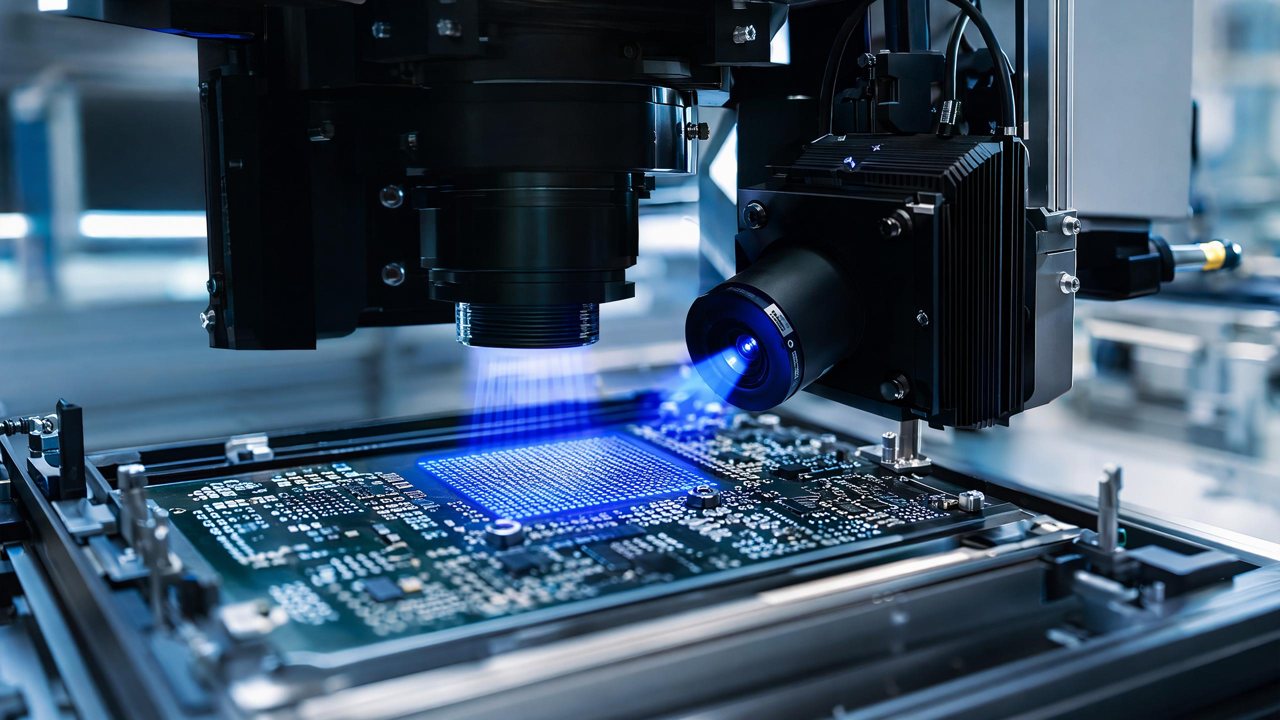
With the continuous development of the electronics industry, the requirements for product quality are getting higher and higher. As important connecting components in electronic devices, the coplanarity of pins/connectors directly affects the performance and stability of electronic products. WeLinkirt's 3D AI AOI equipment provides an efficient and accurate solution for the coplanarity detection of pins/connectors in the electronics/PCBA industry with its advanced technology and excellent performance.
Industry background and user scenario: In the electronics/PCBA industry, pins/connectors are indispensable key components widely used in various electronic products. Their coplanarity detection is particularly important because it directly affects the normal and stable operation of electronic products. Take a leading electronics manufacturer as an example. After the assembly process of pins/connectors on its PCBA production line, it is necessary to strictly detect the coplanarity of pins/connectors. Once there is a problem with the coplanarity of pins/connectors, it may cause faults such as unstable signal transmission and poor contact in electronic products, seriously affecting the product quality and market competitiveness.
Pain points: Why is it difficult?
Traditional detection methods have many problems that are difficult to solve. First of all, the false-negative rate is relatively high, about 3%. This is because traditional methods often rely on 2D image detection and lack the capture of the height information of objects. It is difficult to accurately identify some defects such as hidden solder joints and small coplanarity deviations, resulting in some defective products flowing into subsequent processes. These defective products may cause more problems in subsequent processes, increasing the product rework cost and after-sales cost. According to statistics, the product rework cost caused by false-negatives accounts for 5% -8% of the total cost.
Secondly, the false-positive rate is also quite high, about 15%. The algorithms of traditional detection methods are not intelligent enough. Some normal product features may be misjudged as defects, so a large number of qualified products are misjudged and need to be re-examined. This not only wastes a lot of manpower and time but also reduces the production efficiency of the production line. In some large-scale production lines, the number of products that need to be re-examined due to misjudgment can reach thousands every day, consuming a large amount of human and material resources.
Finally, the long model-changing time is another serious problem. Every time the product model is changed, traditional detection equipment needs about 30 minutes to adjust parameters and reprogram. This is because the programming of traditional equipment is complex and requires professional technicians to operate. Moreover, the detection parameters of different product models vary greatly, and the adjustment process is cumbersome. The long model-changing time seriously affects the production efficiency of the production line, making it unable to quickly respond to market demand changes.
Technical principle
WeLinkirt's 3D AI AOI equipment uses a self-developed 3D camera for image acquisition, and its principle is based on structured light projection and triangulation. The equipment projects a specific structured light pattern onto the object to be measured, captures the light pattern reflected from the object surface through the camera, and calculates the three-dimensional coordinates of each point on the object surface using the triangulation principle, thereby realizing three-dimensional topography reconstruction and generating point cloud data. This method can accurately obtain the three-dimensional topography information of pins/connectors. Compared with the traditional 2D detection method, 3D data contains the height information of the object, which can more comprehensively reflect the real shape of the object and avoid the false-negative problem caused by the lack of height information in 2D detection.
At the same time, the equipment adopts 2D-3D fusion technology, which combines the texture information of 2D images and the depth information of 3D point clouds. By extracting and matching features from 2D images and 3D point clouds, it can better identify various defects, and can use machine learning algorithms to classify and discriminate different types of defects. This fusion technology further improves the detection accuracy, enabling the equipment to detect defects in 2D optical blind areas such as hidden solder joints, coplanarity, micron-scale topography, and air holes.
Typical application scenarios
- Pin coplanarity detection: The coplanarity of pins has a great impact on the performance of electronic products. The equipment obtains the three-dimensional topography information of pins through 3D imaging, accurately measures the height difference of each pin of the pins, and judges whether it meets the coplanarity requirements. The difficulty lies in the fact that the pin pins are small and the height difference is tiny, requiring high-precision measurement and analysis.
- Hidden solder joint detection: Hidden solder joints are easily missed in 2D detection. The 3D AI AOI equipment uses structured light projection and 3D imaging technology to clearly detect the position and status of hidden solder joints and judge whether there are defects such as false solder and missed solder. The difficulty lies in the fact that the position of hidden solder joints is hidden, and the equipment needs to have strong penetration and resolution.
- Micron - scale topography detection: For some electronic products with extremely high precision requirements, micron-scale topography defects will also affect their performance. The equipment can detect micron-scale surface unevenness, scratches and other defects through a high-precision 3D camera and advanced algorithms. The difficulty lies in the need for high-precision imaging equipment and accurate algorithms to identify tiny topography changes.
- Air hole detection: Air holes will affect the quality and reliability of solder joints. The 3D AI AOI equipment can detect the size, position and quantity of air holes by analyzing 3D point cloud data. The difficulty lies in the different shapes and sizes of air holes, and the equipment needs to have strong feature recognition ability.
Implementation case
A leading electronics manufacturer has a large-scale PCBA production line and can produce tens of thousands of electronic products every day. Before introducing WeLinkirt's 3D AI AOI equipment, the manufacturer had been using traditional detection methods and faced problems such as high false-negative rate, high false-positive rate and long model-changing time. During the implementation process, WeLinkirt's technical team conducted a comprehensive survey and analysis of the manufacturer's production line, customized the equipment according to the manufacturer's actual needs, and provided systematic training to the manufacturer's operators. After a period of debugging and optimization, the equipment was officially put into use.
After using WeLinkirt's 3D AI AOI equipment, the coplanarity detection of pins/connectors of the manufacturer has been significantly improved.
WeLinkirt's solution and products
WeLinkirt takes the 3D AI AOI equipment as the core and provides a complete detection solution for the manufacturer. The equipment has high-precision 3D imaging ability and advanced 2D-3D fusion detection technology, which can quickly and accurately detect the coplanarity of pins/connectors and other potential defects. The 3D camera of the equipment can quickly obtain the three-dimensional point cloud data of pins/connectors, and convert the point cloud data into an intuitive three-dimensional model through the three-dimensional topography reconstruction algorithm, which is convenient for the detection personnel to observe and analyze. The supporting DaoAI AI AOI software system adopts the feature recognition technology of the visual basic model. Only 1-20 good samples are needed, and 0-code automatic programming can be realized within 5 minutes, greatly shortening the programming time and difficulty. At the same time, the APDT positive sample/few-shot learning and semantic false-positive filtering functions of the software can effectively reduce the false-positive rate and improve the detection efficiency.
Quantitative results: After using WeLinkirt's 3D AI AOI equipment, the detection rate of the coplanarity of pins/connectors of the manufacturer has increased to 99.2%, and the false-negative rate has decreased to < 0.8%, effectively reducing the situation of defective products flowing into subsequent processes. The false-positive rate has decreased by -70%, from the original 15% to 4.5%, greatly reducing the re-examination workload. The model-changing time has been shortened from the original 30 minutes to 5 minutes, improving the production efficiency of the production line. These quantitative results fully prove the excellent performance and value of WeLinkirt's 3D AI AOI equipment.
FAQ
Can the 3D AI AOI equipment detect other types of defects?
Yes. The equipment can not only detect the coplanarity of pins/connectors, but also detect defects in 2D optical blind areas such as hidden solder joints, micron-scale topography, and air holes. It adopts 2D-3D fusion technology, combining the texture information of 2D images and the depth information of 3D point clouds, making the detection more comprehensive and accurate.
Is the programming of the DaoAI AI AOI software system complex?
No. It adopts the feature recognition technology of the visual basic model. Only 1-20 good samples are needed, and 0-code automatic programming can be realized within 5 minutes, greatly shortening the programming time and difficulty. Ordinary operators can also get started quickly.
How much can WeLinkirt's 3D AI AOI equipment improve the production efficiency of the production line?
The improvement is significant. The model-changing time is shortened from the original 30 minutes to 5 minutes, enabling a quick response to product model changes. At the same time, the false-positive rate is reduced by -70%, reducing the re-examination workload and effectively improving the overall production efficiency of the production line.
This article was generated by AI. Customer cases are simulated scenarios based on real product capabilities and figures are illustrative; see product pages for official benchmarks.