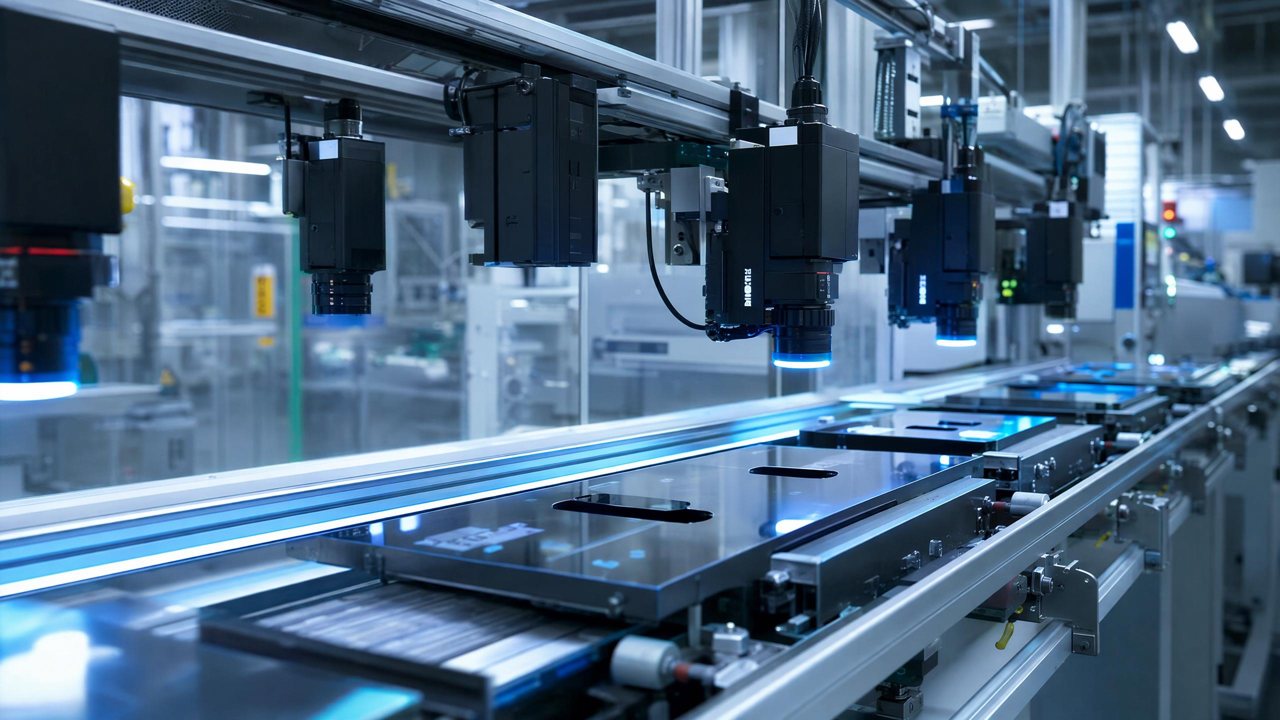
The advanced AI AOI software system of WeLinkirt, with its unique technology and efficient solutions, brings about a revolution in the appearance inspection of home appliance panels and solves the problems of traditional inspection methods.
In the consumer goods industry, home appliances play an important role. As an important part of home appliances, the appearance quality of home appliance panels directly affects the overall image of the product and the user experience. A leading home appliance manufacturer mainly produces operation panels for various home appliances on its home appliance panel production line. These panels are widely used in common home appliances such as refrigerators, washing machines, and air conditioners. The inspection object is the appearance of home appliance panels, including surface scratches, stains, printing defects and other defects. With the continuous improvement of consumers' requirements for the appearance quality of home appliances, higher requirements are also put forward for the accuracy and efficiency of home appliance panel appearance inspection.
Pain Points: Why Is It Difficult?
Under the traditional inspection method, the manufacturer faces many difficulties. In terms of quantitative indicators, the missed detection rate is relatively high, about 3%, which means that some defective products will flow into the market. Taking the annual production of 1 million home appliance panels as an example, 30,000 defective products will enter the market, which will undoubtedly affect the brand reputation. The false alarm rate also reaches 20%. A large number of qualified products need to be re-inspected, which increases the labor and time costs. Assuming that each production line inspects 1,000 panels per day, 200 qualified panels need to be re-inspected, which will consume a lot of human and time resources. At the same time, when changing the production of different models of home appliance panels, it takes a lot of time to reprogram and debug, and the change-over time is as long as 30 minutes. If the change-over is carried out 5 times a day, 150 minutes of production time will be wasted.
The root cause of these problems lies in the limitations of traditional inspection methods. Traditional inspection mainly relies on manual visual recognition. Human vision is prone to fatigue, and it is difficult to accurately identify small defects. At the same time, the standards of manual inspection are difficult to unify, and the judgment results of different inspectors may vary. In addition, the traditional programming and debugging methods are complex and require professional technicians to operate, which not only increases the labor cost but also leads to a long change-over time and low production efficiency.
Technical Principle
The AI AOI software system of WeLinkirt uses an advanced visual basic model for feature recognition. The model is trained with a large amount of image data and can accurately identify various features of the appearance of home appliance panels. During the inspection process, the system uses the APDT positive-sample/few-sample learning algorithm. Only 1-20 good samples are needed to quickly learn the features of normal panels. This is because the algorithm can extract key feature information from a small number of samples and use it as a benchmark for inspection. Compared with traditional methods, traditional methods require a large number of samples for training, and may not be able to identify new defect types in time. The APDT positive-sample/few-sample learning algorithm reduces the dependence on a large number of samples and improves the adaptability and flexibility of the system.
At the same time, the semantic false-alarm filtering technology can effectively filter false alarms according to the semantic information of defects, such as the length and width of scratches, and improve the accuracy of inspection. The visual basic model can conduct in - depth analysis of complex appearance features, and even small defects can be accurately identified. Traditional methods often can only identify obvious defects and are prone to miss small defects. The AI AOI software system of WeLinkirt can more accurately detect various defects through the semantic false-alarm filtering technology and the visual basic model, and avoid false alarms caused by environmental factors or small interferences.
Typical Application Scenarios
- Surface scratch detection: When detecting surface scratches, the system uses the visual basic model to scan the panel surface and identify the features of scratches. The difficulty lies in the identification of small scratches. Traditional methods are difficult to detect scratches at the micron level, while the AI AOI software system of WeLinkirt can accurately identify small scratches through advanced algorithms and models.
- Stain detection: For stain detection, the system analyzes the color and texture features of the image to determine whether there are stains. The difficulty lies in the fact that the colors and shapes of stains may be diverse, and some stains may be similar to the color of the panel itself, which is prone to misjudgment. The AI AOI software system of WeLinkirt can effectively filter false alarms caused by factors such as similar colors through the semantic false-alarm filtering technology.
- Printing defect detection: When detecting printing defects, the system compares the printing pattern of the normal panel with that of the panel to be inspected to identify whether there are problems such as pattern missing or blurring. The difficulty lies in the fact that there are many details in the printing pattern, and traditional methods are difficult to accurately identify small printing defects. The AI AOI software system of WeLinkirt can accurately identify various printing defects through in - depth analysis of the printing pattern by the visual basic model.
- Corner defect detection: When detecting corner defects, the system focuses on scanning the corners of the panel to identify whether there are problems such as breakage or deformation. The difficulty lies in the fact that the shape and structure of the corners are relatively complex, and traditional methods are prone to miss detection. The AI AOI software system of WeLinkirt can more accurately detect corner defects through advanced imaging technology and algorithms.
Implementation Case
A large-scale home appliance manufacturer has multiple home appliance panel production lines and produces a large number of home appliance panels every day. Before introducing the AI AOI software system of WeLinkirt, the manufacturer faced problems such as high missed detection rate, high false alarm rate, and long change-over time. During the implementation process, the technical team of WeLinkirt conducted a detailed investigation and analysis of the manufacturer's production line and carried out customized deployment of the system according to the actual situation of the production line. After a period of debugging and optimization, the system was officially put into operation.
The AI AOI software system of WeLinkirt has brought significant improvements to the appearance inspection of home appliance panels, improving the inspection efficiency and accuracy and reducing the production cost.
WeLinkirt's Solutions and Products
Centered on the AI AOI software system, WeLinkirt provides a complete set of solutions. The software system has the ability of zero-code automatic programming. Only one good sample is needed, and the programming can be completed within 5 minutes, greatly shortening the change-over time. At the same time, the system supports SDK/API/Docker deployment and can achieve 100% local privatization to ensure that enterprise data does not leave the factory and meet the data security requirements of enterprises. In terms of supporting facilities, it can be combined with DaoAI 2D/3D AI AOI equipment, using its self-developed 3D camera and three-dimensional topography reconstruction technology to detect hidden defects of the panel.
Quantitative results: By using the AI AOI software system of WeLinkirt, the inspection effectiveness of the manufacturer has been significantly improved. The detection rate has increased to 99%, and the missed detection rate has decreased to <1%, effectively avoiding defective products from flowing into the market. The false alarm rate has decreased by -60%, reducing a large amount of re-inspection work and improving the inspection efficiency. The change-over time has been shortened from 30 minutes to 5 minutes, greatly improving the production flexibility and response speed.
FAQ
How many samples does the AI AOI software system need for learning?
The system uses the APDT positive-sample/few-sample learning algorithm. Only 1-20 good samples are needed to quickly learn the features of normal panels, reducing the dependence on a large number of samples. This algorithm can extract key feature information from a small number of samples and use it as a benchmark for inspection, improving the adaptability and flexibility of the system.
How much can the change-over time of the system be shortened?
The system has the ability of zero-code automatic programming. Only one good sample is needed, and the programming can be completed within 5 minutes, greatly shortening the change-over time from the traditional 30 minutes to 5 minutes. This greatly improves the production flexibility and response speed and reduces the time waste in the production process.
How does the system ensure data security?
The system supports SDK/API/Docker deployment and can achieve 100% local privatization to ensure that enterprise data does not leave the factory and meet the data security requirements. Through this deployment method, enterprise data can be processed and stored locally, avoiding the risk of data leakage.
This article was generated by AI. Customer cases are simulated scenarios based on real product capabilities and figures are illustrative; see product pages for official benchmarks.