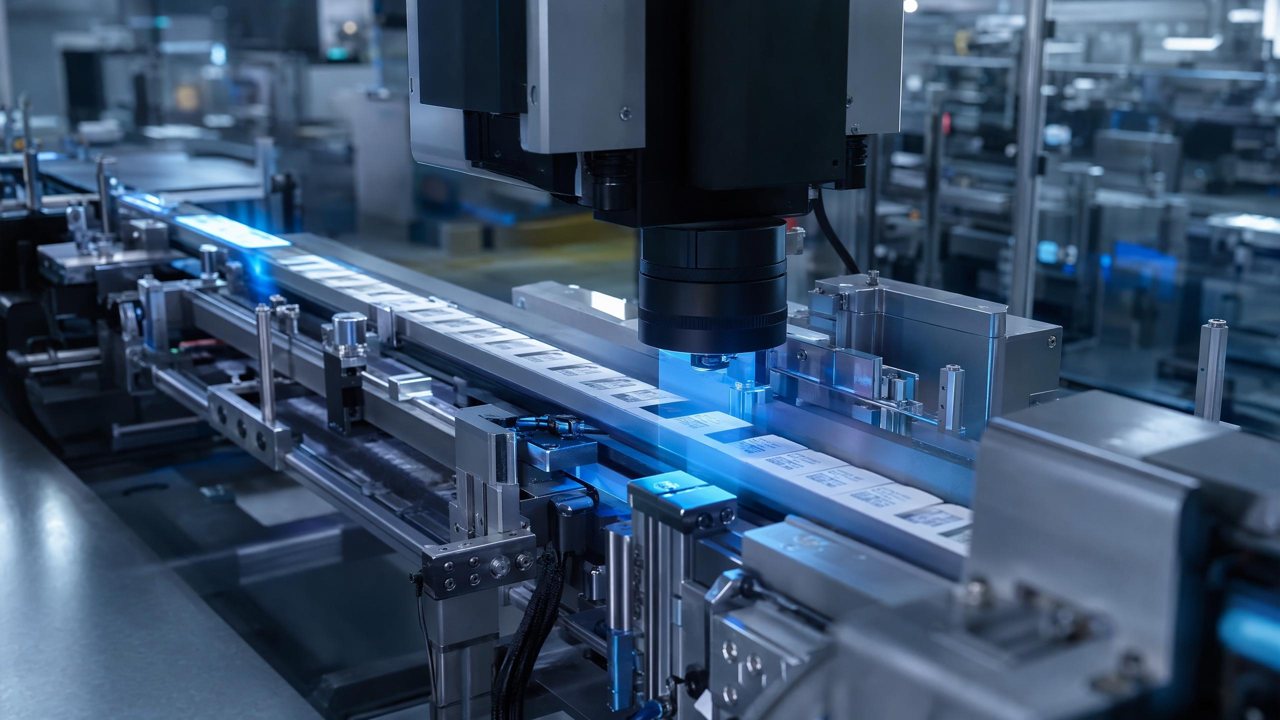
In today's fast-paced consumer goods/general industry, the demand for high - SKU label printing detection is increasing day by day. WeLinkirt's AI AOI software system has emerged as the times require, providing an innovative detection solution for this complex scenario and greatly improving detection efficiency and accuracy.
In the consumer goods/general industry, the product update speed is extremely fast, which makes label printing feature a high number of SKUs. There are significant differences in the specifications, styles, texts, patterns, colors, and barcodes of labels for different products, and the styles change frequently. The label-printing production line of a leading consumer goods manufacturer is responsible for producing a variety of product labels with different specifications and styles. The detection objects of this production line cover various types of information on the labels, including the accuracy of texts, the integrity of patterns, the consistency of colors, and the readability of barcodes. Due to the large number of product SKUs and the continuous change of label styles, high requirements are put forward for the flexibility and accuracy of the detection system.
Pain Points: Why Is It Difficult?
Currently, this production line uses a combination of manual visual inspection and traditional machine vision inspection, but this method has many quantitative difficulties. From the perspective of efficiency, manual visual inspection is extremely inefficient, with an average of only about 500 labels being inspected per hour. This is because manual inspection requires inspectors to highly concentrate their attention. After working for a long time, their eyes are prone to fatigue, resulting in a significant decrease in the inspection speed. Moreover, manual inspection is also easily affected by subjective factors, and the judgment standards of different inspectors may vary, further affecting the inspection efficiency.
From the perspective of accuracy, the missed-detection rate of manual visual inspection is as high as 2%. Long - term repetitive work makes inspectors prone to visual fatigue and negligence, and they are likely to miss some minor defects, such as blurred texts and small flaws in patterns. Although traditional machine vision inspection improves the inspection accuracy to a certain extent, it has poor adaptability to new label styles. When encountering a new label style, professional personnel need to reprogram and debug the system, and the model-changing time is as long as 30 minutes, which seriously affects the production rhythm and leads to low production efficiency.
From the perspective of cost, the existing detection methods are relatively costly. Manual inspection requires a large amount of manpower, which not only increases the labor cost but also requires training and management of inspectors, increasing the management cost. Traditional machine vision inspection requires professional programmers to operate when facing new label styles, which also increases the labor cost and time cost. As the application of AI computing power in the industrial field deepens, the existing detection methods are difficult to meet the enterprise's requirements in terms of efficiency and accuracy and cannot fully leverage the advantages of the integration of AI computing power and industrial visual quality inspection.
Technical Principle
WeLinkirt's AI AOI software system is based on the feature-recognition algorithm of the visual basic model, which is its core technology. Through a large number of sample trainings, this algorithm learns the normal feature patterns of labels and establishes a feature database. During the detection process, the system compares the collected label images with the features in the database to determine whether the labels have defects. Compared with traditional methods, this algorithm has higher accuracy and flexibility. Traditional machine vision inspection usually detects based on fixed rules and templates, and it needs to be reprogrammed and debugged for new label styles. In contrast, the AI AOI system can quickly adapt to new label styles without a complex programming process.
The system also features zero-code automatic programming. Only by providing a good-quality label, the system can complete automatic programming within 5 minutes without professional programmers. This greatly shortens the model-changing time and improves production efficiency. The principle is that the system analyzes and learns the image of the good-quality label, automatically extracts the feature information of the label, and generates the corresponding detection program. In addition, the system uses the APDT positive-sample/few-sample learning method. It only needs 1-20 good-quality labels as positive samples to learn the normal features of the labels, reducing the workload of sample collection. At the same time, the system has a semantic false-alarm filtering function, which can perform semantic analysis on false-alarm information and filter out false alarms caused by environmental factors or image noise, improving the detection accuracy.
Typical Application Scenarios
- Text detection: The system will recognize and compare the texts on the labels character by character. The difficulty lies in that texts of different fonts, sizes, and colors may interfere with the recognition. Through learning a large number of text samples, the system can accurately recognize texts of various fonts and colors and determine whether there are problems such as missing, blurred, or incorrect texts.
- Pattern detection: Detect the integrity and clarity of patterns. Some detailed parts of complex patterns are easily overlooked, and patterns may be deformed or flawed due to printing processes and environmental factors. By analyzing the feature points and edge information of patterns, the system can accurately determine whether there are defects in patterns.
- Color detection: Ensure that the colors on the labels meet the design requirements. Slight color deviations may affect the overall image of the product, but it is difficult for humans to accurately judge color differences. By establishing a color model, the system can accurately measure and compare the differences between the label colors and the standard colors and detect color deviations.
- Barcode detection: Verify the readability and accuracy of barcodes. The printing quality and position of barcodes may affect the scanning effect. By analyzing the coding rules and features of barcodes, the system can detect whether there are problems such as damage, blurring, or coding errors in barcodes.
Implementation Case
A leading-scale consumer goods manufacturer faced the problem of high - SKU label detection in its label-printing production line. Before introducing WeLinkirt's AI AOI software system, the production line used a combination of manual visual inspection and traditional machine vision inspection, with low detection efficiency, high missed-detection rate, and long model-changing time. During the implementation process, WeLinkirt's technical team first conducted a detailed investigation and analysis of the production line, customized the AI AOI software system according to the actual needs of the production line, then installed and debugged the system, and trained the production-line operators to ensure that they could use the system proficiently.
WeLinkirt's AI AOI software system significantly improves the efficiency and accuracy of high - SKU label-printing detection, bringing real benefits to enterprises.
Before implementation, manual visual inspection could only detect about 500 labels per hour on average, the missed-detection rate was as high as 2%, and the model-changing time of traditional machine vision inspection was as long as 30 minutes. After implementation, the label-detection rate increased to 99.2%, the missed-detection rate decreased to <0.8%, the false-alarm rate decreased by -65%, the model-changing time was shortened from 30 minutes to 5 minutes, and the production efficiency was greatly improved.
WeLinkirt's Solution and Products
Centered on the AI AOI software system, WeLinkirt provides the manufacturer with a complete label-printing detection solution. The system supports 100% local private deployment of SDK/API/Docker, and the data does not leave the factory, ensuring the security of enterprise data. In the process of data transmission and storage, the system uses advanced encryption technology to prevent data leakage. At the same time, the system can be used in conjunction with other product lines of WeLinkirt, such as DaoAI 2D/3D AI AOI equipment and SkyVision, to further improve the detection effect. These devices and systems can cooperate with each other to achieve more comprehensive and accurate label detection. During the implementation process, the system can quickly adapt to the label changes of different SKUs and achieve efficient and accurate detection.
Quantitative results: After using WeLinkirt's AI AOI software system, the label-detection rate of the manufacturer increased to 99.2%, and the missed-detection rate decreased to <0.8%. This means that more defects can be detected in time, and the product quality is effectively guaranteed. The false-alarm rate decreased by -65%, reducing a large amount of re-inspection work, improving the detection efficiency, and reducing the labor cost. The model-changing time was shortened from 30 minutes to 5 minutes, improving the production efficiency, meeting the rapid model-changing requirements of high - SKU label printing, and enabling the enterprise to respond to market changes more flexibly.
FAQ
What are the requirements for the number of samples in the AI AOI software system?
The system uses the APDT positive-sample/few-sample learning method. It only needs 1-20 good-quality labels as positive samples to learn the normal features of the labels. This greatly reduces the workload of sample collection. Enterprises do not need to spend a lot of time and energy collecting a large number of samples, and the system can carry out effective detection learning.
Why can the model-changing time of the system be so short?
The system supports zero-code automatic programming within 5 minutes with one good-quality label. It does not require professional programmers. By analyzing and learning the image of the good-quality label, it automatically generates the detection program and can quickly adapt to the label changes of different SKUs. Therefore, the model-changing time can be significantly shortened from 30 minutes to 5 minutes.
How to ensure the security of enterprise data?
The system supports 100% local private deployment of SDK/API/Docker, and the data does not leave the factory. In the process of data transmission and storage, advanced encryption technology is used to prevent data from being stolen or tampered with during transmission, effectively ensuring the security of enterprise data.
This article was generated by AI. Customer cases are simulated scenarios based on real product capabilities and figures are illustrative; see product pages for official benchmarks.