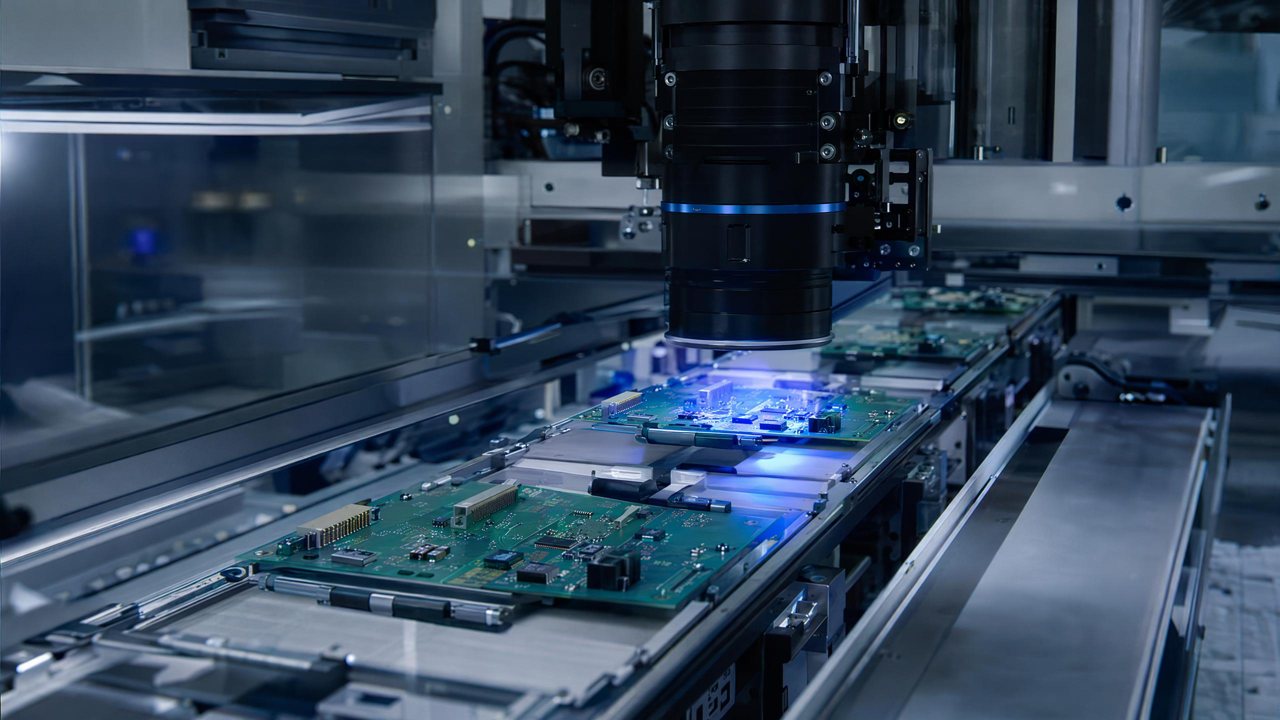
In industrial production, the problems of missing parts and misassembly in product assembly have always been key factors affecting product quality and production efficiency. With the development of AI technology, WeLinkirt's AI AOI software system provides an effective way to solve this problem.
Industry background and user scenario: At present, the application scope of AI technology is constantly expanding. After achieving remarkable results in the field of chip design, it has gradually extended to the field of industrial visual quality inspection. In the consumer goods/general industry, the assembly process of products involves the assembly of a variety of components, and the requirements for product quality and performance are extremely high. This is the case for the production line of a leading consumer goods manufacturer. The assembled finished products need to be strictly inspected to ensure that there are no missing or misassembled components in each product. These finished products may be electronic products, mechanical equipment, etc. Any missing or misassembled component may cause the product to fail to function properly and even pose a safety hazard. Therefore, ensuring the accuracy of product assembly is crucial for improving product quality and market competitiveness.
Pain points: Why is it difficult?
Low efficiency of manual inspection: In the traditional assembly inspection process, manual inspection is mainly relied on. However, manual inspection has many limitations. Due to the large number of inspection objects and the cumbersome inspection tasks, inspectors are prone to fatigue, resulting in low inspection efficiency. According to statistics, under the traditional manual inspection, the missed detection rate of this manufacturer is as high as 4%, and the false alarm rate is 30%. This not only increases the production cost but also may cause unqualified products to enter the market, damaging the corporate reputation.
Long changeover time: With the change of market demand, the product replacement speed is accelerating, and manufacturers need to frequently change product models. In the traditional detection method, a large amount of time is required for reprogramming and debugging every time the product model is changed. The changeover time of this manufacturer is as long as 3 hours, which seriously affects the production efficiency and makes it difficult for the enterprise to quickly respond to market changes. The root cause is that the traditional programming method relies on manual writing of complex codes, which requires high professional requirements for technicians, and the programming process is cumbersome and error-prone.
Difficulty in meeting compliance requirements: With the continuous improvement of industry standards and regulations, the requirements for product quality are getting higher and higher. The traditional manual inspection method is difficult to meet the strict compliance requirements because manual inspection is subjective and uncertain, and it cannot guarantee the consistency and accuracy of the inspection results. This makes the enterprise face greater pressure in the face of regulatory inspections and may lead to compliance risks.
Technical principles
Feature recognition of the visual basic model: WeLinkirt's AI AOI software system uses the visual basic model for feature recognition. Its core is to extract and analyze the features in the image through advanced algorithms. Compared with traditional methods, traditional methods may only be able to recognize some simple features, while this system is based on a deep-learning network and can automatically recognize complex features such as the shape, position, and color of different components. For example, through learning from good-product images, the system can accurately remember the standard shape and installation position of a certain screw. When the shape of the screw in the detected image is abnormal or the installation position is incorrect, it can be identified in a timely and accurate manner. This automatic recognition ability greatly improves the accuracy and efficiency of detection.
APDT positive/ few-sample learning algorithm: In the detection of missing parts and misassembly in assembly, the system uses the APDT positive/ few-sample learning algorithm. Traditional detection methods usually require a large number of samples for training, and the workload of sample collection and annotation is huge. However, this system only needs 1-20 good-product images as samples to quickly learn the normal feature pattern of the product. This is because the algorithm deeply analyzes a small number of good-product samples to dig out the essential features of the product, thus achieving fast and accurate learning. This few-sample learning ability greatly reduces the time and cost of sample collection and annotation.
Semantic false-alarm filtering algorithm: To effectively reduce false alarms, the system uses a semantic false-alarm filtering algorithm. During the detection process, the system will further judge the detection results based on semantic information. For example, when a suspected defect area is detected, the traditional method may directly judge it as a defect, but the system will analyze the semantic information of this area. If it matches the normal product features, this false alarm will be filtered out. This algorithm improves the accuracy of detection and avoids unnecessary rework and cost increase caused by false alarms.
Zero - code automatic programming function: The zero-code automatic programming function of the system is one of its highlights. The traditional programming method requires professional technicians to spend a lot of time writing complex codes, while this system can complete programming based on a single good-product in 5 minutes. The principle is that the system automatically analyzes the features of the good-product image and converts them into detection rules without manual code writing. This greatly shortens the programming time, improves the changeover efficiency, and enables enterprises to quickly adapt to product changes.
Typical application scenarios
- Screw assembly detection: Screws are common components in product assembly. Detecting whether the screws are missing, the tightening degree, and the installation position are correct is crucial. The system can quickly judge whether the screws are assembled correctly by accurately identifying the shape, size, and position of the screws. The difficulty lies in the small size of the screws, and the image features are easily affected by factors such as light. The system needs to have strong anti-interference ability.
- Plug - in installation detection: Whether the plug - in is installed in place directly affects the electrical performance of the product. The system judges whether the plug - in is installed correctly by detecting features such as the insertion depth, direction, and connection status of the plug - in. The difficulty lies in the wide variety of plug-ins, with different shapes and sizes. The system needs to be able to accurately identify different types of plug-ins.
- Label pasting detection: The pasting position and integrity of the label are crucial for product identification and traceability. The system detects whether the label is pasted correctly and is intact by identifying the color, pattern, and position of the label. The difficulty lies in that the material and surface texture of the label may affect the clarity of the image. The system needs to have good image pre-processing ability.
- Component direction detection: Some components have specific direction requirements during assembly. If the direction is wrong, the product will not work properly. The system judges whether the direction of the component is correct by analyzing its shape and features. The difficulty lies in that some components have similar shapes and the direction difference is not obvious. The system needs to have high-precision recognition ability.
Implementation case
A leading consumer goods manufacturer, which has a large scale and high popularity in the industry, produces a large number of products on its production line every day. Before introducing WeLinkirt's AI AOI software system, the manufacturer faced many problems such as low efficiency of manual inspection and long changeover time. During the implementation process, WeLinkirt's technical team closely cooperated with the manufacturer to customize and optimize the system to ensure that it could adapt to the manufacturer's production environment and detection requirements. After a period of debugging and testing, the system was officially put into operation.
After using the AI AOI software system, the production efficiency and product quality of the manufacturer have been significantly improved.
WeLinkirt's solution and product
WeLinkirt's AI AOI software system is the core product for solving the problems of missing parts and misassembly in assembly. The system has a powerful feature-recognition ability of the visual basic model and can quickly and accurately identify the normal and abnormal features of products. Through APDT positive/ few-sample learning, the model training can be completed with only a small number of good-product samples, greatly reducing the workload of sample collection and annotation. The semantic false-alarm filtering function of the system effectively reduces the false-alarm rate and improves the accuracy of detection. At the same time, it supports 100% local privatized deployment of SDK/API/Docker, and the data does not leave the factory, ensuring the security and privacy of data. In practical applications, it can be used in conjunction with DaoAI 2D/3D AI AOI equipment, using its self-developed 3D camera and three-dimensional morphology reconstruction technology to conduct a more comprehensive inspection of products.
Quantitative results
After using the AI AOI software system, the detection rate of the manufacturer has increased to 99.2%, the missed detection rate has decreased to <0.8%, the false-alarm rate has decreased by -70%, and the changeover time has been shortened from 3 hours to 5 minutes. These significant results show that the system can effectively improve production efficiency and product quality, bringing huge economic benefits to the enterprise.
FAQ
How many good-product samples does the AI AOI software system need for training?
The system uses the APDT positive/ few-sample learning algorithm and only needs 1-20 good-product samples for training. This greatly reduces the workload of sample collection and annotation. Compared with traditional methods, it can more quickly establish an effective detection model to adapt to product changes.
What is the changeover time of the system?
The system has a zero-code automatic programming function and can complete programming based on a single good-product in 5 minutes. This significantly shortens the changeover time, improves production efficiency, enables enterprises to quickly respond to market demand, and promptly change product models for production.
How does the system reduce the false-alarm rate?
The system uses a semantic false-alarm filtering algorithm. During the detection process, it will further judge the detection results based on semantic information. When a suspected defect area is detected, but the semantic information of this area matches the normal product features, this false alarm will be filtered out, effectively improving the detection accuracy.
This article was generated by AI. Customer cases are simulated scenarios based on real product capabilities and figures are illustrative; see product pages for official benchmarks.