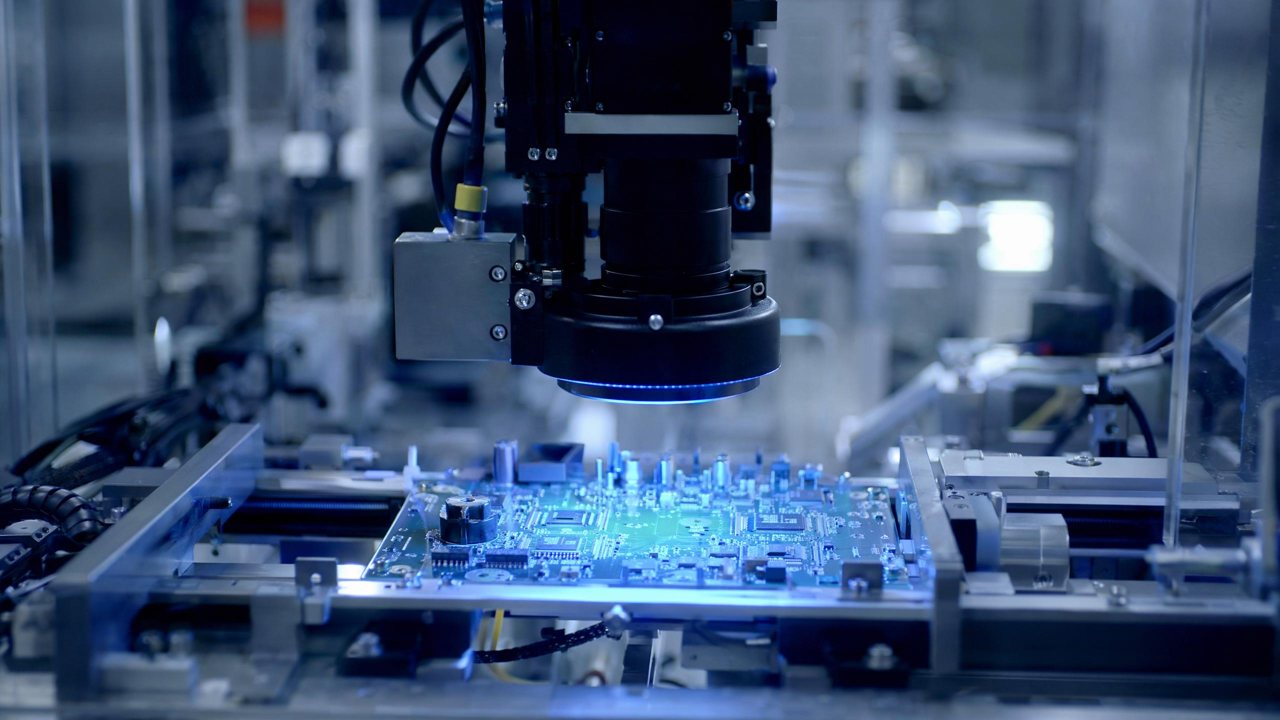
Quality inspection in the electronics/PCBA industry is of great importance, but the problem of false alarms for component polarity reversal has always been a headache for enterprises. The emergence of WeLinkirt's AI AOI software system has brought a turning point to this difficult problem.
In today's era of rapid technological development, the electronics/PCBA industry, as an important pillar of the technology industry, its product quality directly affects the stability and development of the entire technology ecosystem. In the quality inspection process of this industry, the detection of electronic components is particularly crucial. Take the PCBA production line of a leading electronics manufacturer as an example. This production line is mainly responsible for producing printed circuit boards for various electronic products. In the assembly process of the circuit board, it is necessary to detect the polarity of electronic components on the circuit board to ensure that the components are installed in the correct direction. The detection objects cover various polarized components such as surface-mount capacitors and diodes. Whether the polarity of these components is installed correctly is directly related to the performance and stability of the circuit board and even the entire electronic product.
Pain Points: Why Is It Difficult?
Traditional industrial vision quality inspection methods face many challenges when detecting component polarity. First of all, the false alarm rate remains high, about 20%. This means that for every 100 components detected, about 20 may be misjudged as having reversed polarity, greatly increasing the workload of manual re-inspection. Manual re-inspection not only consumes a lot of manpower and time, reducing production efficiency, but may also lead to missed detections due to human factors. Secondly, with the development of Industry 4.0, the application of industrial AI controllers in industrial vision quality inspection has gradually become a hot topic. However, traditional methods are difficult to effectively combine with industrial AI controllers and cannot fully utilize their advantages. The algorithms and models of traditional methods are relatively fixed and difficult to adapt to the intelligent and automated requirements brought by industrial AI controllers. In addition, when changing the production line model, reprogramming is required, which takes a long time, about 30 minutes, seriously affecting the production flexibility. In today's rapidly changing market demand, enterprises need to quickly adjust their production strategies, and the long model-changing time of traditional methods obviously cannot meet this demand.
The root cause of these pain points lies in the limitations of traditional methods. Traditional industrial vision quality inspection methods mainly detect based on preset rules and templates. For some complex components and circuit boards, these rules and templates often cannot accurately identify the polarity characteristics of components. Moreover, traditional methods lack the ability to deeply analyze and learn data, making it difficult to adapt to the constantly changing production environment and component types. In addition, the programming process of traditional methods is complex and requires professional technicians to operate, which not only increases the labor cost of enterprises but also limits the flexibility and response speed of the production line.
Technical Principles
WeLinkirt's AI AOI software system uses a feature recognition algorithm based on a visual foundation model. Through learning from a large number of good products, this algorithm can accurately identify the characteristics of components, including polarity characteristics. During the detection process, the system compares the actually detected component characteristics with the learned characteristics to determine whether the component polarity is correct. Compared with traditional methods, this algorithm has stronger adaptability and accuracy. Traditional methods are based on preset rules and templates and may not be able to accurately detect new component types or circuit board layouts. However, the visual foundation model has strong generalization ability, which can adapt to different types of components and circuit boards and improve the detection coverage.
In addition, the system also uses APDT positive-sample/few-sample learning technology. Only 1-20 good products are needed to quickly complete the model training, greatly shortening the training time. For enterprises, this means that they can start production faster, improving production efficiency. At the same time, the system also has a semantic false-alarm filtering function, which can intelligently analyze and filter false-alarm information, reducing unnecessary false alarms. Through semantic analysis of false-alarm information, the system can determine which are real false alarms and which are problems that need further attention, thereby improving the detection accuracy.
Typical Application Scenarios
- Surface - mount capacitor polarity detection: When detecting the polarity of surface-mount capacitors, the difficulty lies in the small size of the capacitors and the inconspicuous polarity characteristics. WeLinkirt's AI AOI software system can accurately identify the polarity characteristics of capacitors through the feature recognition algorithm of the visual foundation model, and can accurately detect even tiny capacitors.
- Diode polarity detection: The polarity detection of diodes needs to distinguish the positive and negative poles. Traditional methods are easily affected by light and background. The semantic false-alarm filtering function of this system can effectively filter out these interference information and improve the detection accuracy.
- Integrated circuit chip pin polarity detection: Integrated circuit chips have many pins, and the polarity detection is difficult. The APDT positive-sample/few-sample learning technology of the system can quickly complete the model training and adapt to the polarity detection of different types of chip pins.
- Electrolytic capacitor polarity detection: The polarity of electrolytic capacitors has a great impact on their performance, and high-precision detection is required. The visual foundation model of the system can accurately identify the polarity characteristics of electrolytic capacitors, ensuring the accuracy of the detection results.
Implementation Case
A medium-sized electronics manufacturing enterprise, whose PCBA production line mainly produces various types of electronic product circuit boards. Before introducing WeLinkirt's AI AOI software system, the enterprise used traditional industrial vision quality inspection methods. The false alarm rate of component polarity reversal was as high as 20%, the production line model-changing time was about 30 minutes, the manual re-inspection workload was large, and the production efficiency was low. During the implementation process, WeLinkirt's technical team conducted a detailed investigation and analysis of the enterprise's production line and carried out customized configuration of the system according to the actual needs of the enterprise. After a period of debugging and optimization, the system was officially put into operation.
After using WeLinkirt's AI AOI software system, the detection rate of component polarity reversal of this enterprise reached 98%, the missed detection rate was reduced to <2%, the false alarm rate was reduced by -75%, the production line model-changing time was shortened from the original 30 minutes to 5 minutes, and the production efficiency was significantly improved.
WeLinkirt's Solutions and Products
WeLinkirt's AI AOI software system provides an efficient and accurate solution for the quality inspection of the electronics/PCBA industry with its advanced technology and excellent performance. The system has a 0-code automatic programming function, and it only takes 5 minutes to complete the programming for one good product, greatly shortening the production line model-changing time. This means that enterprises can respond more quickly to changes in market demand and improve production flexibility. At the same time, the system supports 100% local private deployment of SDK/API/Docker, and the data does not leave the factory, ensuring data security. In practical applications, combined with DaoAI 2D/3D AI AOI equipment, it can more accurately detect the polarity of components and provide more reliable quality assurance for enterprises.
Quantitative results: After using the AI AOI software system, the detection rate of component polarity reversal reached 98%, and the missed detection rate was reduced to <2%. The false alarm rate was reduced by -75%, greatly reducing the workload of manual re-inspection. The production line model-changing time was shortened from the original 30 minutes to 5 minutes, improving production flexibility and efficiency. These quantitative results fully prove the effectiveness and superiority of WeLinkirt's AI AOI software system in solving the problem of false alarms for component polarity reversal.
FAQ
What problems can WeLinkirt's AI AOI software system solve?
WeLinkirt's AI AOI software system can solve the problem of false alarms for component polarity reversal in the quality inspection of the electronics/PCBA industry. It can increase the detection rate of component polarity reversal to 98%, reduce the false alarm rate by 75%, shorten the production line model-changing time from 30 minutes to 5 minutes, ensure data security, and reduce the workload of manual re-inspection.
What is the technical principle of the system?
The system uses a feature recognition algorithm based on a visual foundation model to identify component characteristics by learning from good products. This algorithm has strong generalization ability and can adapt to different components and circuit boards. Combined with APDT technology, the model can be quickly trained with only 1-20 good products. It also has a semantic false-alarm filtering function to reduce unnecessary false alarms.
What are the effects of using the system?
After using the system, the detection rate of component polarity reversal reaches 98%, the missed detection rate is reduced to <2%, and the false alarm rate is reduced by 75%, greatly reducing the workload of manual re-inspection. The production line model-changing time is shortened from 30 minutes to 5 minutes, significantly improving production flexibility and efficiency.
This article was generated by AI. Customer cases are simulated scenarios based on real product capabilities and figures are illustrative; see product pages for official benchmarks.