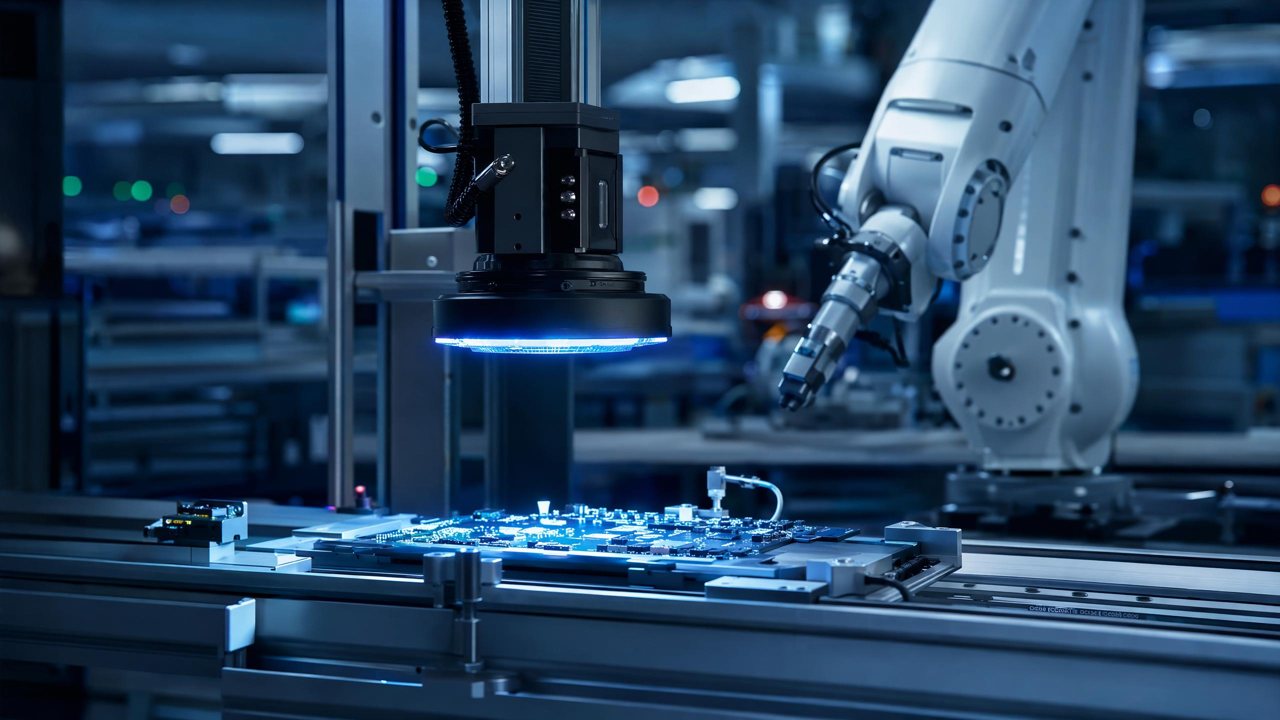
With the advancement of the intelligent manufacturing wave, the importance of industrial vision inspection in the electronics/PCBA industry has become increasingly prominent. WeLinkirt's AI AOI software system has brought new breakthroughs in solving PCBA assembly problems.
In the current trend of intelligent manufacturing, the electronics/PCBA industry is facing unprecedented changes and challenges. Industrial vision inspection, as a key link in ensuring product quality, has become increasingly important. The PCBA assembly production line of a leading electronics manufacturing company is mainly responsible for the production of printed circuit board assemblies (PCBA) for various electronic products. In the PCBA assembly process, quality control of components is crucial. It is necessary to conduct missing-component detection on the components of the PCBA and mis-installation detection of connectors. The detection objects include various surface-mount components, through-hole components, and connectors. Whether these components are installed correctly directly affects the performance and stability of the final electronic products.
Pain Points: Why Is It Difficult?
Traditional PCBA detection methods are facing numerous difficulties in the wave of intelligent manufacturing. Quantitatively, the company previously used a combination of manual visual inspection and traditional AOI equipment. The miss-detection rate was as high as 3%, which means that 3 out of every 100 products with defects might not be detected. The false-alarm rate reached 20%. A large number of false alarms not only led to a large number of products needing re-inspection, greatly increasing labor costs but also seriously affecting production efficiency. In terms of product model change, the traditional programming method required more than 30 minutes for reprogramming, which seriously affected the flexibility of the production line for high-efficiency production.
The root causes of these problems are as follows. Manual visual inspection is subjective and prone to fatigue. Prolonged inspection work can easily lead to visual fatigue of inspectors, thereby reducing the accuracy of inspection. Moreover, it is difficult for manual inspection to make accurate judgments on tiny defects and complex assembly situations. Although traditional AOI equipment has certain detection capabilities, its programming method is relatively complex and requires professional technicians to operate. When facing product model changes, a large number of programs need to be rewritten, which is not only time-consuming and labor-intensive but also prone to programming errors. In addition, as the industry's requirements for product quality continue to increase, traditional detection methods are struggling to meet increasingly strict compliance standards.
Technical Principle
WeLinkirt's AI AOI software system is based on an advanced visual foundation model for feature recognition. The model uses deep-learning algorithms to conduct in - depth learning and analysis of a large amount of PCBA image data. In this way, the system can accurately identify the features of various components, including their shape, size, color, and position. Compared with traditional methods, traditional detection methods are often based on preset rules for detection, making it difficult to accurately identify some complex situations and tiny defects. The AI AOI software system can continuously optimize its detection ability by learning a large amount of data, thus achieving more accurate detection.
In terms of missing-component detection, the system can quickly scan each position on the PCB and compare the actually detected components with the pre-learned standard model. If it finds that a component that should exist in a certain position is actually missing, the system can quickly issue an alarm. For connector mis-installation detection, the system can make accurate judgments based on the shape, position, and pin characteristics of the connector. It can identify whether the connector is installed correctly and whether the pins are aligned. In addition, the system also has some advanced functions. The function of 5-minute zero-code automatic programming for a good product uses advanced image analysis technology to automatically learn and program a good product in a short time without writing complex codes, greatly shortening the programming time. The APDT positive-sample/few-sample learning function allows the system to quickly learn the normal features of the product through only 1-20 positive samples of good products, thereby effectively identifying defective products. The semantic false-alarm filtering function enables the system to filter false alarms according to semantic information, reducing unnecessary false alarms and improving the detection accuracy. It supports local private deployment methods such as SDK/API/Docker, ensuring that the data does not leave the factory and protecting the security and privacy of the data.
Typical Application Scenarios
- Missing detection of surface-mount components: In the PCBA production process, there are a large number of surface-mount components with small sizes. During detection, the system obtains the PCB image through high-resolution imaging equipment and then uses deep-learning algorithms to identify and count the surface-mount components in the image. The difficulty lies in the fact that surface-mount components may be stacked or offset, which affects the detection accuracy. The system needs to accurately judge whether a surface-mount component is missing through multi-angle analysis and feature extraction of the image.
- Error detection of through-hole component insertion: Through - hole components usually have specific pins and installation directions. During detection, the system detects the position and direction of the pins according to the pre-learned features of the through-hole components. The difficulty is that the pins of through-hole components may be bent or deformed, increasing the detection difficulty. The system needs to accurately judge whether the through-hole component is inserted correctly by precisely analyzing the shape and angle of the pins.
- Connector mis-installation detection: Connectors have different shapes and pin characteristics. The system identifies the appearance and pin arrangement of the connector to judge whether it is installed in the correct position. The difficulty is that the appearances of connectors may be similar and easily confused. The system needs to accurately identify the connector mis-installation situation by comparing the detailed features of the connectors.
- Solder joint defect detection: The quality of solder joints directly affects the electrical performance of the PCBA. The system obtains the solder joint image through high-contrast imaging technology and then analyzes the shape, size, color, and other features of the solder joints. The difficulty is that the defects of solder joints may be very tiny, requiring the system to have high-resolution detection ability and precise image analysis algorithms.
- Polarity detection of polarized components: Polarized components such as capacitors and diodes need to be installed with the correct polarity. The system identifies the markings and positions of polarized components to judge whether their polarities are correct. The difficulty is that the polarity markings may be unclear, and the system needs to assist in judging the polarity by analyzing the surrounding environment of the component.
Implementation Case
The customer in this case is a leading electronics manufacturing company with a large scale and multiple PCBA assembly production lines. Before deciding to introduce WeLinkirt's AI AOI software system, the company faced problems such as low product-detection efficiency and difficulty in ensuring product quality. During the implementation process, the WeLinkirt team first conducted a detailed investigation and analysis of the company's existing detection equipment and production process, and then smoothly integrated the AI AOI software system with the existing detection equipment. After a period of debugging and optimization, the system was officially put into use.
After introducing WeLinkirt's AI AOI software system, the PCBA detection efficiency and quality of the company have been significantly improved.
WeLinkirt's Solutions and Products
WeLinkirt provides a complete PCBA detection solution for the company with the AI AOI software system as the core. The system can be integrated with the factory's existing detection equipment for rapid deployment. When changing product models, new programming can be completed in just 5 minutes, greatly improving the production-line model-changing efficiency. At the same time, the APDT positive-sample/few-sample learning ability of the system allows model training to be completed with only a small number of good-product samples, reducing the difficulty and cost of sample collection. In addition, the semantic false-alarm filtering function effectively reduces false alarms and improves detection efficiency. The supporting DaoAI 2D/3D AI AOI equipment can provide more comprehensive detection and accurately detect hidden solder joints.
Quantitative Results
After applying WeLinkirt's AI AOI software system, the company has achieved remarkable results in PCBA detection. The detection rate has increased to 99%, which means that almost all defective products can be detected. The miss-detection rate has been reduced to less than 1%, greatly reducing the risk of defective products entering the market. The false-alarm rate has been reduced by -70%, reducing a large amount of re-inspection work and improving production efficiency. The product model-changing time has been shortened from more than 30 minutes to 5 minutes, greatly improving the flexibility and production efficiency of the production line. These quantitative data fully demonstrate the powerful ability of WeLinkirt's AI AOI software system in improving PCBA detection quality and efficiency.
FAQ
How many good-product samples does the AI AOI software system need for training?
The system uses APDT positive-sample/few-sample learning. Only 1-20 good-product samples are required to complete model training. This greatly reduces the difficulty and cost of sample collection. Enterprises do not need to spend a lot of time and energy collecting a large number of samples, and the system can quickly learn the normal features of the product.
How long does it take to program the AI AOI software system when changing product models?
The system supports 5-minute zero-code automatic programming for a good product. When changing product models, new programming can be completed in just 5 minutes. Compared with the more than 30-minute traditional programming method, it greatly improves the production-line model-changing efficiency and makes production more flexible.
How does the AI AOI software system reduce the false-alarm rate?
The system has a semantic false-alarm filtering function. It can filter false alarms according to semantic information and exclude false-alarm signals caused by non-real defects. In this way, unnecessary false alarms are effectively reduced, and the detection accuracy and production efficiency are improved.
This article was generated by AI. Customer cases are simulated scenarios based on real product capabilities and figures are illustrative; see product pages for official benchmarks.