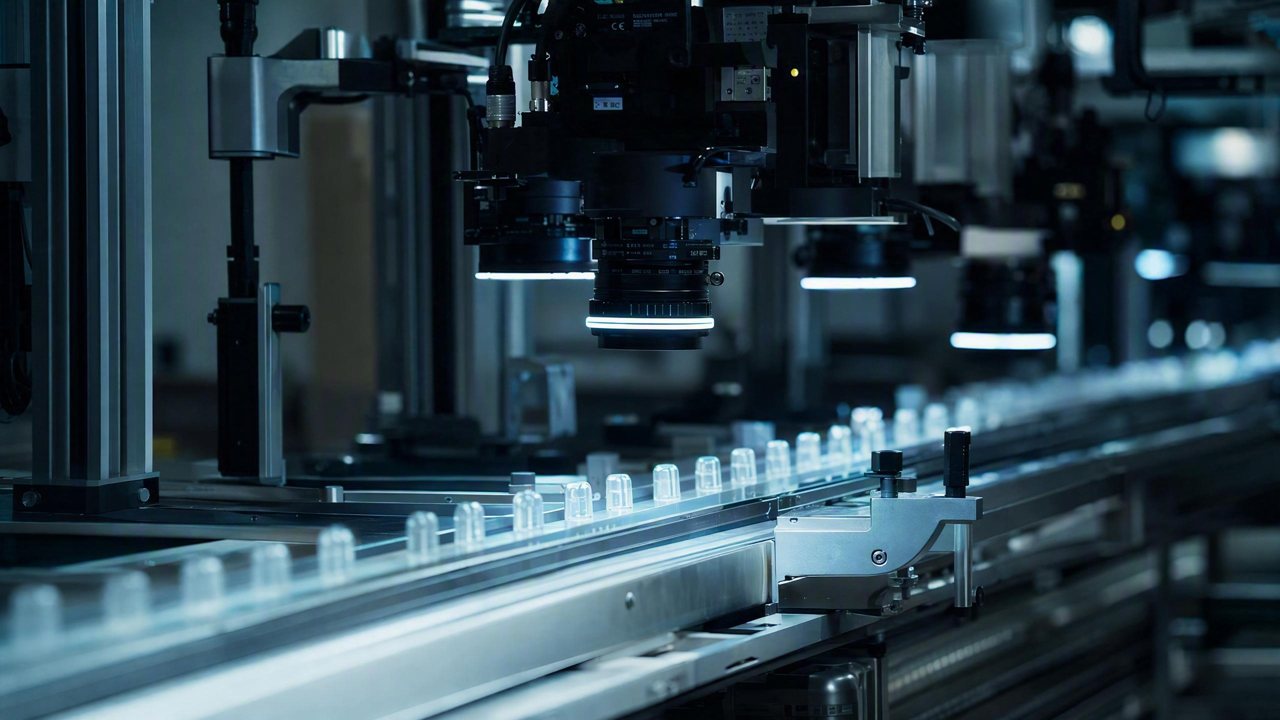
WeLinkirt's DaoAI AI AOI software system (featuring visual foundation model-based feature recognition, 5-minute 0-code automatic programming with one good sample, APDT positive/few-shot learning with 1-20 good samples, semantic false positive filtering, and SDK/API/Docker support for 100% local private deployment) ensures absolute localization and security of pharmaceutical production data, while enabling rapid self-training and precise detection of various capsule defects, reducing the false positive rate of traditional manual inspection to <0.5%. In the pharmaceutical industry, capsules, as common oral solid preparations, have an appearance quality directly related to drug safety and patient health. However, capsule production lines typically operate under high-throughput, multi-batch, multi-SKU production modes, posing severe challenges to appearance defect detection. From scratches, color differences, and deformation of the capsule shell to uneven filling of contents and foreign matter inclusion, any minor flaw can lead to an entire batch of products being non-compliant. Traditional inspection methods often rely on manual visual inspection or rule-based machine vision systems, but these methods struggle to cope with complex and varied defect types, high precision requirements, and strict compliance standards.
WeLinkirt's DaoAI AI AOI software system (featuring visual foundation model-based feature recognition, 5-minute 0-code automatic programming with one good sample, APDT positive/few-shot learning with 1-20 good samples, semantic false positive filtering, and SDK/API/Docker support for 100% local private deployment) ensures absolute localization and security of pharmaceutical production data, while enabling rapid self-training and precise detection of various capsule defects, reducing the false positive rate of traditional manual inspection to <0.5%. In the pharmaceutical industry, capsules, as common oral solid preparations, have an appearance quality directly related to drug safety and patient health. However, capsule production lines typically operate under high-throughput, multi-batch, multi-SKU production modes, posing severe challenges to appearance defect detection. From scratches, color differences, and deformation of the capsule shell to uneven filling of contents and foreign matter inclusion, any minor flaw can lead to an entire batch of products being non-compliant. Traditional inspection methods often rely on manual visual inspection or rule-based machine vision systems, but these methods struggle to cope with complex and varied defect types, high precision requirements, and strict compliance standards.
Pain Points: Why This Hurdle Is Difficult to Overcome
In pharmaceutical capsule production, defect detection faces multiple challenges. First is the **diversity and subtlety of defect types**: capsule defects include scratches, bubbles, black spots, color differences, deformation, adhesion, breakage, and many other types, many of which are microscopic and difficult to discern with the naked eye. For example, tiny black spots or fine scratches smaller than 0.2mm in diameter are easily missed on high-speed production lines. Second is **data security and compliance**: the pharmaceutical industry has extremely high requirements for data security and privacy protection, and any leakage of production data can lead to serious compliance risks and economic losses. Traditional cloud-based AI solutions, which require data to be uploaded to third-party servers for training and inference, struggle to meet strict local deployment requirements. Third is **inefficient and inconsistent manual inspection**: high-speed lines can produce thousands of capsules per minute, and manual inspection is susceptible to factors such as fatigue and emotion, leading to high missed detection rates (often between 1-3%) and high false positive rates (potentially exceeding 5%), with inconsistent judgment standards among different inspectors, resulting in product quality fluctuations. Finally, **slow changeover and new defect response**: when product batches or defect types change, rule-based traditional AOI systems require hours or even days for parameter adjustment and programming, severely impacting production efficiency. For sudden new types of defects, traditional systems are almost unable to quickly identify and learn, leading to a large number of non-conforming products flowing into subsequent stages.
From a process perspective, the translucent nature and curved structure of capsule surfaces make lighting conditions and image acquisition exceptionally complex, prone to reflections, shadows, and other noise that interfere with defect recognition. At the same time, the continuous increase in production rhythm demands that the detection system complete image acquisition, processing, and judgment in a very short time, posing a huge challenge to the real-time performance of traditional vision algorithms. These root causes collectively lead to traditional detection solutions struggling to achieve ideal detection results and data security standards in the pharmaceutical capsule field.
Technical Principles
WeLinkirt's DaoAI AI AOI software system fundamentally addresses the shortcomings of traditional AOI and manual inspection through its unique visual foundation model and APDT (Anomaly Pattern Discovery & Training) learning mechanism. This system does not rely on predefined rules but is based on a visual foundation model trained on large-scale image data, possessing powerful feature recognition capabilities to autonomously learn and understand the normal appearance characteristics of capsules. When a deviation from the 'normal' pattern is detected, the system can identify it as a potential defect. Compared to traditional rule-based AOI, WeLinkirt's DaoAI AI AOI eliminates the need for manual definition of defect features, greatly simplifying the programming and debugging process.
Its core advantages lie in **few-shot learning capability** and **local private deployment**. Through APDT positive/few-shot learning technology, WeLinkirt's DaoAI AI AOI software system only requires 1-20 good sample images to automatically generate a detection model for specific defect types in 5 minutes, achieving 0-code programming. This means that even when facing entirely new, previously unseen capsule defects, the production line can respond quickly and deploy detection capabilities rapidly. Furthermore, the system's built-in semantic false positive filtering mechanism effectively distinguishes between normal product textures and true defects, keeping the false positive rate at an extremely low level of <0.5%. Most critically, WeLinkirt's DaoAI AI AOI software system supports various deployment methods such as SDK/API/Docker, enabling 100% local private deployment. All data is processed, stored, and trained within the customer's internal network, ensuring absolute security of pharmaceutical production data and fully complying with industry regulations such as GMP, eliminating customer concerns about data leakage.
Typical Application Scenarios
- **Capsule Shell Scratch and Breakage Detection**: During capsule filling and encapsulation, friction or mechanical stress can cause micron-level scratches or localized breakage on the shell surface. WeLinkirt's DaoAI AI AOI software system utilizes high-resolution image acquisition, combined with its visual foundation model's sensitivity to subtle texture anomalies, to accurately identify these defects that are difficult to detect with the naked eye, ensuring shell integrity.
- **Capsule Color Difference and Stain Detection**: Different batches of capsule shells may have slight color differences, or may be contaminated with oil stains, dust, etc., during the production process. The DaoAI AI AOI system efficiently distinguishes between normal color fluctuations and actual color differences or stains through color space analysis and abnormal region identification, preventing non-conforming products from being mixed in. The challenge lies in distinguishing between normal batch color variations and true defects.
- **Capsule Deformation and Adhesion Detection**: In improper drying or storage environments, capsules may deform, such as becoming oval or flattened, or adhere to each other due to moisture. WeLinkirt's DaoAI AI AOI software system precisely extracts capsule contours and shape features to identify various non-standard capsule forms and determine if adhesion exists, ensuring product appearance consistency.
- **Content Filling Anomaly and Foreign Matter Detection**: Although the internal contents of capsules are not easily directly observed, underfilling or overfilling, or even the inclusion of foreign matter (such as metal shavings, fibers), can cause subtle changes in the capsule's appearance (e.g., localized bulging, indentation, or abnormal color transmission). WeLinkirt's DaoAI AI AOI system indirectly assesses the uniformity of content filling and the presence of foreign matter by analyzing abnormal patterns in transmitted or reflected light images, a sophisticated detection capability difficult for traditional AOI to achieve.
Implementation Case Study
A leading domestic pharmaceutical enterprise, with a capsule production line producing millions of capsules daily, previously relied primarily on manual visual inspection and a few rule-based AOI devices. With the expansion of production scale and the increase in product SKUs, the missed detection rate and false positive rate of manual inspection became critical bottlenecks limiting capacity and quality improvement. Especially concerning data security, the client was cautious about any cloud-based solutions. The client introduced WeLinkirt's DaoAI AI AOI software system and opted for a 100% local private deployment solution. In the initial phase of the project, WeLinkirt's technical team worked closely with the client to integrate the DaoAI AI AOI system into the existing production line and trained models using a small number of good samples provided by the client (an average of only 10-15 images per defect type). The system quickly self-learned to detect various common capsule defects, such as scratches, black spots, and color differences.
"The local private deployment of WeLinkirt's DaoAI AI AOI software system completely eliminated our data security concerns. More importantly, it can quickly learn new defects in 5 minutes, reducing our false positive rate by −75%, far exceeding expectations."
After deployment, WeLinkirt's DaoAI AI AOI software system demonstrated significant results. Compared to before deployment, the **manual re-inspection workload on this production line was reduced by approximately −75%**, significantly alleviating the burden on quality inspection personnel. Concurrently, the **overall missed detection rate decreased from 1.2% to <0.3%**, leading to a notable improvement in product quality stability. More importantly, when facing newly emerging minor defects, the client's engineers only needed to provide a small number of good images to complete model updates within 5 minutes, quickly deploying new defect recognition capabilities to the production line, ensuring production continuity and adaptability. Through 100% local private deployment, all production data is processed and stored on the client's internal servers, fully complying with their stringent data security and compliance requirements.
WeLinkirt Solution and Products
WeLinkirt's core offering for pharmaceutical capsule inspection is the DaoAI AI AOI software system. This system, built upon the powerful feature recognition capabilities of its visual foundation model, achieves rapid modeling with "one good sample, 5 minutes, 0-code automatic programming." This means that customers do not need professional AI engineers; production line operators can use an intuitive interface and the APDT positive/few-shot learning mechanism to quickly train detection models for specific capsule defects with just 1-20 good images. For deployment, WeLinkirt's DaoAI AI AOI software system provides flexible SDK/API/Docker interfaces, supporting 100% private deployment on customer's local servers. All image data, model training, and inference processes are completed within the customer's firewall, ensuring the absolute security of core production data and fully meeting the GxP compliance requirements of the pharmaceutical industry. Furthermore, the system possesses powerful semantic false positive filtering capabilities, effectively identifying and excluding false positives caused by normal production fluctuations or background noise, keeping the false positive rate at an extremely low level and significantly reducing the burden of manual re-inspection. WeLinkirt can also provide DaoAI 2D/3D AI AOI equipment integration services, combining self-developed high-precision industrial cameras to offer customers an integrated software and hardware solution, further enhancing detection accuracy and efficiency. Through this series of capabilities, WeLinkirt's DaoAI AI AOI software system helps pharmaceutical enterprises achieve intelligent, efficient, and flexible capsule defect detection while ensuring data security.
By deploying WeLinkirt's DaoAI AI AOI software system, the client achieved significant business value. Firstly, **data security and compliance were fully guaranteed**, eliminating potential risks associated with cloud deployment. Secondly, **detection accuracy and efficiency were significantly improved**, with the missed detection rate reduced to <0.3% and the false positive rate reduced by approximately −75%, significantly reducing manual re-inspection workload and freeing up valuable labor. Thirdly, **production flexibility and response speed were greatly enhanced**, with new defect types or product changeovers requiring only 5 minutes for model updates, greatly shortening downtime and improving production line utilization. These quantifiable achievements collectively promoted the client's quality control level and market competitiveness in pharmaceutical production.
FAQ
How does WeLinkirt's DaoAI AI AOI software system ensure the security of pharmaceutical production data?
WeLinkirt's DaoAI AI AOI software system supports 100% local private deployment. Through SDK/API/Docker interfaces, all image data, model training, and inference processes are completed on the customer's internal servers, ensuring data never leaves the factory. This fully complies with the strict data security and privacy protection requirements of the pharmaceutical industry.
How long does the system take to train models for new defect types?
Leveraging APDT positive/few-shot learning technology, WeLinkirt's DaoAI AI AOI software system only requires 1-20 good sample images to automatically program and train new defect models within 5 minutes, achieving 0-code deployment. This significantly shortens the response time for new defects.
How does this system reduce false positive rates and alleviate the burden of manual re-inspection?
WeLinkirt's DaoAI AI AOI system incorporates a semantic false positive filtering mechanism that accurately distinguishes between normal product textures and true defects, effectively excluding false positives caused by production fluctuations or background noise. This keeps the false positive rate at an extremely low level of <0.5%, thereby significantly reducing the workload and time for manual re-inspection.
This article was generated by AI. Customer cases are simulated scenarios based on real product capabilities and figures are illustrative; see product pages for official benchmarks.