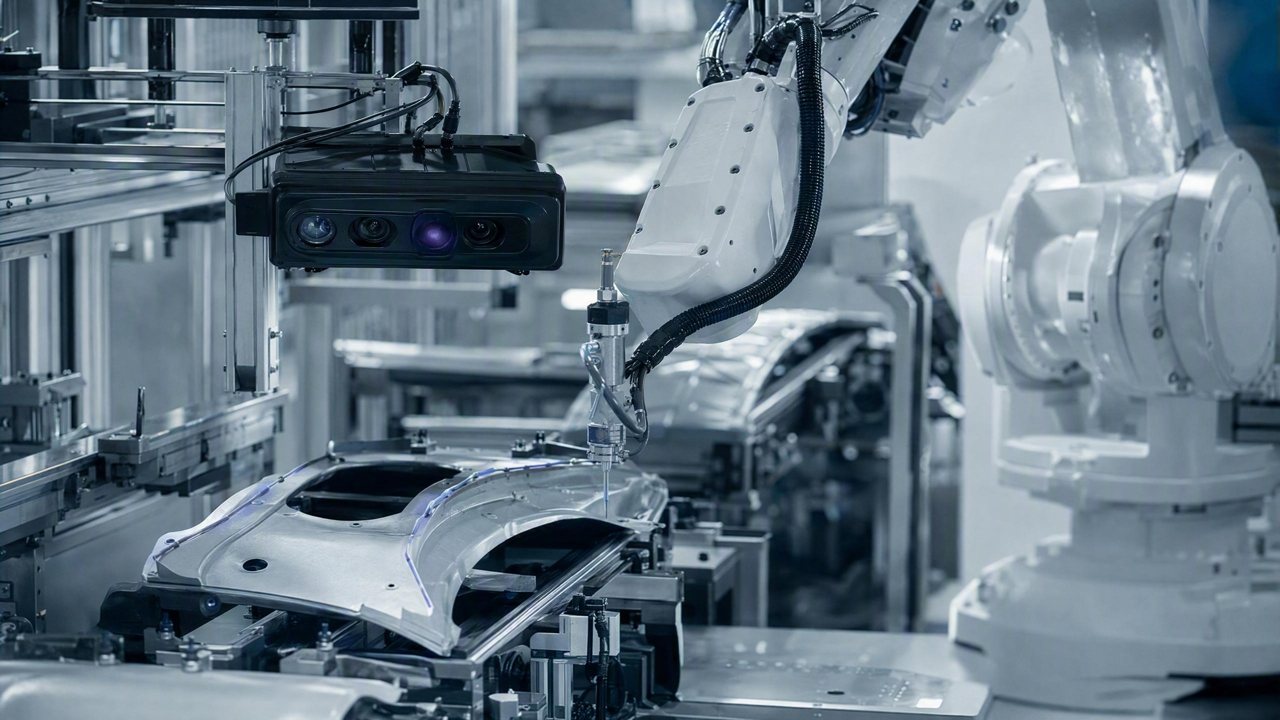
WeLinkirt DaoAI 3D Robot Vision system, with its proprietary 3D cameras and 6D pose estimation capabilities, achieves sub-millimeter level guidance and 100% in-line inspection for complex curved surface gluing paths in automotive component gluing/sealing processes, effectively reducing the gluing defect false negative rate from 3% in traditional solutions to <0.3%, while improving the single-piece inspection cycle time to under 300 milliseconds.
In automotive component manufacturing, gluing and sealing are critical processes for ensuring product performance, durability, and safety. Particularly for new energy vehicle battery pack sealing, wire harness fixation, and structural component connections, the quality of gluing directly impacts waterproofing, dustproofing, insulation, and even crash safety. However, traditional gluing processes are often challenged by complex workpiece geometries, precise gluing paths, and stringent cycle time requirements, making it difficult to achieve 100% in-line inspection and real-time path correction. This leads to production line bottlenecks and potential quality risks. WeLinkirt DaoAI 3D Robot Vision system, with its proprietary 3D cameras and core capabilities such as 6D pose estimation, bin picking, guidance for gluing/assembly/loading/unloading, brain-eye-body closed-loop control, and sub-millimeter hand-eye coordination, successfully addresses the core problem of traditional manual inspection or rule-based AOI solutions failing to meet production cycle time and 100% full inspection capacity in automotive component gluing processes, significantly reducing the false negative rate of gluing defects and substantially improving production efficiency.
Pain Points: Why This Hurdle Is So Difficult to Overcome
Quality control in automotive component gluing faces multiple challenges. Firstly, there's a severe conflict between stringent production line cycle time and 100% inspection capacity. For example, a gluing line for automotive interior parts requires a single-piece inspection cycle time of less than 500 milliseconds. Traditional manual inspection or 2D vision-based rule-based AOI often struggle with image processing speed and complex defect pattern recognition, making it difficult to achieve 100% coverage with fast in-line inspection, leading to false negative rates of 3%~5%. Secondly, complex curved surfaces and varying poses are another major difficulty. Gluing paths for automotive components like inner door panels and battery pack covers are often on complex curved surfaces, and workpieces on the conveyor belt may have slight pose deviations. This limits the accuracy of fixed-path robot gluing, as traditional 2D vision cannot accurately acquire Z-axis depth information for path compensation, leading to high risks of misaligned or overflowed glue. Thirdly, diverse and tiny defect types. Gluing defects include not only broken glue, overflow, and bubbles, but also sub-millimeter details like uneven bead width and inconsistent height. These defects are difficult for the naked eye to quickly identify, and traditional rule-based AOI often has a high false alarm rate due to difficulty in feature extraction, increasing the manual re-inspection workload, requiring 4-6 hours daily for re-inspection and problem tracing, which severely impacts production efficiency and product consistency.
From a process and imaging perspective, the root cause of these difficulties lies in: gluing materials often having reflective, light-absorbing, or translucent properties, leading to unstable imaging quality under traditional 2D light sources; random pose changes of workpieces on the production line making it impossible for preset fixed inspection windows to align accurately; and most importantly, achieving sub-millimeter level gluing guidance and defect detection requires high-precision 3D morphology data and real-time 6D pose sensing capabilities, which are shortcomings of traditional solutions. The current industry hot topic of CM8252D+CM2001AT module sets in AI robot vision perception closed-loop systems also emphasizes the critical role of high precision, real-time performance, and multi-dimensional data acquisition in enhancing autonomous operation capabilities. WeLinkirt DaoAI's solution builds upon this by providing stable, high-precision 3D point cloud data through its proprietary 3D cameras, combined with advanced 6D pose estimation algorithms, to achieve a “brain-eye-body” closed-loop coordination, thereby overcoming the aforementioned bottlenecks.
Technical Principles
The core of the WeLinkirt DaoAI 3D Robot Vision system lies in its proprietary 3D cameras and advanced vision algorithms. Our 3D cameras utilize structured light or laser triangulation principles to quickly and stably acquire high-density 3D point cloud data of workpiece surfaces, overcoming the sensitivity of traditional 2D vision to lighting and material reflectivity. This point cloud data contains precise 3D morphological information of the workpiece, which is the basis for achieving sub-millimeter level detection accuracy. Building on this, DaoAI's 6D pose estimation algorithm can real-time calculate the precise position and orientation (X, Y, Z, Rx, Ry, Rz) of the workpiece in 3D space, accurately capturing even slight random deviations. This enables the robot to adjust its path based on the actual workpiece pose, achieving high-precision gluing guidance and effectively reducing the risk of gluing misalignment and overflow.
Compared to traditional methods, the advantages of WeLinkirt DaoAI 3D Robot Vision are significant. Traditional rule-based AOI primarily relies on 2D image features like grayscale and edges for comparison, with limited ability to recognize complex geometries and tiny defects, and is sensitive to lighting changes and workpiece pose. When defect patterns change slightly, extensive manual rule adjustments are required, leading to high maintenance costs. Manual inspection, on the other hand, is limited by human eye fatigue, subjective judgment, and production line cycle time, making 100% full inspection impossible and resulting in high false negative rates. The WeLinkirt DaoAI system directly perceives geometric features of the glue bead such as width, height, and continuity through 3D data, combined with deep learning algorithms for high-precision classification and localization of defects, reducing the gluing defect false negative rate by over -90% and improving the single-piece inspection cycle time to under 300 milliseconds, fully meeting the stringent cycle time requirements of automotive production lines. Furthermore, DaoAI's “brain-eye-body” closed-loop system tightly couples visual perception, decision planning, and robot execution, achieving sub-millimeter hand-eye coordination between the robot and vision system, ensuring gluing precision and consistency.
Typical Application Scenarios
- **Battery Pack Seal Bead Inspection and Guidance:** New energy vehicle battery packs have extremely high sealing requirements. The WeLinkirt DaoAI 3D Robot Vision system can real-time detect the width, height, continuity, and presence of bubbles in seal beads on complex curved surfaces like battery pack covers and housings, and provide high-precision guidance for robot gluing paths, ensuring uniform and complete seal beads to prevent leakage risks. The challenge lies in global accuracy for large workpieces and the recognition of micron-level sealing defects.
- **Automotive Interior Part Bonding Gluing Guidance and Quality Inspection:** Automotive interior parts such as dashboards and door panels have complex bonding gluing paths, requiring both aesthetic appeal and bonding strength. The DaoAI 3D vision system can perform 6D pose estimation on irregularly shaped interior parts, guide robots for precise gluing, and conduct in-line inspection for glue overflow, breaks, or deviations. The challenge lies in the impact of various colors and materials of interior parts on imaging and fast changeovers for multiple product types.
- **Engine/Gearbox Housing Sealant Application:** The application of sealant to engine and gearbox housings is a critical step to prevent oil leakage. WeLinkirt DaoAI 3D Robot Vision can handle challenges such as rough casting surfaces and uneven reflections, precisely identifying gluing locations and paths, guiding robots to apply high-strength sealant with precision, and real-time inspecting the quality of the sealant bead. The challenge lies in high-temperature environment adaptability and interference from oil stains on visual recognition.
- **Car Body Weld Seam Sealant Inspection:** Sealant on car body weld seams not only provides waterproofing and dustproofing but also affects body rigidity. The DaoAI 3D vision system can perform 3D scanning of complex weld seam paths on the car body, detecting the width, height, and flatness of the sealant to ensure sealing effectiveness and aesthetic quality. The challenge lies in large variations in lighting and uneven surfaces at weld seams, leading to accuracy challenges.
Implementation Case Study
A leading automotive Tier-1 supplier, whose main business is providing car body structural parts and interior modules for several well-known automotive brands, faced severe challenges on a critical automotive door panel sealant application production line. Due to the complex shape of the door panels and precise gluing paths, traditional 2D AOI systems based on template matching could not effectively handle minor workpiece pose deviations, leading to inaccurate gluing paths, overflow, and broken glue beads. Although manual inspection could identify some issues, the fast production line cycle time (single-piece production cycle less than 1 second) made 100% full inspection difficult, with the false negative rate consistently around 2.5%, resulting in high downstream rework costs and even batch-related quality risks. Simultaneously, the false alarm rate of traditional 2D AOI systems was as high as 8%, requiring 2-3 quality inspectors to spend long hours on re-inspection daily, severely slowing down overall production efficiency.
To solve this problem, the manufacturer introduced the WeLinkirt DaoAI 3D Robot Vision system. During the implementation process, the WeLinkirt engineering team first performed 3D scanning of the production line to obtain high-precision workpiece models and used the DaoAI platform for automatic planning and optimization of gluing paths. Through the 6D pose estimation capability of DaoAI 3D Vision, the robot could real-time perceive the precise position and orientation of each door panel and dynamically adjust the gluing path, ensuring the glue bead was always in the predetermined position. At the same time, the system also integrated an in-line 3D inspection module to perform 100% full inspection of the completed glue bead, detecting key indicators such as bead width, height, and continuity. After 2 weeks of debugging and small-batch trial production, the system was officially launched. After launch, the false negative rate of gluing defects significantly reduced from 2.5% to <0.2%, and the false alarm rate also reduced by -85%, to about 1.2%. More importantly, the WeLinkirt DaoAI system stably controlled the single-piece inspection cycle time to under 280 milliseconds, fully meeting and exceeding the production line's 500-millisecond cycle time requirement, achieving true 100% in-line full inspection, which greatly enhanced production capacity and product quality.
WeLinkirt DaoAI 3D Robot Vision system not only solved the false negative problem in automotive gluing but also elevated production line cycle time and 100% inspection capacity to new heights, truly achieving sub-millimeter precision operation under a “brain-eye-body” closed-loop.
WeLinkirt Solutions and Products
WeLinkirt DaoAI 3D Robot Vision is at the core of this solution. It integrates proprietary high-precision 3D cameras capable of rapidly and stably acquiring complete 3D morphological data of automotive components. For deployment, WeLinkirt offers various integration methods such as SDK/API/Docker, supporting 100% local private deployment to ensure customer data security remains on-site. For gluing guidance, the DaoAI platform utilizes high-precision 6D pose estimation algorithms to real-time identify the exact position and orientation of the workpiece and feedback the corrected path data to the robot controller in real-time, achieving closed-loop coordination of the robot's “brain-eye-body”. In the inspection phase, DaoAI leverages its powerful deep learning capabilities to intelligently analyze the acquired 3D point cloud data, automatically identifying various gluing defects such as broken glue, overflow, bubbles, and uneven width/height. It also features APDT positive/few-shot learning capabilities, requiring only a small number of good samples (1-20 images) to quickly train new models, enabling 0-code rapid changeover, which significantly shortens product changeover downtime.
Furthermore, the WeLinkirt DaoAI World Model, as a unified underlying vision model, further enhances the system's semantic understanding and cross-scenario generalization capabilities, allowing the system to continuously learn and optimize from production line feedback when facing new gluing scenarios or products. This not only significantly reduces the cost of model training and maintenance but also improves the system's adaptability and robustness. Through this comprehensive solution, WeLinkirt DaoAI 3D Robot Vision ensures the quality consistency of automotive component gluing processes, significantly improves production efficiency and automation levels, ultimately bringing substantial economic benefits and competitive advantages to customers.
FAQ
How does the DaoAI 3D Robot Vision system handle complex curved surfaces and irregular workpieces in automotive gluing applications?
WeLinkirt DaoAI 3D Robot Vision system utilizes proprietary high-precision 3D cameras to acquire the complete 3D morphology of workpieces. Combined with advanced 6D pose estimation algorithms, it can real-time and accurately identify the actual position and orientation of complex curved surfaces and irregular workpieces. Based on this 3D data, the system dynamically adjusts the robot's gluing path, ensuring the glue bead is always precisely positioned, effectively solving the accuracy challenges of traditional solutions on complex workpieces.
What are the typical deployment cycle and cost of the DaoAI 3D Robot Vision system?
The deployment cycle of the DaoAI 3D Robot Vision system typically depends on the complexity of the production line and integration requirements, generally completed within 2-4 weeks. In terms of cost, it is primarily influenced by the number of 3D cameras needed, the difficulty of robot integration, and the demand for customized algorithm development. WeLinkirt offers flexible deployment solutions and licensing models. We recommend clients schedule an expert consultation to obtain a customized quote and ROI analysis based on their specific production line conditions, ensuring the most optimized solution.
What are the significant advantages of DaoAI 3D Robot Vision in gluing inspection compared to traditional 2D vision systems?
The significant advantage of DaoAI 3D Robot Vision lies in its ability to acquire Z-axis depth information, enabling 3D morphology inspection. This means it can identify volumetric defects such as the height, width, and continuity of glue beads, which 2D vision struggles with. Additionally, 3D vision is less sensitive to lighting changes and material reflectivity, providing more stable imaging. Combined with 6D pose estimation, it effectively handles random workpiece poses, offering more precise gluing guidance and lower false negative and false alarm rates.
This article was generated by AI. Customer cases are simulated scenarios based on real product capabilities and figures are illustrative; see product pages for official benchmarks.