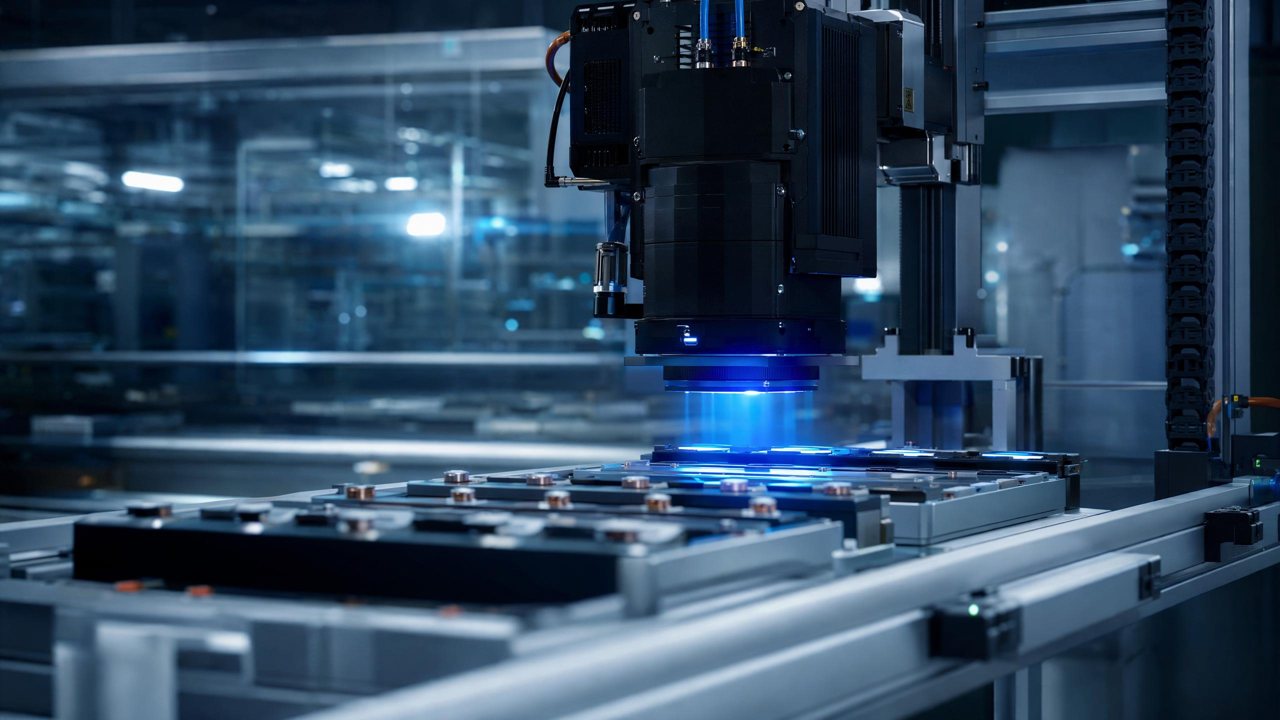
The new energy battery industry is booming, and the requirements for the quality of battery modules are becoming increasingly strict. As the key connection part of the battery module, the quality of the weld spot directly affects the safety and performance of the battery. The emergence of WeLinkirt's DaoAI 3D robot vision technology has brought a new breakthrough in solving the problem of weld spot inspection.
Industry background and user scenario: With the continuous growth of global demand for clean energy, the new energy battery market has witnessed an explosive growth. As the core component of electric vehicles, energy storage systems and other fields, the quality and safety of new energy batteries are of crucial importance. In the production process of new energy batteries, the inspection of weld spots in battery modules is a key step to ensure battery quality. A leading new energy battery manufacturer faces great challenges in the weld spot inspection process on its battery module production line. The manufacturer produces various specifications of new energy battery modules, and the quality of the weld spots directly affects the safety and performance of the battery modules. Therefore, high-precision inspection of weld spots is a necessary means to ensure product quality.
In - depth analysis of pain points: Why is it difficult?
From a quantitative perspective, traditional inspection methods have many difficulties. Firstly, regarding the missed detection rate, the missed detection rate of traditional methods is as high as 3%, which means that a large number of defective products may flow into subsequent processes. These defective products may cause safety accidents during subsequent use and also increase the rework cost. For example, in the assembly process of battery modules, if a poorly welded or missed weld spot is not detected, the module may need to be disassembled and repaired, which not only wastes time and labor but may also damage other components. Secondly, the false alarm rate is also a serious problem. The false alarm rate of traditional inspection methods reaches 25%. Frequent false alarms require operators to spend a lot of time and energy on re-inspection. This not only affects the production line rhythm but also reduces production efficiency. In addition, when changing the type of battery modules of different specifications, traditional methods require 30 minutes of manual adjustment. This is because the parameter settings and inspection models of traditional inspection equipment are usually customized for specific module specifications. When the module specification needs to be changed, the equipment parameters need to be manually readjusted and the inspection model needs to be replaced. This method is not only inefficient but also prone to human errors.
The root cause why traditional inspection methods are difficult to meet the requirements lies in the limitations of their technical principles. Traditional two-dimensional vision inspection technology mainly analyzes based on the two-dimensional image information of the object surface, and cannot obtain the three-dimensional shape information of the object. The quality inspection of weld spots not only needs to focus on the surface features of the weld spots but also needs to understand their three-dimensional shape, height, position and other information. In the actual production process, factors such as reflection and shadow on the surface of the weld spot will interfere with the two-dimensional image information, leading to misjudgment of the inspection results. In addition, traditional inspection methods lack intelligent and automated capabilities and cannot automatically adjust inspection parameters and inspection models according to different module specifications. They can only rely on manual intervention, which greatly reduces production efficiency and inspection accuracy.
Technical principle
DaoAI 3D robot vision uses a self-developed 3D camera for imaging. The 3D camera uses the structured light principle to project a specific structured light pattern onto the detection object. When the structured light pattern irradiates the object surface, the reflected pattern will be deformed due to the different height and shape of the object surface. The 3D camera can obtain the three-dimensional shape information of the object by capturing this deformed pattern. For weld spot inspection, this imaging method can clearly present the three-dimensional shape, height, position and other features of the weld spots.
In terms of algorithms, DaoAI 3D robot vision uses a 6D pose estimation algorithm to accurately determine the position and orientation of the weld spots in space. This algorithm can conduct in - depth analysis of the three-dimensional information of the weld spots and achieve sub-millimeter - level hand-eye coordination. In this way, various defects of the weld spots, such as poor soldering, missed soldering, and solder bumps, can be accurately identified. Compared with traditional two-dimensional inspection methods, three-dimensional information is more abundant and can avoid misjudgment caused by factors such as reflection and shadow on the surface of the weld spots. For example, in a two-dimensional image, the reflection on the surface of the weld spot may mask some defects, but in the three-dimensional information, these defects will be clearly displayed. Therefore, DaoAI 3D robot vision technology has higher accuracy and reliability in weld spot inspection.
Typical application scenarios
- Poor soldering detection: Poor soldering refers to the situation where the weld spot and the welded part are not fully fused, resulting in poor contact. DaoAI 3D robot vision can detect whether the height, shape and other features of the weld spot meet the standards by obtaining the three-dimensional shape information of the weld spot. If the height of the weld spot is too low or the shape is irregular, there may be a problem of poor soldering. The difficulty in detection lies in that the features of poor soldering may be relatively subtle, and high-precision detection equipment and algorithms are required for accurate identification.
- Missed soldering detection: Missed soldering means that some weld spots are not welded during the welding process. DaoAI 3D robot vision can judge whether there is missed soldering by detecting the position and quantity of the weld spots. The difficulty in detection lies in accurately identifying the position of each weld spot and distinguishing between normal weld spots and missed-soldering positions.
- Solder bump detection: A solder bump refers to the metal bump formed when the weld metal flows to the unmelted base metal outside the weld during the welding process. DaoAI 3D robot vision can detect whether there is a solder bump by analyzing the three-dimensional shape of the weld spot. The difficulty in detection lies in that the shape and size of the solder bumps may vary, and the algorithm needs to be able to adapt to different situations for accurate judgment.
- Weld spot size detection: The size of the weld spot also has an important impact on the performance of the battery module. DaoAI 3D robot vision can accurately measure the diameter, height and other size parameters of the weld spot to determine whether they are within the specified range. The difficulty in detection lies in the need for high-precision measurement equipment and algorithms to ensure the accuracy of the measurement results.
Implementation case
A leading new energy battery manufacturer applied WeLinkirt's DaoAI 3D robot vision technology on its battery module production line. The manufacturer has a large-scale production line and produces a variety of specifications of new energy battery modules. During the implementation process, WeLinkirt's technical team closely cooperated with the manufacturer's engineers to conduct a detailed investigation and analysis of the actual situation of the production line. First, the 3D camera was reasonably installed and debugged to ensure that it could accurately obtain the three-dimensional information of the weld spots. Then, the 6D pose estimation algorithm and the DaoAI AI AOI software system were optimized and configured to adapt to the manufacturer's production needs. After a period of testing and optimization, the system was officially put into operation.
The application of DaoAI 3D robot vision technology has significantly improved the accuracy and efficiency of weld spot inspection of new energy battery modules.
Before the implementation, the manufacturer used traditional inspection methods with a missed detection rate of up to 3%, a false alarm rate of 25%, and a model-changing time of 30 minutes. After the implementation, the detection rate of weld spots increased to 99.2%, the missed detection rate decreased to <0.8%, the false alarm rate decreased by -60%, and the model-changing time was shortened from 30 minutes to 5 minutes. These data show that the application of DaoAI 3D robot vision technology has significantly improved the inspection accuracy and production efficiency, and effectively reduced the production cost and product risk.
WeLinkirt's solution and product
Centered around DaoAI 3D robot vision, this product has the capabilities of disordered bin picking, glue application/assembly/loading and unloading guidance, and brain-eye - body closed-loop. In the weld spot inspection of new energy battery modules, first, the self-developed 3D camera is used to obtain the three-dimensional data of the weld spots, and then the 6D pose estimation algorithm is used for accurate analysis. At the same time, combined with the DaoAI AI AOI software system, feature recognition and semantic false alarm filtering are performed on the obtained data to improve the inspection accuracy. When changing models, the unified base of the DaoAI World model is used to achieve rapid parameter adjustment and model switching, and the model-changing time is shortened to 5 minutes. DaoAI 3D robot vision provides a comprehensive and high-precision solution for the weld spot inspection of new energy battery modules.
Quantitative results: Through the application of DaoAI 3D robot vision, the detection rate of weld spots has increased to 99.2%, and the missed detection rate has decreased to <0.8%, effectively preventing defective products from flowing out. The false alarm rate has decreased by -60%, greatly reducing the labor and time cost of re-inspection. The model-changing time has been shortened from 30 minutes to 5 minutes, significantly improving the model-changing efficiency of the production line and adapting to the production needs of battery modules of different specifications.
FAQ
How does DaoAI 3D robot vision improve the accuracy of weld spot inspection?
DaoAI 3D robot vision obtains the three-dimensional shape of the weld spots through a self-developed 3D camera and uses a 6D pose estimation algorithm to accurately analyze the position and orientation of the weld spots. At the same time, combined with the AI AOI software system for feature recognition and false alarm filtering, it avoids misjudgment caused by reflection and shadow in two-dimensional detection, thus improving the inspection accuracy.
How much time can this product save during model change?
Traditional methods require 30 minutes for model change. However, by using DaoAI 3D robot vision combined with the DaoAI World model, rapid parameter adjustment and model switching can be achieved during model change. The model-changing time can be shortened to 5 minutes, greatly saving time.
How much has the false alarm rate decreased after applying this product?
After applying DaoAI 3D robot vision, the false alarm rate has decreased by -60%. This significant reduction effectively reduces the labor and time cost required for re-inspection and improves the overall efficiency of the production line.
This article was generated by AI. Customer cases are simulated scenarios based on real product capabilities and figures are illustrative; see product pages for official benchmarks.