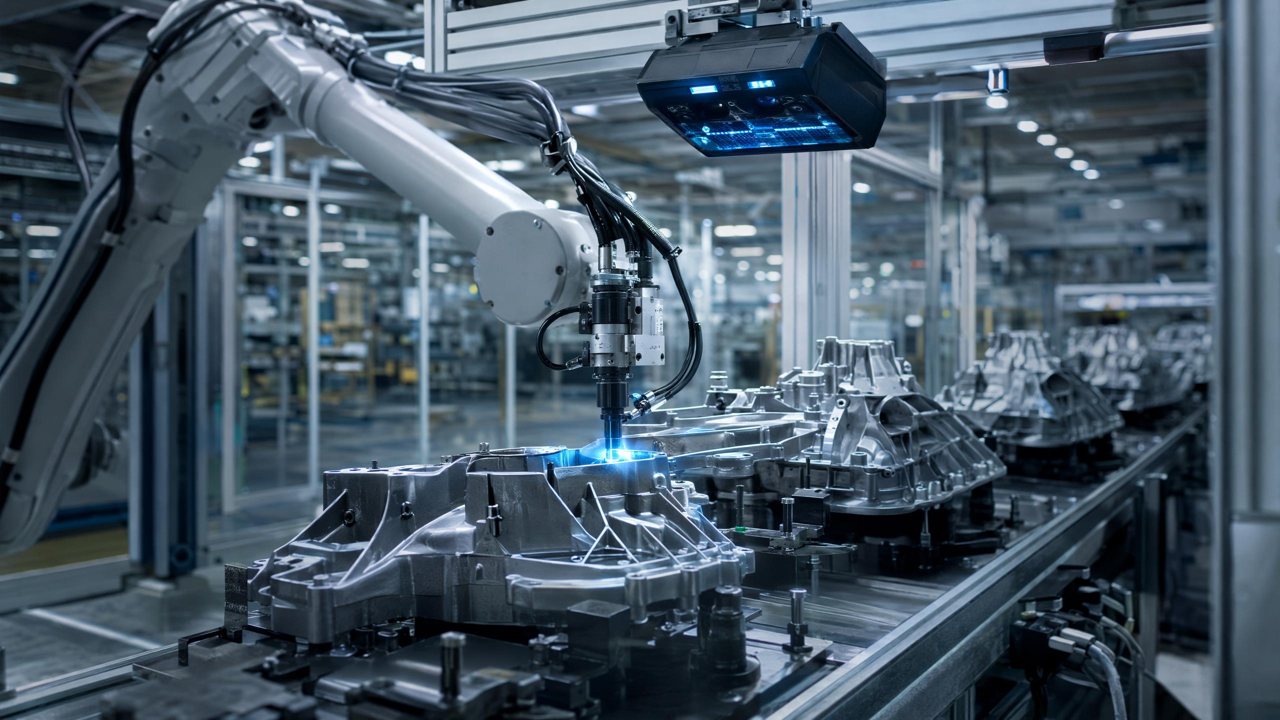
DaoAI 3D Robot Vision (proprietary 3D camera + 6D pose estimation, bin picking, glue dispensing/assembly/loading/unloading guidance, brain-eye-body closed loop, sub-millimeter hand-eye coordination) precisely detects and guides automotive sub-assembly processes, reducing bolt misplacement and missing rates from 1.8% to 0.05%, significantly enhancing assembly quality and efficiency.
DaoAI 3D Robot Vision (proprietary 3D camera + 6D pose estimation, bin picking, glue dispensing/assembly/loading/unloading guidance, brain-eye-body closed loop, sub-millimeter hand-eye coordination) precisely detects and guides automotive sub-assembly processes, reducing bolt misplacement and missing rates from 1.8% to 0.05%, significantly enhancing assembly quality and efficiency. In the automotive and parts manufacturing sector, sub-assembly is a critical stage determining product performance and safety. As vehicle electrification and intelligence accelerate, sub-assembly structures are becoming increasingly complex, component counts are surging, and assembly precision requirements have reached unprecedented levels. Especially on critical component assembly lines such as powertrains and chassis, even minor misassemblies or missing parts can lead to severe quality issues, even safety hazards. Traditionally, quality control for such assemblies heavily relied on manual inspection or simple presence/absence checks based on 2D vision. However, facing complex 3D structures, diverse component models, and high-throughput production demands, traditional methods have shown limitations. A client, a leading Tier-1 supplier specializing in new energy vehicle battery pack sub-assembly manufacturing, faced challenges in the battery module assembly process, including bolt misplacement, missing bolts, stripped threads, and model mix-ups. These issues directly impacted the electrical connection reliability and structural integrity of the battery packs.
Pain Points: Why This Hurdle Was So Difficult
The client's battery pack module assembly faced multi-dimensional and profound pain points: Firstly, **high misassembly and missing part rates**. Before adopting the DaoAI solution, the bolt misplacement and missing rate alone reached 1.8%, far exceeding industry best practices, leading to extensive rework and scrap. Secondly, **inefficient manual re-inspection**. Each potential defect required at least 15 minutes of manual re-inspection time, severely slowing down the production rhythm. Thirdly, **long changeover downtime**. Due to the numerous battery pack models, each changeover required approximately 25 minutes of downtime to readjust detection parameters, impacting production flexibility. Finally, **high compliance risks**. The safety of battery packs directly relates to overall vehicle safety, and any assembly defect could trigger recalls, resulting in significant economic losses and brand reputation damage.
The roots of these difficulties lie in: **Process Complexity**. Battery pack modules have compact internal structures, numerous and densely arranged bolts, and subtle differences in size and head shape between various bolt models. **Imaging Challenges**. Bolt surface materials (e.g., galvanized, stainless steel) exhibit varying reflective properties under different lighting conditions, and bolt holes are often obscured by shadows. Traditional 2D vision struggles to consistently capture clear, complete feature information, making it difficult to accurately distinguish between 'present' and 'absent,' or 'correct' and 'incorrect' bolts. Especially under the philosophy of 'give it an image, get the whole world back,' traditional 2D images often provide only two-dimensional planar information, lacking depth and 3D spatial understanding. This prevents judgment on whether a bolt is correctly tightened, if it's stripped, or if the bolt model matches. Manual inspection, under high-intensity, repetitive work, is prone to fatigue, making it difficult to control the missing detection rate, and lacks real-time feedback on assembly quality.
Technical Principles
The core of the DaoAI 3D Robot Vision solution lies in its proprietary high-precision 3D camera and advanced 6D pose estimation algorithms. We employ structured light or laser triangulation principles, projecting specific encoded patterns or laser lines onto the surface of the object to be measured. High-resolution cameras then capture the deformed patterns or lines, accurately reconstructing the object's 3D point cloud data. Compared to traditional 2D cameras which only provide planar grayscale or color information, our 3D camera obtains X, Y, Z coordinates for each point, thus fully reproducing the bolt's true spatial form, height, diameter, and other geometric features. It operates stably even in complex reflective or shadowed environments. This acquisition of 3D information is the foundation for high-precision misassembly and missing part detection. After obtaining the 3D point cloud data, the critical 6D pose estimation technology comes into play. We train deep learning models on vast amounts of collected 3D point cloud data, enabling them to identify different bolt models and accurately estimate their 3D position (X, Y, Z) and 3D orientation (Rx, Ry, Rz) in space, i.e., 6 degrees of freedom information. This allows the system not only to determine if a bolt is present but also if it is correctly installed, if there is tilt or floating, and even to identify if the bolt model is correct through feature matching. For stripped bolts, the system analyzes the 3D morphology changes of the bolt head before and after tightening, or detects the gap between the bolt head and the mounting surface, to determine if stripping has occurred or if it is not fully tightened.
Compared to traditional rule-based 2D AOI or manual inspection, DaoAI 3D Robot Vision offers significant advantages. Traditional 2D AOI struggles with complex conditions like lighting variations, surface reflections, and shadow occlusion, and cannot acquire depth information. While it can determine the 'presence' or 'absence' of a bolt, it falls short in judging 'correct installation,' 'stripped threads,' or 'correct model.' Manual inspection is limited by human eye fatigue, subjective judgment, and insufficient sensitivity to subtle defects, resulting in high missing detection rates on high-throughput lines and inability to record and trace inspection data. Our 3D vision system provides objective, quantitative 3D data, achieving sub-millimeter hand-eye coordination accuracy. Combined with brain-eye-body closed-loop capabilities, it can guide robots for precise assembly operations in real-time, and upon defect detection, immediately alarm or guide the robot for correction, smoothly integrating detection and execution, greatly enhancing assembly quality and automation.
Typical Application Scenarios
- **Bolt/Nut Misplacement and Missing Detection**: In automotive sub-assembly, such as engines, transmissions, battery packs, numerous bolts of various types are used. DaoAI 3D robot vision can precisely identify the presence of bolts in each hole, whether the bolt model matches the standard, and verify correct height and orientation using 3D point cloud data, preventing structural loosening or poor electrical connections due to misplacement or missing bolts. The difficulty lies in small bolt sizes, dense arrangement, and subtle differences between bolt models.
- **Bolt Tightening Completeness and Stripped Thread Detection**: Whether a bolt is fully tightened directly affects connection strength and sealing. The system can detect gaps between the bolt head and the mounting surface, or analyze 3D morphology for bolt head deformation (stripped threads), ensuring assembly quality. The challenge is that minor differences in tightening torque may result in inconspicuous morphological changes, requiring extremely high 3D detection precision.
- **Connector Insertion Direction and Completeness Detection**: In circuit board or wiring harness connections, incorrect connector insertion direction or incomplete insertion can lead to functional failure. 3D vision can precisely identify the 3D features of connectors and the relative position of insertion ports, guiding robots for accurate insertion and verifying complete insertion. The difficulty lies in complex, small-sized connector structures and potential occlusions.
- **Sealing Strip/Gasket Installation Integrity Detection**: Ensuring correct installation of seals is crucial for preventing fluid leakage. 3D vision can detect the integrity, positional deviation, twisting, or damage of sealing strips, and whether gaskets are properly compressed. The challenge is the low contrast of black rubber materials in vision and the high precision required for deformation detection.
- **Component Assembly Gap and Coplanarity Measurement**: In body panels, interior parts, or battery pack casing assembly, gaps and coplanarity between components directly affect aesthetic quality and structural integrity. 3D vision can precisely measure these geometric parameters, promptly detect assembly deviations, and guide robots for adjustments. The difficulty lies in high-precision measurement of large components and handling complex curved surfaces.
Case Study
A leading Tier-1 supplier of new energy vehicle battery pack sub-assemblies previously faced persistent issues with bolt misplacement, missing bolts, stripped threads, and model mix-ups on its battery module assembly line. Due to the complex structure of battery packs, there were hundreds of bolts of various specifications. Traditional 2D vision systems could not effectively distinguish between different bolt models or determine if bolts were truly tightened, resulting in an average misassembly and missing bolt rate of 1.8%. Manual re-inspection was time-consuming and labor-intensive, requiring at least 2 quality inspectors per shift for continuous patrol and re-evaluation, yet still carrying the risk of missed defects. After implementing the DaoAI 3D Robot Vision solution, multiple proprietary 3D cameras were deployed above the production line, working collaboratively with robotic arms. The system first performed a 3D scan of standard battery pack modules to create a baseline 3D model of the bolts. In actual production, after each module's bolt assembly was completed, the 3D camera performed a high-speed scan, comparing the collected real-time 3D point cloud data with the baseline model. Through our trained deep learning models, the system completed 6D pose estimation, model identification, and tightening completeness judgment for each bolt in milliseconds. Upon detecting misplacement, missing bolts, stripped threads, or model mismatch, the system immediately alerted and located the defect, even guiding the robotic arm for secondary confirmation or correction. After deployment, the bolt misplacement and missing rate on this production line rapidly decreased to 0.05%, achieving nearly zero-defect assembly. Manual re-inspection time dropped from an average of 15 min/occurrence to virtually zero, freeing up quality inspectors for more value-added tasks. Furthermore, thanks to the system's rapid changeover capability, switching between battery pack models now only requires 5 min for model loading and parameter adjustment, significantly improving production flexibility. The client highly recognized these results and plans to extend this solution to other critical sub-assembly lines.
“DaoAI 3D Robot Vision truly delivers on 'give it an image, get the whole world back,' moving beyond simple presence/absence checks to precise 3D perception and control of the entire assembly process.”
DaoAI Solution and Products
The DaoAI 3D Robot Vision solution, with its proprietary 3D camera as the hardware foundation, supplemented by powerful 6D pose estimation algorithms and a 'brain-eye-body closed-loop' control system, provides end-to-end intelligent error-proofing capabilities for automotive sub-assembly. During implementation, we first establish precise 3D digital twin models for the client's different battery pack modules through a one-time high-precision scan. This includes all bolt hole positions, bolt models, and their correct installed 3D morphology. When deployed on the production line, our 3D cameras are smoothly integrated with the client's existing robotic arms, enabling data exchange and command control through standard interfaces (e.g., TCP/IP, Ethernet/IP). For changeovers between different battery pack models, operators simply select the corresponding preset model in our software interface, and the system completes model loading and automatic adjustment of detection parameters within 5 min, without complex programming. Our DaoAI World World Model serves as a unified foundation, enabling semantic understanding, cross-scenario generalization, and continuous learning from production line feedback to optimize detection strategies, ensuring high accuracy and robustness even with new models or complex conditions. Furthermore, the solution supports 100% local private deployment, with all data processed within the client's factory, ensuring data security and privacy.
Through the DaoAI 3D Robot Vision system, the client achieved a significant reduction in bolt misplacement and missing rates, fundamentally improving the assembly quality and reliability of battery packs. This not only reduced extensive rework and scrap, lowering production costs, but also avoided potential recall risks, strongly safeguarding product safety and brand reputation. Concurrently, automated inspection replaced high-intensity manual re-inspection, optimizing human resource allocation and enhancing overall production efficiency and automation levels. The system's high precision and rapid changeover capability also provide solid technical support for the client to expand into more product models and flexible production in the future.
FAQ
How does DaoAI 3D Robot Vision handle complex surface reflections on automotive parts?
Our proprietary 3D camera utilizes advanced structured light or laser triangulation technology. By actively projecting encoded patterns or laser lines and combining specific image processing algorithms, it effectively separates diffuse and specular reflections. This enables stable acquisition of high-quality 3D point cloud data even on complex reflective surfaces, preventing misjudgments or missed detections caused by reflections in traditional 2D vision.
What level of accuracy can this system achieve when detecting bolt tightening completeness?
DaoAI 3D Robot Vision, combining a high-precision 3D camera and sub-millimeter hand-eye coordination, can achieve a measurement accuracy of 0.1mm for the gap between the bolt head and the mounting surface when detecting bolt tightening completeness. This is sufficient to identify subtle height differences caused by incompletely tightened or stripped bolts, ensuring assembly quality.
How specifically is DaoAI's 'brain-eye-body closed-loop' capability manifested in automotive sub-assembly?
The 'brain-eye-body closed-loop' means our AI vision system (eye) perceives assembly status in real-time. Deep learning algorithms (brain) make decisions and identify defects, immediately feeding instructions back to the robotic arm (body) for precise assembly guidance or correction. For example, if the system detects a misaligned bolt, it instantly calculates the correct 6D pose and guides the robotic arm to adjust the bolt's position, achieving a smooth closed loop of detection, judgment, and execution, greatly enhancing the precision and efficiency of automated assembly.
This article was generated by AI. Customer cases are simulated scenarios based on real product capabilities and figures are illustrative; see product pages for official benchmarks.