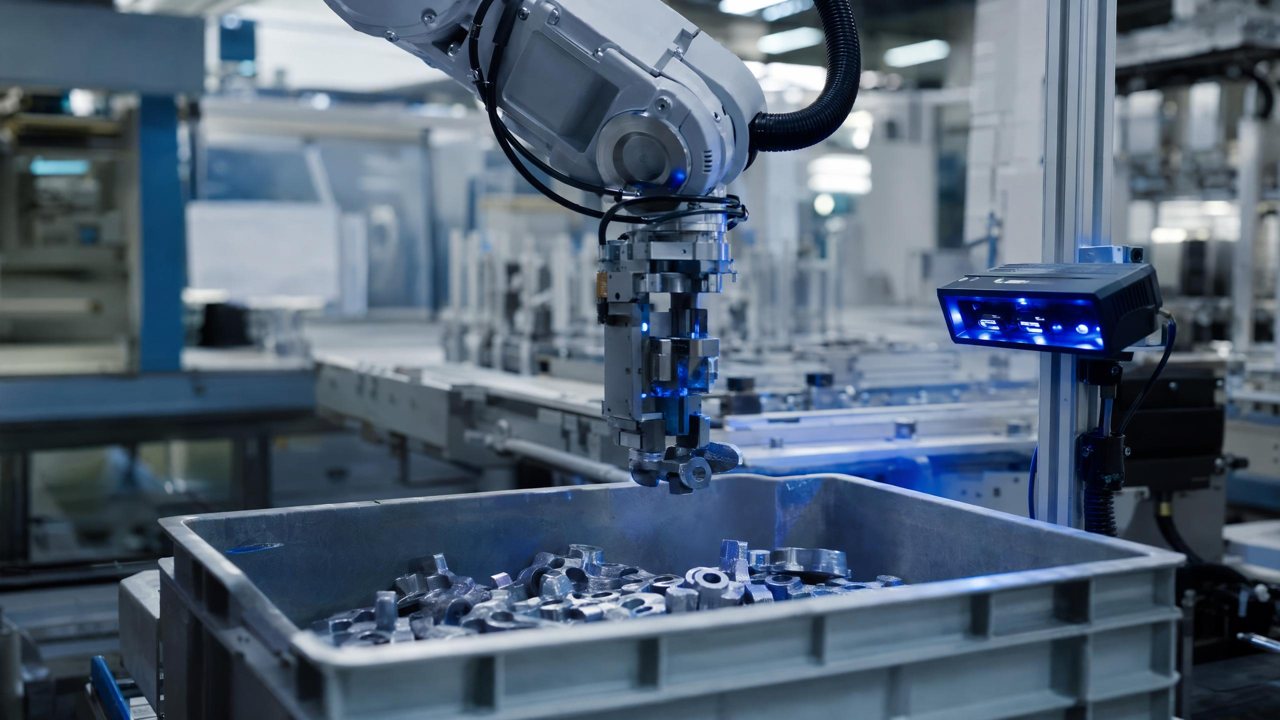
In the automotive parts production industry, grasping parts from unordered bins has always been a difficult problem. DaoAI 3D robot vision from WeLinkirt provides an effective solution to this problem with its advanced technology.
In the context of the rapid development of the manufacturing industry today, the trend of embodied intelligence is becoming more and more obvious. Devices such as lidar lawn mowing robots have put forward higher requirements for 3D grasping and guiding functions. In the automotive parts production industry, the 6D pose problem of grasping parts from unordered bins has also become an urgent problem to be solved. On the production line of a leading automotive parts supplier, various parts of automobile engines are mainly produced. In the feeding process of parts, the parts are placed randomly in the bins, and they need to be accurately grasped and placed at the specified processing positions. These engine parts with different shapes and random arrangements pose a huge challenge to traditional grasping methods.
Pain Points: Why Is It Difficult?
Traditional grasping methods have many problems. From the efficiency dimension, manual grasping is inefficient, with only about 60 grasps per hour. This is because manual operation takes a lot of time to identify the position and posture of parts, and the position and angle of the hand need to be continuously adjusted during the grasping process, resulting in a slow operation speed. From the cost dimension, high labor cost is a significant problem. With the continuous rise of labor costs, enterprises need to pay high wages to hire workers for parts grasping, which undoubtedly increases the production cost of enterprises. From the accuracy dimension, manual operation is prone to missed and incorrect grasps. The missed grasp rate reaches about 5%, and the incorrect grasp rate is about 3%. This is because manual workers are prone to fatigue after long-term work, and it is difficult to concentrate. For some parts with complex shapes and irregular arrangements, it is difficult for manual workers to accurately judge their positions and postures, resulting in missed and incorrect grasps.
The root cause of the difficulty lies in the random arrangement and shape diversity of parts. The random arrangement makes the parts block each other, increasing the difficulty of identification. The shape diversity requires operators to have higher skills and experience to accurately judge the position and posture of parts. In addition, manual operation is also affected by environmental factors such as light and noise, which will further reduce the efficiency and accuracy of manual grasping.
Technical Principle
DaoAI 3D robot vision uses a self-developed 3D camera for imaging. The camera uses the structured light principle. By projecting a specific structured light pattern onto the object surface, the camera captures the deformation of the reflected pattern. Since different shapes and positions of objects reflect and deform the structured light pattern differently, according to the triangulation principle, the three-dimensional coordinates of each point on the object surface can be calculated, thus realizing the three-dimensional morphology reconstruction of parts. Compared with traditional imaging methods, this structured light imaging method can obtain three-dimensional information of objects more accurately. Even in the case of dim light or reflective object surfaces, it can also form clear images.
In terms of 6D pose estimation, a deep learning algorithm is used to analyze the reconstructed three-dimensional point cloud data. Through training with a large number of labeled samples, the model can learn the features and spatial pose information of different parts, thus accurately predicting the 6D pose of parts. Traditional pose estimation methods often rely on manually designed features and rules. For parts with complex shapes and random arrangements, it is difficult to accurately estimate their poses. The deep learning algorithm has a strong learning ability and can automatically extract features from data, thus more accurately estimating the pose of parts. For grasping parts from unordered bins, the system will plan the best grasping path according to the 6D pose information. Considering the mutual occlusion and spatial layout of parts in the bin, the algorithm will avoid obstacles to ensure that the robotic arm can accurately and stably grasp the target parts. In the process of gluing, assembly, and feeding guidance, the system will monitor the position and posture of the robotic arm in real-time and compare it with the target position. Through the brain-eye - body closed-loop control, the motion trajectory of the robotic arm is continuously adjusted to achieve sub-millimeter - level hand-eye coordination and ensure high-precision operation.
Typical Application Scenarios
- Gluing process: In the gluing process, it is necessary to accurately control the gluing position and thickness. DaoAI 3D robot vision can precisely guide the robotic arm for gluing operation by monitoring the position and posture of parts in real-time. The difficulty lies in the fluidity of glue and the unevenness of the part surface, which requires the system to be able to adjust the gluing parameters in real-time.
- Assembly process: In the assembly process, different parts need to be accurately assembled together. DaoAI 3D robot vision can identify the 6D pose of parts and guide the robotic arm for precise assembly. The difficulty lies in the high requirement for the matching accuracy between parts, which requires the system to ensure the accuracy of assembly.
- Feeding and unloading process: In the feeding and unloading process, parts need to be grasped from the bin and placed at the specified position. DaoAI 3D robot vision can quickly and accurately identify the position and posture of parts and plan the best grasping path. The difficulty lies in the random arrangement and mutual occlusion of parts in the bin, which requires the system to be able to effectively avoid obstacles.
- Defect detection process: In the production process, it is necessary to detect defects in parts. DaoAI 3D robot vision can detect surface scratches, cracks and other defects by analyzing the three-dimensional morphology of parts. The difficulty lies in the unobvious features of defects, which requires the system to have high detection accuracy.
Implementation Case
A large-scale automotive parts supplier with a large production scale needs to process a large number of automobile engine parts every day. Before introducing DaoAI 3D robot vision from WeLinkirt, the traditional manual grasping method was used, which was inefficient, costly, and had serious missed and incorrect grasps. During the implementation process, the technical team of WeLinkirt first conducted a detailed on - site investigation and analysis to determine the best installation position and parameter settings. Then, the self-developed 3D camera was installed in a suitable position to scan and image the parts in the bin in real-time. Next, the 6D pose estimation algorithm was used to process the imaging data to obtain the accurate pose information of parts, and this information was transmitted to the robotic arm control system to plan the best grasping path. Before the implementation, the manual grasping efficiency was about 60 times per hour, the missed grasp rate was about 5%, and the incorrect grasp rate was about 3%. After the implementation, the grasping efficiency was greatly improved to about 180 times per hour, the missed grasp rate was reduced to <0.5%, and the incorrect grasp rate was reduced to <1%.
The application of DaoAI 3D robot vision makes the grasping of automotive parts in unordered bins efficient and accurate.
WeLinkirt's Solution and Product
Centered on DaoAI 3D robot vision, this product has high-precision 6D pose estimation ability and can accurately identify the position and posture of parts in unordered bins. In terms of implementation, first, the self-developed 3D camera is installed in a suitable position to scan and image the parts in the bin in real-time. Then, the 6D pose estimation algorithm is used to process the imaging data to obtain the accurate pose information of parts. Next, this information is transmitted to the robotic arm control system to plan the best grasping path. DaoAI 3D robot vision realizes the brain-eye - body closed-loop, making the operation of the robotic arm more precise and efficient.
Quantitative results: After using DaoAI 3D robot vision, the grasping efficiency is greatly improved, with about 180 grasps per hour, which is 3 times the manual grasping efficiency. The missed grasp rate is reduced to <0.5%, and the incorrect grasp rate is reduced to <1%, greatly improving the accuracy and stability of production. At the same time, due to the realization of automated operation, labor costs are reduced, and the production rhythm is effectively controlled.
FAQ
Which automotive parts can DaoAI 3D robot vision be applied to for grasping?
DaoAI 3D robot vision can be used for grasping various automotive engine parts with different shapes, such as pistons and connecting rods placed randomly in bins. It can accurately identify the position and posture of these parts through high-precision 6D pose estimation and complete the grasping operation.
What level of accuracy can this product achieve?
During the process of grasping parts from unordered bins, through the brain-eye - body closed-loop control, DaoAI 3D robot vision can achieve sub-millimeter - level hand-eye coordination. This ensures the high-precision operation of the robotic arm, effectively reducing the missed and incorrect grasp rates and improving the accuracy and stability of production.
What cost changes can be brought by using this product?
After using DaoAI 3D robot vision, the grasping efficiency can be greatly improved, and manual operation can be reduced, thus reducing labor costs. At the same time, the reduction of the missed and incorrect grasp rates reduces the additional costs caused by errors and effectively controls the production rhythm.
This article was generated by AI. Customer cases are simulated scenarios based on real product capabilities and figures are illustrative; see product pages for official benchmarks.