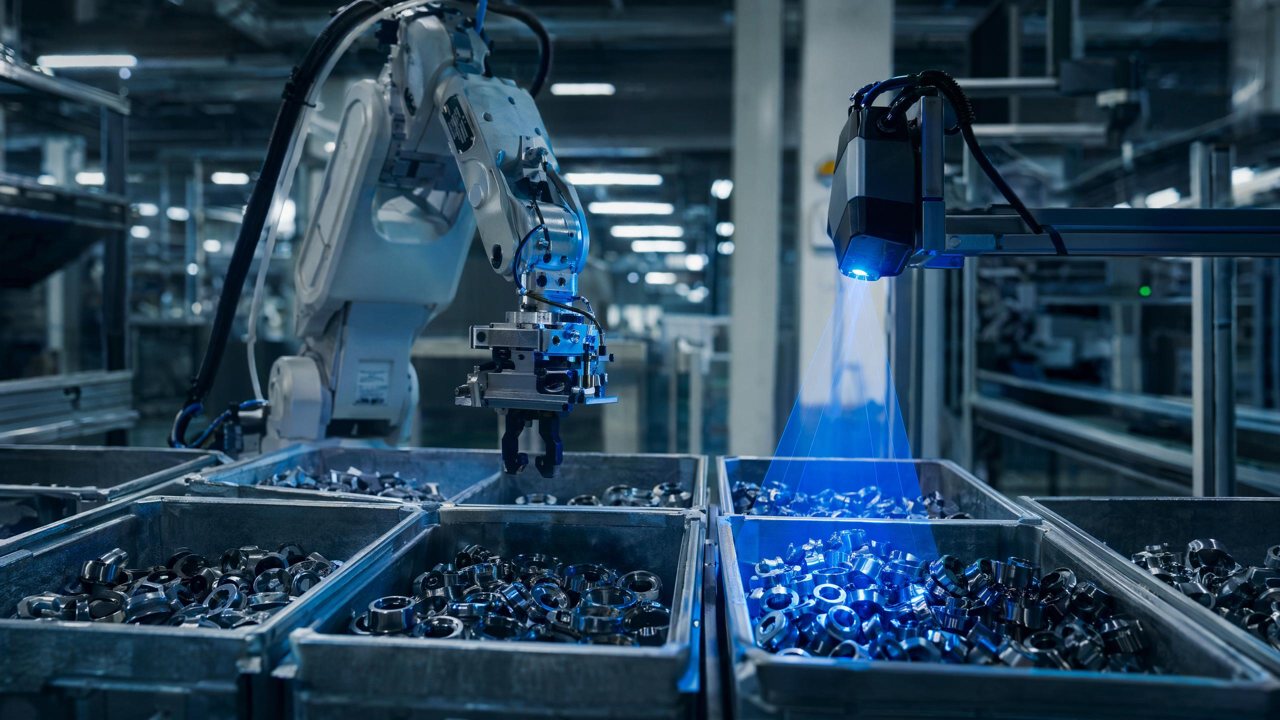
With the open-source of embodied intelligence-specific video models, robot vision technology has ushered in new development opportunities. WeLinkirt's DaoAI 3D robot vision plays an important role in the unordered bin picking scenario of the automotive parts industry, bringing significant changes to the industry.
In the current booming environment of the automotive manufacturing industry, the production and supply of automotive parts are of crucial importance. A leading automotive parts supplier faces the task of picking and loading various automotive parts of different shapes and sizes in the feeding process of its production line. These parts are placed randomly in bins, and the detection objects include various key parts such as engine blocks and transmission gears. The diversity and complexity of automotive parts, as well as their random placement, pose great challenges to traditional picking and detection technologies. Traditional technologies have difficulty in accurately identifying and picking these parts, resulting in low production efficiency and increased labor costs.
Pain Points: Why It's Difficult
From a quantitative perspective, traditional vision systems have many problems in unordered bin picking. The miss-detection rate is as high as 5%, which means that 5 out of every 100 parts may be missed. Frequent manual re-inspections are required, greatly increasing labor costs. The false-alarm rate reaches 10%, which causes the robot to perform unnecessary picking actions, affecting the production rhythm and reducing production efficiency. Moreover, when replacing different types of parts, the change-over time is as long as 30 minutes, seriously affecting the flexibility and response speed of the production line.
The root causes of these problems are that automotive parts have different shapes and sizes, and they are randomly placed in bins, which may block each other. Traditional vision systems have difficulty in obtaining complete information about the parts. At the same time, traditional systems lack effective feature extraction and generalization capabilities, and cannot accurately identify parts in different perspectives and postures. In addition, the algorithms and hardware mechanisms of traditional systems are not advanced enough to quickly adapt to the change-over requirements of different types of parts.
Technical Principle
DaoAI 3D robot vision uses a self-developed 3D camera for imaging. The camera uses the structured light principle to project a specific light pattern onto the object surface and then obtains the three-dimensional information of the object based on the deformation of the reflected light. This imaging method can provide basic data for subsequent processing and accurately present the three-dimensional morphology of the object. In terms of 6D pose estimation, a deep-learning algorithm is used to train a large number of part samples. The deep-learning model has strong feature extraction and generalization capabilities, which can learn the features of parts in different perspectives and postures, and accurately identify the 6D pose of parts in an unordered state, providing accurate position and posture information for subsequent picking operations.
Compared with traditional methods, traditional vision systems can usually only obtain two-dimensional information and have difficulty in handling the three-dimensional features and complex postures of parts. The combination of structured light imaging and deep-learning algorithm in DaoAI 3D robot vision can effectively solve these problems. Structured light imaging provides accurate three-dimensional information, and the deep-learning algorithm can efficiently process and analyze this information, greatly improving the accuracy of detection and picking. In addition, the system also uses the brain-eye - body closed-loop technology, where the vision system and the robot control system cooperate closely to achieve efficient picking operations. At the same time, sub-millimeter hand-eye coordination ensures the high precision of robot picking and reduces errors.
Typical Application Scenarios
- Engine block picking: Engine blocks are large in volume and complex in shape. When randomly placed in bins, they are easy to block each other. DaoAI 3D robot vision obtains the three-dimensional information of the engine block through a 3D camera and uses a deep-learning algorithm to accurately identify its 6D pose, guiding the robot to pick. The difficulty lies in the large variation of the surface texture and shape of the engine block, which requires the algorithm to have strong generalization ability.
- Transmission gear picking: Transmission gears are small in size and have many fine tooth structures. Traditional vision systems have difficulty in accurately identifying these tooth structures and the posture of the gears. The structured light imaging of DaoAI 3D robot vision can clearly obtain the three-dimensional morphology of the gears, and the deep-learning algorithm can accurately estimate their 6D pose for accurate picking. The difficulty lies in the detailed detection of tooth structures and the accurate identification of small sizes.
- Glue - coating process guidance: In the glue-coating process of automotive parts, it is necessary to accurately control the position and thickness of the glue. DaoAI 3D robot vision can determine the exact position and posture of the parts through 6D pose estimation and guide the glue-coating equipment to perform accurate glue-coating. The difficulty lies in the dynamic changes during the glue-coating process and the high requirements for glue-coating accuracy.
- Assembly process guidance: In the assembly process of parts, different parts need to be accurately assembled together. DaoAI 3D robot vision can detect the position and posture of parts in real-time and provide accurate assembly guidance for the robot. The difficulty lies in the matching accuracy between multiple parts and the dynamic adjustment during the assembly process.
- Loading and unloading process: In the loading and unloading process of the production line, parts need to be picked and placed quickly and accurately. DaoAI 3D robot vision can quickly identify the position and posture of parts in the bin and guide the robot to perform efficient loading and unloading operations. The difficulty lies in the high-frequency operation and the requirements for the speed of robot movement.
Implementation Case
A large-scale automotive parts supplier has a large production scale, and its production line has extremely high requirements for the efficiency of part picking and loading. Before introducing WeLinkirt's DaoAI 3D robot vision, the supplier faced the above-mentioned problems such as high miss-detection rate, high false-alarm rate, and long change-over time. During the implementation process, WeLinkirt's technical team first conducted a detailed investigation and analysis of the production line to determine the installation position and parameter settings of the system. Then, the self-developed 3D camera was used to scan and model the parts in the bin, and the deep-learning algorithm was used for the training of 6D pose estimation. After a period of debugging and optimization, the system was officially put into operation.
The application of DaoAI 3D robot vision has brought significant improvements to the production of the automotive parts industry and effectively solved the problem of unordered bin picking.
WeLinkirt's Solution and Products
Centered on DaoAI 3D robot vision, this solution has the capabilities of unordered bin picking, 6D pose estimation, glue-coating/assembly/loading and unloading guidance, etc. During the implementation process, the self-developed 3D camera is first used to scan the parts in the bin to quickly obtain their 3D information. Then, the deep-learning algorithm is used for 6D pose estimation to determine the exact position and posture of the parts. Next, through the brain-eye - body closed-loop technology, the vision information is transmitted to the robot control system to guide the robotic arm to perform accurate picking and loading operations. At the same time, the supporting DaoAI AI AOI software system can perform quality inspection on the picked parts to ensure product quality.
Quantitative results: After using DaoAI 3D robot vision, the detection rate of parts has increased to 99.2%, and the miss-detection rate has decreased to <0.8%, greatly reducing the workload of manual re-inspections. The false-alarm rate has decreased by -60%, effectively improving the production rhythm. The change-over time has been shortened from the original 30 minutes to 5 minutes, significantly improving the flexibility and response speed of the production line.
FAQ
What pain points in the automotive parts industry can WeLinkirt's DaoAI 3D robot vision solve?
WeLinkirt's DaoAI 3D robot vision can solve the problem of unordered bin picking in the automotive parts industry. The original miss-detection rate was 5% and the false-alarm rate was 10%. After using it, the detection rate reaches 99.2%, the false-alarm rate is reduced by 60%, and the change-over time is shortened from 30 minutes to 5 minutes, effectively improving production efficiency and production line flexibility.
What is the technical principle of DaoAI 3D robot vision?
DaoAI 3D robot vision uses a self-developed 3D camera for imaging and obtains the three-dimensional information of the object using the structured light principle. The 6D pose estimation uses a deep-learning algorithm to train a large number of samples. Combined with the brain-eye - body closed-loop and sub-millimeter hand-eye coordination, it ensures operations and improves the accuracy of detection and picking.
What is WeLinkirt's solution for the unordered bin picking of automotive parts?
Centered on DaoAI 3D robot vision, it uses a self-developed 3D camera to scan and obtain 3D information, performs 6D pose estimation through a deep-learning algorithm, guides the robotic arm to pick through the brain-eye - body closed-loop, and uses a supporting software system for quality inspection.
This article was generated by AI. Customer cases are simulated scenarios based on real product capabilities and figures are illustrative; see product pages for official benchmarks.