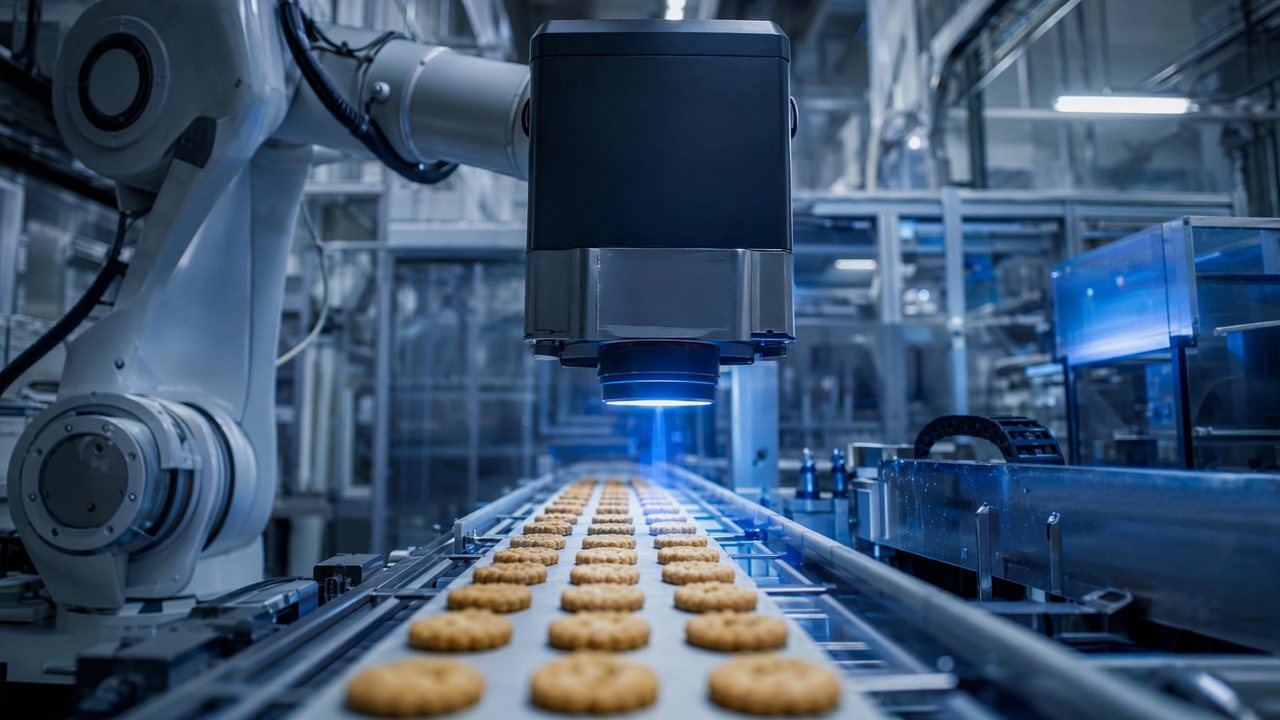
WeLinkirt's DaoAI 3D robot vision plays a crucial role in the foreign object removal and quality grading processes in the food industry with its unique technological advantages, bringing significant benefits to enterprises.
In the food and agriculture industries, ensuring product quality and safety is the cornerstone of enterprise development. Foreign object removal and quality grading, as crucial links in these industries, directly affect the market competitiveness of products and the health of consumers. Take the production line of a leading food manufacturer as an example. Its main products are various types of bagged snacks. Before the snack packaging process, a comprehensive inspection of the products is required. The inspection objects include not only foreign objects in the food, such as metal fragments and plastic particles, but also the quality of the products, such as appearance integrity and size specifications. Only by ensuring that the products entering the packaging process meet strict quality standards can consumers purchase with confidence.
Pain Points: Why It's Difficult
Traditional detection methods have many problems. From the efficiency dimension, manual inspection is extremely inefficient. According to statistics, the missed detection rate of manual inspection is about 5%, and the false alarm rate reaches 10%. This means that for every 100 products, there may be 5 defective products that are missed, and 10 normal products are misjudged as unqualified. This not only increases the unqualified rate of products but also leads to a large waste of labor costs. Take the production line of this food manufacturer as an example. A large number of bagged snacks are produced every day. Manual inspection requires a large amount of manpower and time, and long-term work is likely to cause employee fatigue, further increasing the probability of missed detection and false alarms.
From the perspective of product change-over, with the continuous change of market demand, product change-over has become more and more frequent. Traditional detection equipment has a long change-over time, which takes more than 30 minutes. During this more than 30-minute change-over time, the production line is in a stagnant state, seriously affecting production efficiency. For enterprises, time is cost. A long change-over time will lead to a significant increase in the production cost of enterprises and reduce their market competitiveness.
In terms of technical capabilities, traditional detection methods lack the learning ability of robot vision and embodied intelligence. They cannot improve their detection ability by learning a large number of human work records and can only detect according to preset fixed rules. When encountering new types of foreign objects or changes in product characteristics, it is difficult to accurately identify and judge, resulting in a great discount in the accuracy and reliability of the detection results. This is also one of the fundamental reasons why traditional detection methods are difficult to meet the rapid development needs of the modern food industry.
Technical Principle
DaoAI 3D robot vision uses a self-developed 3D camera for imaging. This 3D camera has powerful functions and can obtain the three-dimensional morphology information of objects. By combining the 6D pose estimation algorithm, the position and pose of objects can be accurately determined. It's like giving the robot a pair of “sharp eyes” to enable it to more accurately understand the specific situation of objects in space. For the foreign object removal function, it uses the feature recognition ability of the visual basic model. By learning a large number of foreign object samples, it can identify the characteristics of foreign objects in food. During the learning process, the model will continuously analyze the shape, color, material and other characteristics of foreign objects, so as to quickly and accurately identify foreign objects in actual detection.
In terms of quality grading, through the three-dimensional morphology reconstruction technology, the appearance and size of products are accurately measured. This technology can reconstruct the three-dimensional information of products to form an accurate digital model, so as to accurately judge whether products meet the quality standards. This technology is effective because the 3D camera provides more information. Compared with traditional 2D imaging, it can see the three-dimensional structure and details of objects, and can more accurately identify foreign objects and judge product quality. For example, for some products with minor surface defects, 2D imaging may not be able to detect them clearly, but 3D imaging can easily capture these details. The 6D pose estimation provides accurate positioning for the robot's operation, enabling the robot to accurately grasp and process the target objects.
Typical Application Scenarios
- Detection of foreign objects in bagged snacks: During the production process of bagged snacks, it is necessary to detect foreign objects such as metal fragments and plastic particles in the food. The difficulty lies in that foreign objects may be covered by snacks and are not easy to be found. DaoAI 3D robot vision obtains the three-dimensional information of snacks through the 3D camera and combines the learning of foreign object characteristics by the visual basic model to penetrate the cover of snacks and accurately identify foreign objects.
- Detection of the appearance integrity of snacks: Detect whether the appearance of snacks is damaged or deformed. The difficulty is that the appearance of different types of snacks varies greatly, and traditional detection methods are difficult to adapt. DaoAI 3D robot vision uses the three-dimensional morphology reconstruction technology to accurately measure and analyze the appearance of each snack and can quickly judge whether the appearance of snacks is complete.
- Size specification detection: Ensure that the size of snacks meets the production standards. Since there may be size deviations during the production process of snacks, traditional detection methods may have errors. DaoAI 3D robot vision uses the 3D camera to obtain the three-dimensional size information of snacks and can accurately judge whether the size of snacks is within the specified range.
- Detection of packaging sealing: Detect whether the snack packaging is well-sealed to prevent air, moisture, etc. from entering and causing snack deterioration. The difficulty is that the sealing situation of packaging is relatively complex, and traditional detection methods are difficult to accurately judge. DaoAI 3D robot vision can detect whether there are gaps or defects at the sealing edge of the packaging by analyzing the three-dimensional morphology of the packaging to ensure the sealing of the packaging.
Implementation Case
There is a large-scale food production enterprise with a large-scale production line that needs to process a large number of bagged snacks every day. Before introducing the DaoAI 3D robot vision system, the enterprise used the traditional manual inspection method and faced problems such as low efficiency, high missed detection rate, high false alarm rate and long change-over time. During the implementation process, the professional technical team of WeLinkirt conducted a detailed investigation and analysis of the enterprise's production line and carried out customized configuration of the system according to the actual needs of the enterprise. It is deployed through SDK/API/Docker, supports 100% local privatization, and ensures that the data does not leave the factory. At the same time, it combines the DaoAI AI AOI software system for positive sample/small-sample learning, enabling the system to quickly adapt to the enterprise's production environment and product characteristics.
The introduction of the DaoAI 3D robot vision system has brought significant benefits to the enterprise, achieving a double leap in production efficiency and product quality.
After the implementation, the effect is remarkable. The foreign object detection rate has increased from less than 90% to 98%, the missed detection rate has been reduced to <2%, and the false alarm rate has been reduced by -70%. The product change-over time has been shortened from more than 30 minutes to 5 minutes, greatly improving production efficiency. At the same time, due to the improvement of detection accuracy, the product quality has been effectively improved, reducing rework and customer complaints caused by quality problems.
WeLinkirt's Solution and Product
WeLinkirt builds a brain-eye - body closed-loop system with DaoAI 3D robot vision as the core. The self-developed 3D camera serves as the “eye” to obtain the three-dimensional information of products in real-time, providing accurate data support for subsequent analysis and judgment. The 6D pose estimation algorithm and the visual basic model serve as the “brain” to conduct in - depth analysis and judgment on the obtained information, identify foreign objects and judge product quality. The robot serves as the “body” to perform foreign object removal and quality grading operations according to the instructions of the “brain”, realizing an efficient closed-loop from data acquisition to decision-making and execution.
In actual implementation, the system can be flexibly deployed through SDK/API/Docker, supports 100% local privatization, and ensures that the data does not leave the factory, meeting the data security and privacy requirements of different enterprises. At the same time, it can be combined with the DaoAI AI AOI software system for positive sample/small-sample learning to further improve detection efficiency and accuracy. In this way, WeLinkirt's solution can quickly adapt to the production environment and product characteristics of different enterprises, providing a reliable guarantee for foreign object removal and quality grading in the food industry.
Quantitative Results
After adopting DaoAI 3D robot vision, the enterprise has achieved significant quantitative results in many aspects. The foreign object detection rate has reached 98%, and the missed detection rate has been reduced to <2%. This means that the enterprise can more accurately find foreign objects in products, greatly improving product safety. The false alarm rate has been reduced by -70%, reducing unnecessary waste and cost increase caused by misjudgment. The product change-over time has been shortened to 5 minutes. Compared with more than 30 minutes of the traditional method, the production efficiency has been greatly improved. In addition, due to the improvement of detection accuracy, the product quality has been effectively guaranteed, reducing rework and customer complaints caused by quality problems, establishing a good brand image for the enterprise and improving its market competitiveness.
FAQ
What types of foreign objects can DaoAI 3D robot vision detect?
DaoAI 3D robot vision can detect various foreign objects such as metal fragments and plastic particles. It learns the characteristics of a large number of foreign object samples through the visual basic model and has strong recognition ability. Even if foreign objects are partially covered by food or have irregular shapes, they can be accurately identified through three-dimensional information and feature learning.
Does the DaoAI 3D robot vision system need to be reprogrammed when changing products?
No. The system supports rapid product change-over, and the change-over time only takes 5 minutes. It can be combined with the DaoAI AI AOI software system for positive sample/small-sample learning, and quickly adjust the detection parameters according to the new product characteristics without reprogramming, greatly improving production flexibility.
Is the deployment method of the DaoAI 3D robot vision system flexible?
Yes, it is flexible. It can be deployed through SDK/API/Docker and supports 100% local privatization to ensure that the data does not leave the factory. Enterprises can choose the most suitable deployment method according to their own network environment, data security requirements, production scale and other factors to meet different application needs.
This article was generated by AI. Customer cases are simulated scenarios based on real product capabilities and figures are illustrative; see product pages for official benchmarks.