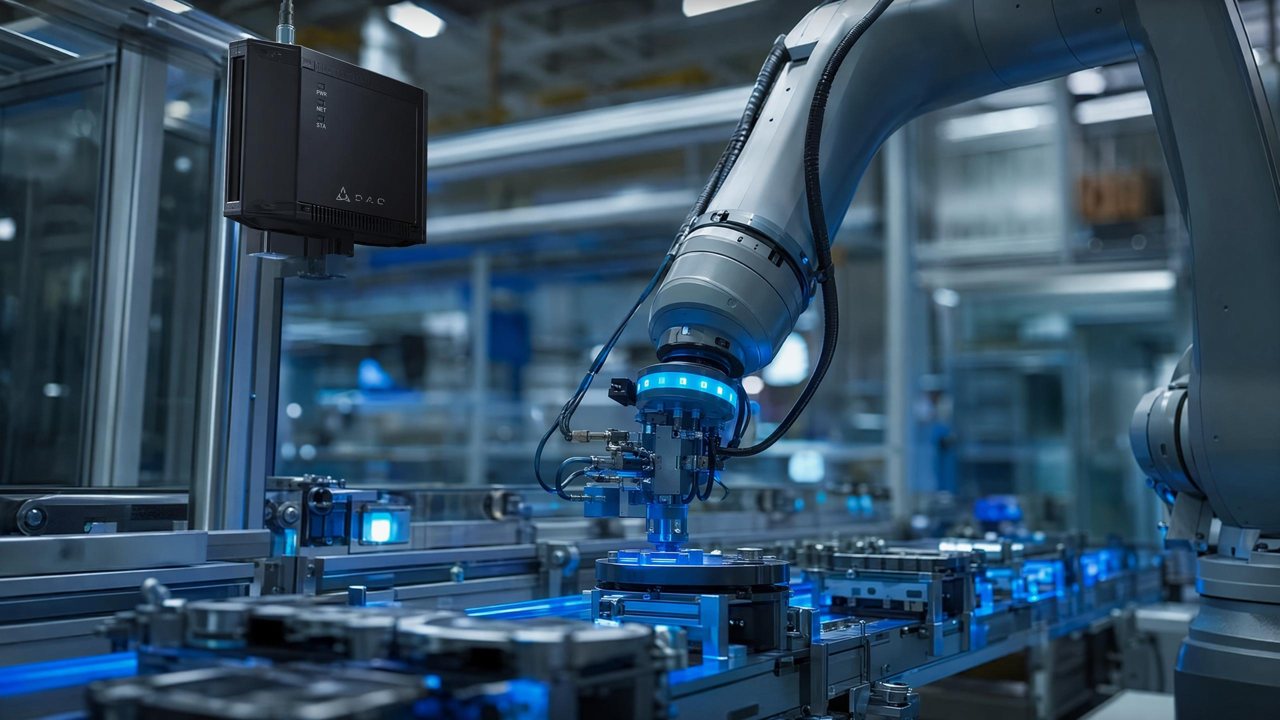
WeLinkirt's DaoAI 3D robot vision technology brings new changes to the assembly process of the consumer goods and general industries with its advanced algorithms and imaging capabilities, effectively solving the problems of missing parts and misassembly.
In today's consumer goods and general industries, the assembly process is a crucial part of the production flow. The assembly lines of many leading consumer goods manufacturers are responsible for producing various small household appliances. The assembly process of these products is complex, requiring multiple components to be precisely assembled onto the product body. The detection objects include small parts such as screws, capacitors, and chips. Ensuring that there are no missing parts or misassembly during the assembly process is of great importance for the quality and performance of the products. With the continuous change and upgrade of market demand, the market potential of automatic charging robot solutions for household and public scenarios is huge, which also puts forward higher requirements for the production accuracy and quality of consumer goods.
Pain Points: Why is it Difficult?
Currently, there are many pain points in the assembly process of this manufacturer. From a quantitative perspective, the efficiency of manual inspection is extremely low, with a missed detection rate as high as 4%. This means that for every 100 products produced, there may be 4 products with missing parts or misassembly that are not detected. The false alarm rate is 7%, which not only wastes a lot of manpower and time to investigate false alarms but also affects the normal operation of the production line. Moreover, the model change time for manual inspection is as long as 30 minutes. When the production line needs to switch to producing different models of products, the long model change time seriously affects production efficiency.
The root cause of these difficult - to - solve problems lies in the limitations of manual inspection. On the one hand, manual inspection relies on human vision and attention, and long-term work can easily lead to fatigue, resulting in an increase in missed detections and false alarms. On the other hand, for some tiny components such as screws and chips, it is difficult for manual inspection to ensure high-precision detection results. In addition, with the continuous increase in product types, manual inspection needs to be retrained and adapt to new detection requirements, which also increases labor costs and model change time.
Technical Principle
DaoAI 3D robot vision uses a self-developed 3D camera for imaging, which is its core hardware. The 3D camera can obtain the three-dimensional topography information of objects. Compared with traditional 2D imaging, it provides richer object features. In the detection of missing parts or misassembly, a 6D pose estimation algorithm is used, which can accurately calculate the spatial position and orientation of each component. By comparing the calculation results with a pre-set standard model, it can accurately determine whether there are missing or misassembled components.
The reason why this method is effective is mainly that it provides more comprehensive information and a more accurate algorithm. The rich three-dimensional information provided by the 3D camera can more comprehensively reflect the object features. Compared with traditional 2D imaging, it can capture more details. The 6D pose estimation algorithm can accurately capture the subtle changes of components, achieving sub-millimeter hand-eye coordination and greatly improving the detection accuracy. Traditional detection methods usually rely only on 2D images, making it difficult to obtain the depth information of objects, and it is difficult to detect some hidden missing parts or subtle misassembly situations.
Typical Application Scenarios
- Screw assembly detection: In small household appliances, screws are common connectors. During detection, the 3D camera obtains the three-dimensional topography of the screws, and the 6D pose estimation algorithm calculates the spatial position and orientation of the screws. The difficulty lies in the small size of the screws, and there may be inconsistent tightening degrees, which requires a high-precision detection algorithm to accurately judge.
- Capacitor installation detection: Capacitors are key components in electronic products. Through 3D imaging and pose estimation, it is detected whether the capacitors are correctly installed in the specified positions. The difficulty lies in the fact that the pins of the capacitors may be bent or have poor soldering, which requires precise identification of these subtle defects.
- Chip assembly detection: The assembly accuracy of chips is extremely high. 3D robot vision can detect the position, orientation, and pin connection of chips. The difficulty lies in the dense and tiny pins of the chips, and it is necessary to avoid false and missed judgments during the detection process.
- Missing component detection: For products composed of multiple components, it is detected whether there are any missing components. By comparing with the standard model, it is judged whether there are any missing components. The difficulty lies in the large differences in the shapes and sizes of different components, and the system needs to be able to adapt to various complex situations.
Implementation Case
An anonymous leading consumer goods manufacturer, with a large scale and multiple assembly lines, faced problems such as low efficiency of manual inspection, high missed detection rate, high false alarm rate, and long model change time before introducing the DaoAI 3D robot vision solution. During the implementation process, the WeLinkirt team first conducted a detailed investigation and analysis of the manufacturer's assembly line to determine the detection objects and standards. Then, the self-developed 3D camera was deployed on the production line, and the system was debugged and optimized to ensure its stable operation. Before implementation, the missed detection rate of manual inspection of this manufacturer was 4%, the false alarm rate was 7%, and the model change time was 30 minutes. After implementation, the missed detection rate was reduced to <0.6%, the false alarm rate was reduced by -63%, and the model change time was shortened to 5 minutes.
The application of DaoAI 3D robot vision technology has brought significant efficiency improvement and cost reduction to the enterprise, making it more competitive in the market.
WeLinkirt's Solution and Products
Centered around DaoAI 3D robot vision, this solution deploys a self-developed 3D camera on the production line to collect 3D images of components in real-time. Through the 6D pose estimation algorithm, the images are analyzed to quickly determine whether there are missing parts or misassembly. When a problem is detected, the system will immediately issue an alarm and correct it in time through the robot. At the same time, the transfer learning technology enables the system to quickly adapt to new product model changes, and the model can be updated with only a small number of samples. The supporting DaoAI World model provides a unified base for cross-scenario generalization and continuous learning, further improving the performance and adaptability of the system.
Quantitative results: After adopting this solution, the missed detection rate was reduced to <0.6%, the false alarm rate was reduced by -63%, and the model change time was shortened to 5 minutes. These significant results not only improve the production line efficiency and product quality but also reduce production costs, making the enterprise more competitive in the market.
FAQ
What types of components can DaoAI 3D robot vision detect?
DaoAI 3D robot vision can detect small parts such as screws, capacitors, and chips. It is suitable for various components in the assembly process of the consumer goods and general industries. Using 3D imaging and 6D pose estimation technology, it can accurately obtain the three-dimensional information and spatial pose of components, thereby achieving precise detection of various components.
What is the role of transfer learning in this solution?
Transfer learning plays a significant role in this solution. It enables the system to quickly adapt to new products and detection tasks using existing models. The model can be updated with only a small number of samples. This greatly shortens the model change time, improves detection efficiency, and makes the system more flexible in meeting the detection needs of different products.
How is the detection accuracy of the system ensured?
The system obtains high-precision three-dimensional topography data through a self-developed 3D camera, which provides a basis for detection. Combined with the 6D pose estimation algorithm, it can achieve sub-millimeter hand-eye coordination and accurately capture the subtle changes of components. Through the combination of these two, the detection accuracy of the system is ensured.
This article was generated by AI. Customer cases are simulated scenarios based on real product capabilities and figures are illustrative; see product pages for official benchmarks.