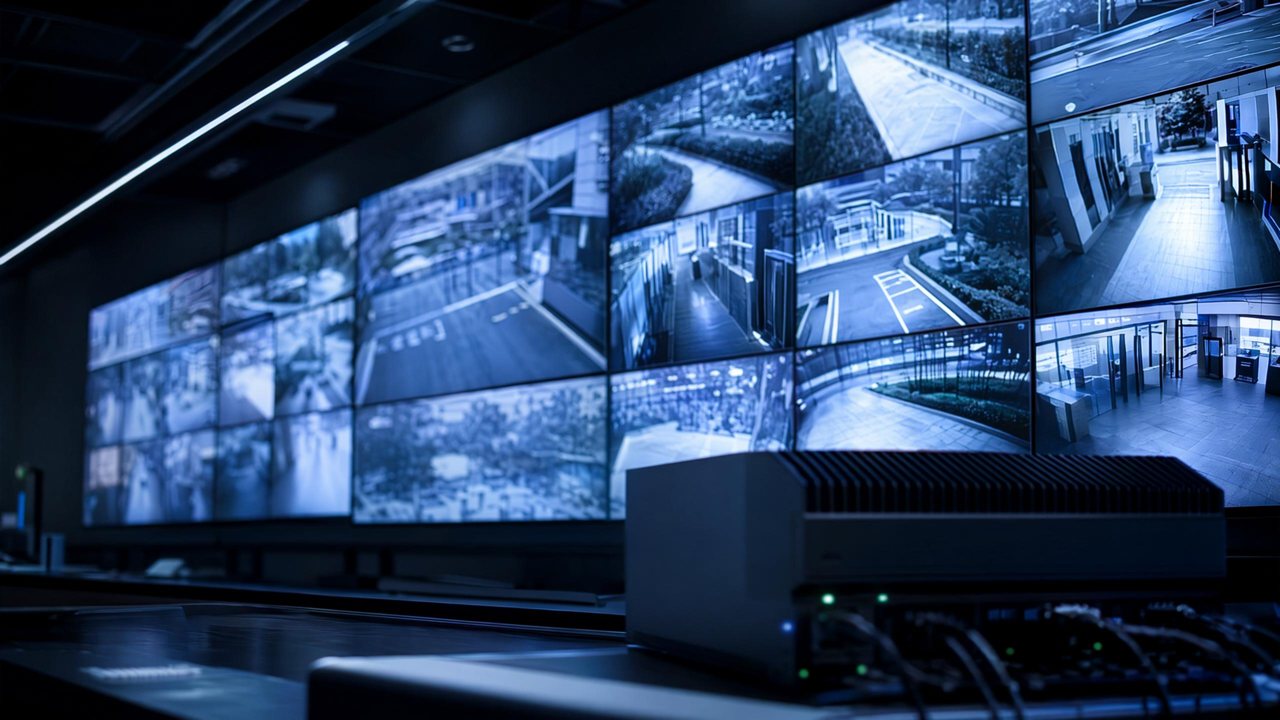
This article focuses on the application of the Tianyan SkyVision platform in passenger flow statistics and heat map analysis of commercial complexes. It elaborates on its technical principles, typical application scenarios, implementation cases, and remarkable quantitative results, providing an efficient solution for business operations.
In today's digital age, AI technology is increasingly widely used in various fields, especially in the field of chip design. Its application expansion has brought new opportunities for the performance improvement of intelligent security video surveillance equipment. For large-scale commercial complexes, real-time statistics of passenger flow in different areas and the generation of heat maps are crucial in daily operations. Through accurate passenger flow data and heat maps, mall operators can reasonably allocate operational resources, such as adjusting the distribution of security personnel and optimizing the time and routes of cleaning services. At the same time, they can also optimize the store layout according to the passenger flow distribution, placing popular stores in more prominent locations to improve the overall operational efficiency and economic benefits of the mall. A large number of video surveillance devices are usually installed at the entrances, passages, and store entrances of the mall, and the detection targets are the people entering, exiting, and moving inside the mall.
Pain Points: Why Is It Difficult?
Traditional methods of passenger flow statistics and heat map generation have many problems. First, in terms of the missed detection rate, due to the limitations of chip performance, the processing capacity of video surveillance devices is seriously insufficient. Generally, the missed detection rate of traditional methods is as high as 15%, which means that a large amount of passenger flow data cannot be accurately counted. For example, during peak hours in the mall, when the crowd is dense, the video surveillance device may miss the entry and exit information of some people due to the inability to process the data in time, resulting in a large deviation between the statistical data and the actual situation. Second, false alarms occur frequently, with a false alarm rate of 20%. This is because traditional algorithms are easily interfered by environmental factors when identifying people, such as changes in light and shadow, object occlusion, etc. As a result, non-human objects may be misjudged as people, or normal human behaviors may be misjudged as abnormal situations, which seriously interferes with operational decisions. In addition, high labor costs are also a prominent problem. Traditional methods require dedicated personnel for data collection and analysis, which not only consumes a lot of manpower but also has low efficiency. For example, the data collection and analysis work that originally required 5 people not only takes a lot of time to view videos and record data but also is prone to errors in manual statistics.
The root causes of these problems lie in the limitations of traditional technologies in terms of chips and algorithms. The insufficient chip performance cannot process a large amount of video data quickly, resulting in data processing delays and omissions. Traditional algorithms lack sufficient intelligence and adaptability and cannot well handle complex mall environments, such as crowded people and changing light conditions, leading to misjudgments and false alarms.
Technical Principles
The Tianyan SkyVision zero-code video surveillance AI platform uses advanced deep-learning algorithms combined with high-performance chip technology. In terms of the chip, it has powerful computing capabilities and can quickly process a large amount of video data. Compared with traditional chips, it has a faster computing speed and can analyze and process images in videos in a short time. At the algorithm level, the convolutional neural network (CNN) is used to identify and track human features in videos. CNN is a neural network specifically designed to process data with a grid structure. It can automatically extract features such as the shape and outline of the human body and convert them into digital feature vectors. Through the analysis and comparison of these feature vectors, accurate population statistics can be achieved.
At the same time, the platform uses a spatio-temporal analysis algorithm to analyze passenger flow data at different time periods and spatial locations to generate accurate heat maps. The spatio-temporal analysis algorithm takes into account both time and space factors and can more accurately reflect the distribution and changes of passenger flow. Compared with traditional methods, it can not only analyze the passenger flow distribution at a certain moment but also predict and analyze the changes in passenger flow at different time periods. The combination of this algorithm and the chip effectively improves the data processing speed and accuracy. The deep-learning algorithm can continuously learn and optimize, adjust according to different scenarios and data, and adapt to the passenger flow statistics needs in different scenarios. The high-performance chip provides powerful computing support to ensure real-time processing of a large amount of video data.
Typical Application Scenarios
- Passenger flow statistics at mall entrances: At mall entrances, due to the frequent and fast movement of people in and out, traditional methods are prone to missed and false detections. The Tianyan SkyVision platform can accurately count the number of people entering and exiting the mall through high-precision human feature recognition and fast data processing capabilities. The difficulty lies in accurately identifying fast-moving people in a short time to avoid missed detections caused by the high speed of people.
- Passenger flow monitoring in passages: The passenger flow in mall passages is complex, and there may be situations such as people crossing and blocking each other. The platform uses the spatio-temporal analysis algorithm combined with the tracking ability of CNN to monitor and analyze the passenger flow in the passages in real-time. The difficulty lies in accurately identifying and tracking the trajectory of each person in the case of mutual occlusion.
- Passenger flow statistics at store entrances: The passenger flow data at store entrances are very important for store operation decisions. The platform accurately counts the number of people entering and leaving the store through video surveillance at store entrances. The difficulty lies in accurately distinguishing target people from non-target people as there may be some non-target people wandering and staying at store entrances.
- Passenger flow analysis in promotional activity areas: When a mall holds a promotional activity, the passenger flow in the activity area will increase significantly, and people's behaviors will be more complex. The platform can analyze the passenger flow in the activity area in real-time, including passenger flow density and stay time. The difficulty lies in accurately analyzing people's behaviors and stay time in the activity area to provide accurate data support for activity effect evaluation.
Implementation Case
A large-scale commercial complex with multiple floors and many stores has a large daily passenger flow. Before introducing the Tianyan SkyVision platform, the mall used traditional methods for passenger flow statistics and heat map generation, facing problems such as high missed detection rates, high false alarm rates, and high labor costs. During the implementation process, the technical team first inspected and debugged the video surveillance devices in the mall to ensure their normal operation. Then, according to the actual situation of the mall, they customized the Tianyan SkyVision platform, including setting detection rules for different areas and training models suitable for the mall scenario. After several hours of on - site training, the model was successfully put into use. Before the implementation, the mall's missed detection rate was 15%, the false alarm rate was 20%, and 5 people were needed for data collection and analysis. After the implementation, the missed detection rate was reduced to <2%, the false alarm rate was reduced by -85%, and only 1 person was needed for data processing, resulting in a labor cost reduction of -80%.
The application of the Tianyan SkyVision platform has brought a qualitative leap to the passenger flow statistics and operational decision-making of commercial complexes.
WeLinkirt's Solution and Product
WeLinkirt's core product, the Tianyan SkyVision zero-code video surveillance AI platform, has the ability to train its own models on - site within hours. This means that mall operators do not need professional programming knowledge and can quickly train models for passenger flow statistics and heat map generation suitable for the mall scenario according to their own needs. The platform supports behavior/event recognition and can accurately identify behaviors such as people entering, exiting, and staying. Through the edge box for real-time alarm, once there is an abnormal passenger flow situation, such as a sudden significant increase or decrease in passenger flow in a certain area, an alarm can be issued in time to remind operators to take corresponding measures. Moreover, the platform realizes 100% local data storage without leaving the site. All passenger flow data are processed and stored locally, avoiding the risk of data leakage and effectively ensuring the security of mall operation data. At the same time, combined with the semantic understanding ability of the DaoAI World model, the platform conducts in - depth analysis of passenger flow data to挖掘 potential operational information and provide more valuable decision-making support for mall operations.
Quantitative Results: By using the Tianyan SkyVision platform, the missed detection rate is reduced to <2%, greatly improving the accuracy of passenger flow data. The false alarm rate is reduced by -85%, reducing the interference with operational decisions. At the same time, labor costs are saved. The data collection and analysis work that originally required 5 people now only needs 1 person, resulting in a labor cost reduction of -80%.
FAQ
How long does it take for the Tianyan SkyVision platform to train a model?
The Tianyan SkyVision platform has the ability to train its own models on - site within hours without the need for professional programming knowledge. Mall operators can quickly train suitable models for passenger flow statistics and heat maps according to their needs, usually within a few hours, which can efficiently meet the actual needs of mall operations.
How does the platform ensure data security?
The platform realizes 100% local data storage without leaving the site. All passenger flow data are processed and stored locally, avoiding the risk of data leakage during data transmission. It effectively ensures the security and privacy of mall operation data, allowing mall operators to have no worries.
How much can the accuracy of passenger flow statistics be improved after using the platform?
After using the Tianyan SkyVision platform, the missed detection rate can be reduced to <2%, and the false alarm rate can be reduced by -85%, greatly improving the accuracy of passenger flow data. This enables mall operators to make scientific and reasonable operational decisions based on more accurate data.
This article was generated by AI. Customer cases are simulated scenarios based on real product capabilities and figures are illustrative; see product pages for official benchmarks.