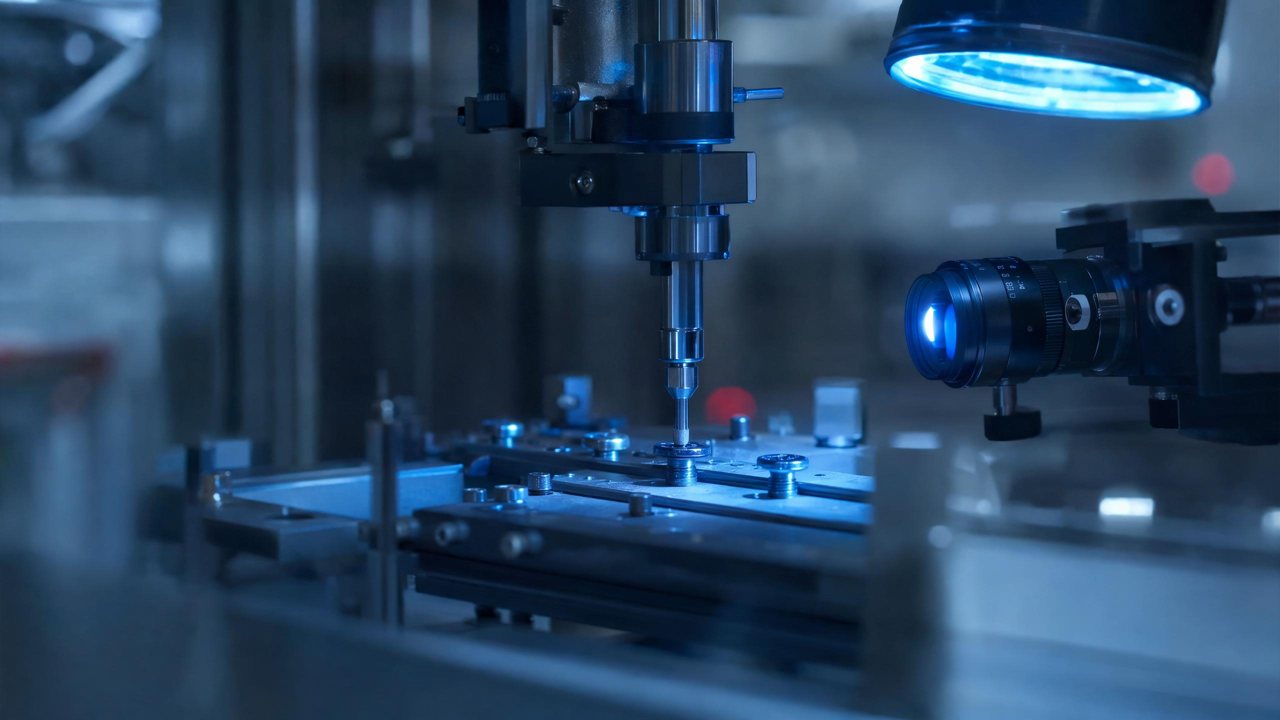
In industrial production, the inspection of the screw-tightening process is of great importance. WeLinkirt's SkyVision platform brings an efficient and accurate detection solution to this process with advanced technology, solving many pain points of traditional detection methods.
In the field of industrial manufacturing, the screw-tightening process is a crucial link in many production processes. From large-scale mechanical equipment to small-scale electronic devices, the tightening state of screws directly affects the quality and stability of products. In the assembly line of a leading industrial manufacturer, a key process is screw-tightening, and the products are large-scale mechanical equipment. In this process, the inspection object is the tightening state of screws, including whether the torque meets the standard, whether the screw appearance is damaged, and whether the installation is correct. This belongs to the typical industrial SOP (Standard Operating Procedure) / operation specification category. Accurate inspection can ensure that products meet quality standards and avoid equipment failures and safety hazards caused by screw problems.
Pain Points: Why It's Difficult
In previous inspections, there were many quantitative difficulties. Firstly, the false-negative rate was about 3%, which means that for every 100 products produced, there might be 3 products with screw-tightening problems that were not detected. These undetected screw problems may cause failures during product use, increasing after-sales maintenance costs and customer complaints. Secondly, the false-positive rate was relatively high, about 15%. A large number of false-positive messages would increase the workload of operators, as they need to spend extra time to verify these false alarms, reducing work efficiency. Moreover, due to the lack of a native unified technology, the accuracy of behavior recognition was greatly reduced. Traditional detection methods often rely on manual experience and simple sensors, making it difficult to accurately judge the tightening behavior and state of screws, resulting in low detection efficiency. In addition, the labor cost was also high because a large amount of manpower was required for detection and re-inspection work. When the product model was changed, it took a lot of time to reset the detection parameters, which would affect the production progress and reduce production efficiency.
The root cause of these problems lies in the limitations of traditional detection methods. Traditional methods lack advanced technical support and cannot accurately identify the complex states of screws. At the same time, different detection links may use different technologies and equipment, lacking unified standards and processes, which makes it difficult to ensure the accuracy and consistency of detection results. Moreover, traditional methods have poor adaptability to product model changes, and manual parameter resetting is required, which is not only time-consuming but also prone to human errors.
Technical Principle
WeLinkirt's SkyVision 0-code video surveillance AI platform uses advanced computer vision algorithms and deep-learning technologies. In terms of imaging, high-definition industrial cameras are used to capture the image and video information of screws. High - definition cameras can provide clear and accurate images, providing a reliable data basis for subsequent analysis and detection. Its hardware principle is based on the edge box, which has powerful real-time processing capabilities. It can quickly process and analyze the data collected by the cameras and issue alarms in a timely manner. Compared with the traditional centralized processing method, the edge box can achieve 100% local data processing without leaving the site, ensuring data security and real-time detection.
In terms of algorithms, semantic understanding is carried out through the DaoAI World model. This model has a unified base and can accurately analyze the semantics of the screw-tightening behavior and state. Compared with traditional algorithms, the DaoAI World model can better understand the screw-tightening process and state, improving the accuracy of behavior recognition. The deep-learning model has been trained with a large amount of data and can achieve on - site self-model training within hours, quickly adapting to different products and detection requirements. This means that when the product model is changed, the platform can quickly adjust the detection model without spending a lot of time resetting parameters, greatly improving production efficiency.
Typical Application Scenarios
- Screw - tightening torque detection: High - definition industrial cameras are used to capture the image and video information during the screw-tightening process. Computer vision algorithms and the DaoAI World model are used to analyze the tightening angle and force of the screw to determine whether the torque meets the standard. The difficulty lies in accurately measuring the tightening angle and force of the screw and the influence of different screw models and materials on the torque.
- Screw appearance damage detection: High - definition cameras are used to take images of the screw appearance. Deep - learning models are used to identify damage such as scratches and cracks on the screw surface. The difficulty lies in distinguishing normal surface defects from real damage and the influence of different lighting conditions on the detection results.
- Screw installation position detection: By analyzing the position and angle of the screw on the product, it is determined whether the screw is installed correctly. The difficulty lies in accurately identifying the position and angle of the screw and the differences in installation requirements for different products.
- Screw missing detection: Image recognition technology is used to determine whether there are missing screws on the product. The difficulty lies in accurately identifying the presence or absence of screws in a complex production environment.
Implementation Case
A large-scale industrial manufacturing enterprise has multiple assembly lines and produces a large number of large-scale mechanical equipment every day. Before introducing WeLinkirt's SkyVision platform, the screw-tightening process inspection of this enterprise had problems such as high false-negative rate, high false-positive rate, and low detection efficiency. The false-negative rate was about 3%, the false-positive rate was about 15%, and it took several hours to reset the detection parameters when the product model was changed. During the implementation process, the WeLinkirt team conducted a detailed investigation and analysis of the enterprise's production process and customized the platform according to the enterprise's actual needs. After a period of debugging and optimization, the platform was officially put into operation.
The SkyVision platform makes the screw-tightening inspection in industry more accurate and efficient, significantly improving production quality and efficiency.
WeLinkirt's Solution and Products
Centered on the SkyVision 0-code video surveillance AI platform, this platform has the ability to train self-models on - site within hours. Without complex programming, operators can quickly train models according to different product requirements. For the double inspection of screw-tightening torque and vision, the platform can accurately identify the screw-tightening behavior and state. At the same time, combined with the real-time alarm function of the edge box, once it is detected that the screw-tightening does not meet the specifications, an alarm will be issued immediately. In addition, the semantic understanding ability of the DaoAI World model further improves the detection accuracy. In terms of supporting facilities, it can be assisted by the DaoAI AI AOI software system, using the feature recognition of its visual basic model to improve the detection accuracy of the screw appearance.
Quantitative results: By using the SkyVision platform, the false-negative rate is reduced to <0.6%, and the detection rate reaches 99.4%. The false-positive rate is reduced to -63%, greatly reducing the ineffective workload of operators. The product model change time is shortened from several hours to 5 minutes, improving production efficiency.
FAQ
Can the SkyVision platform adapt to the screw detection of different products?
Yes. The platform has the ability to train self-models on - site within hours without complex programming. Operators can quickly train models according to different product requirements, thus adapting to various screw detection scenarios and greatly improving the flexibility of detection.
How is the data security of the platform guaranteed?
The platform uses the edge box for real-time calculation, achieving 100% local data processing without leaving the site. This not only ensures data security but also guarantees real-time feedback of detection results, so enterprises don't need to worry about data leakage.
How much labor cost can be reduced by using this platform?
By reducing the false-negative and false-positive rates, the platform reduces the workload of manual re-inspection. Although the reduction ratio of labor cost is not accurately calculated, it can significantly improve personnel efficiency, reduce manpower input, and thus lower the enterprise's labor cost.
This article was generated by AI. Customer cases are simulated scenarios based on real product capabilities and figures are illustrative; see product pages for official benchmarks.