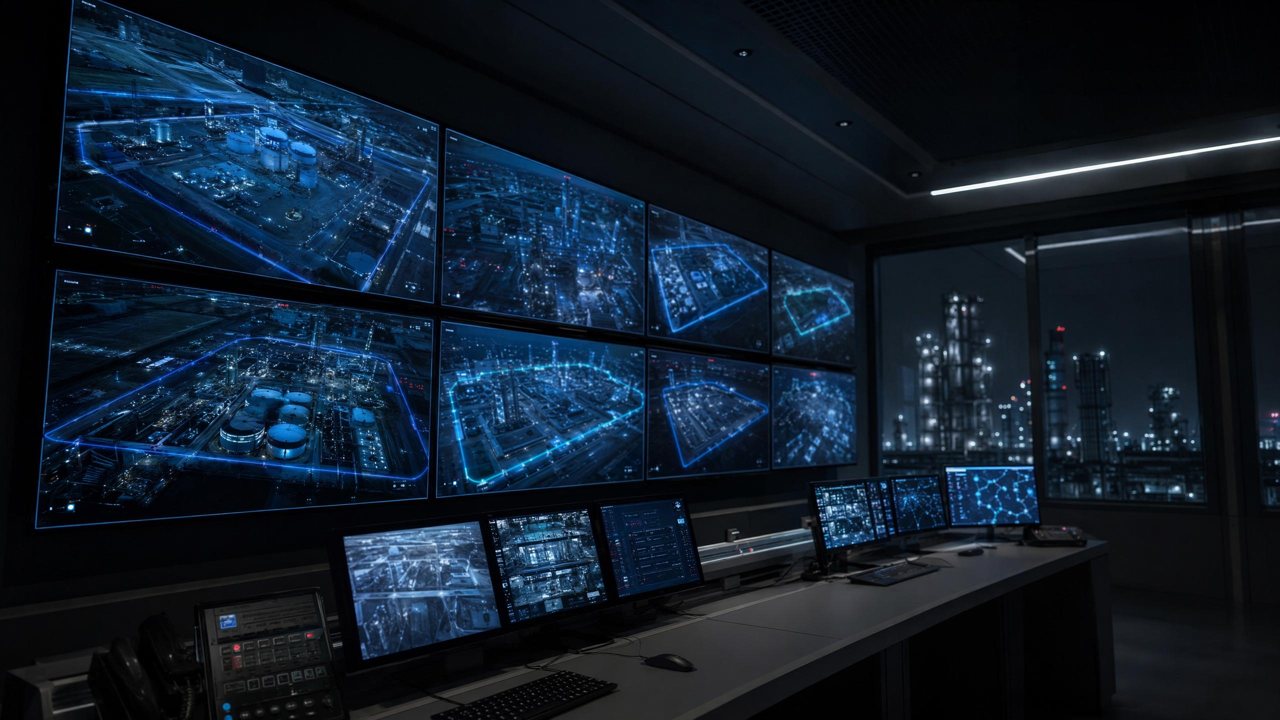
With the wide application of video surveillance in various industries, boundary crossing/ tripwire detection has become a key link in ensuring safety and efficient management. WeLinkirt's Tianyan SkyVision platform brings new breakthroughs to solve this problem with its excellent performance.
In today's digital age, the importance of the video surveillance industry is becoming increasingly prominent. Whether it is urban security monitoring, enterprise park safety management, or traffic flow monitoring, video surveillance plays an indispensable role. Among them, boundary crossing/ tripwire detection, as a key function in video surveillance, is crucial for ensuring the safety and order of specific areas. Take a large industrial park as an example. There is a clear division between the production area and the office area in this park, and there are strict restrictions on personnel entering some dangerous areas. In the daily operation of the park, it is necessary to monitor the personnel and various vehicles in each area in real-time, especially to detect whether there are any boundary-crossing or tripwire-crossing situations of personnel or vehicles. Once a boundary-crossing behavior occurs, it may lead to a series of safety accidents, such as personal injury, equipment damage, and production process interruption. Therefore, timely and accurate detection of boundary-crossing behaviors is the top priority of the park's safety management.
Pain Points: Why Is It Difficult?
Traditional video surveillance methods face many challenges in boundary crossing/ tripwire detection. From the perspective of labor cost, traditional methods mainly rely on manual viewing of surveillance footage. Suppose there are 20 surveillance cameras in the industrial park, and each camera needs a dedicated person to view it in real-time to ensure timely detection of boundary-crossing behaviors. According to the requirement of 24-hour continuous monitoring, with each monitoring staff working 8 hours a day, at least 60 monitoring staff are required. This not only brings high labor costs but also extremely low efficiency.
In terms of detection accuracy, manual monitoring is prone to fatigue and negligence. Statistics show that after 4 hours of continuous work, the attention of monitoring staff will decline significantly, and the missed detection rate will gradually increase. In the actual operation of the park, the missed detection rate of traditional manual monitoring is as high as 15%. That is to say, 15 out of every 100 boundary-crossing behaviors may be missed, which undoubtedly brings great hidden dangers to the park's safety management. At the same time, the false alarm rate reaches 12%. Due to the strong subjectivity of manual judgment and the influence of external factors such as light changes and picture jitter, it is easy to misjudge a situation as a boundary-crossing behavior, resulting in a large number of unnecessary alarms and affecting the monitoring efficiency.
Considering the system flexibility, when the area division or monitoring rules of the park change, it is difficult to adjust the traditional monitoring system. For example, if the park needs to redraw the boundary of a dangerous area or add new tripwire detection rules, resetting the monitoring system requires a lot of time and manpower. Technicians need to adjust the parameters and settings of each camera one by one, and the whole process may take hours or even days to complete, seriously affecting the normal operation of the park. The root cause is that the traditional monitoring system lacks an intelligent adjustment mechanism and cannot quickly adapt to changing monitoring requirements.
Technical Principle
WeLinkirt's Tianyan SkyVision zero-code video surveillance AI platform uses advanced deep learning algorithms and computer vision technology. In terms of image recognition, it uses Convolutional Neural Networks (CNNs) to extract and analyze features from each frame of the surveillance video. CNNs are neural networks designed specifically for processing data with grid-like structures (such as images). Through structures like convolutional layers, pooling layers, and fully connected layers, they can automatically extract key features from images. For example, in the recognition of people and vehicles, the model can accurately identify the contours, postures of people and the shapes, colors of vehicles through learning a large number of samples. Compared with traditional image recognition methods, which usually require manual design of feature extraction algorithms, CNNs can automatically learn the most representative features, greatly improving the recognition accuracy.
For boundary crossing/ tripwire detection, the platform presets boundaries and tripwires in the surveillance footage and uses coordinate positioning technology to determine in real-time whether the positions of people or vehicles exceed the set range. Coordinate positioning technology can accurately determine the positions of people and vehicles by analyzing the position information of pixels in the image. Once a boundary-crossing or tripwire-crossing behavior is detected, the system will immediately issue an alarm. The reason why this technical principle is effective is that deep learning algorithms can continuously learn and optimize. As the surveillance data accumulates, the model can automatically adjust its parameters to adapt to the monitoring requirements in different scenarios and can process a large amount of video data quickly and accurately. In contrast, traditional boundary-crossing detection methods can only make fixed-rule judgments for specific scenarios and cannot adapt to changes in scenarios.
Typical Application Scenarios
- Park entrance and exit detection: Set up tripwires at the entrances and exits of the park to detect whether people and vehicles enter or exit normally. The difficulty lies in the large flow of people and vehicles at the entrances and exits, which may lead to congestion and cross-situations. The algorithm needs to accurately distinguish normal entry/exit and boundary-crossing behaviors. The CNN is used to identify the features of people and vehicles in real-time, and coordinate positioning is combined to determine whether the tripwire is crossed.
- Dangerous area boundary-crossing detection: Set boundaries for dangerous areas in the park, such as high-voltage distribution rooms and chemical storage areas, to detect boundary-crossing behaviors. The difficulty is that there may be complex environmental factors in these areas, such as dim light and obstacles, which affect the accuracy of image recognition. The platform optimizes the CNN model to improve the recognition ability under low-light and occluded conditions.
- Personnel activity detection in the production area: Detect whether personnel enter non-working areas in the production area. The difficulty is that there are many pieces of equipment in the production area and the personnel activities are complex. It is necessary to accurately identify the behaviors and positions of personnel. Coordinate positioning technology is used to track the positions of personnel in real-time, and the behavior recognition function is combined to determine whether there is a boundary-crossing situation.
- Parking lot vehicle parking detection: Set up parking space boundaries and driving lane tripwires in the parking lot to detect whether vehicles are parked and driven according to regulations. The difficulty is that the parking angles and postures of vehicles may vary, and the algorithm needs to accurately identify the contours and positions of vehicles. By learning a large number of vehicle samples, the recognition accuracy of the CNN model for vehicles is improved.
Implementation Case
A large comprehensive industrial park with thousands of employees, a large number of production equipment and vehicles, and frequent daily personnel and vehicle movements. Before introducing WeLinkirt's Tianyan SkyVision platform, the park used the traditional manual monitoring method. Before going live, the missed detection rate was as high as 15%, the false alarm rate reached 12%, and when the monitoring rules needed to be adjusted, the model-changing time required several hours. During the implementation process, the technical team of WeLinkirt first conducted a detailed investigation and analysis of the park's monitoring needs. According to the actual situation of the park, they trained the model and set the parameters on the Tianyan SkyVision platform. After on - site training within hours, a suitable boundary crossing/ tripwire detection model was successfully customized for the park. At the same time, edge boxes were installed to achieve real-time alarm function, and the platform was ensured to support 100% local data storage without leaving the park, which guaranteed the security of the park's data. After going live, the missed detection rate decreased from 15% to <0.6%, the false alarm rate decreased from 12% to -95%, and the model-changing time was shortened from several hours to 5 minutes.
WeLinkirt's Tianyan SkyVision platform has brought a qualitative leap to the safety management of the park and effectively solved the pain points of traditional monitoring methods.
WeLinkirt's Solution and Products
WeLinkirt takes the Tianyan SkyVision zero-code video surveillance AI platform as the core to provide a comprehensive solution for boundary crossing/ tripwire detection. The platform has the ability to train its own model on - site within hours and can train a suitable boundary crossing/ tripwire detection model according to the actual needs of the park in a short time. Through the behavior/event recognition function, it can accurately identify the boundary-crossing behaviors of people and vehicles. For example, the platform can distinguish whether a person is walking normally or deliberately crossing the boundary, and whether a vehicle is driving normally or illegally crossing the tripwire. At the same time, it is paired with edge boxes to achieve real-time alarms. Once an abnormal situation is detected, an alarm is immediately issued to ensure that park management personnel can handle it in time. In addition, the platform supports 100% local data storage without leaving the park. All data is processed and stored locally, effectively protecting the security of the park's data and preventing data leakage. The DaoAI World model also provides semantic understanding function, further enhancing the intelligent analysis ability of the platform, enabling it to better understand the monitoring scenarios and behaviors and provide more accurate detection results. When the monitoring rules of the park need to be adjusted, zero-code operation can be carried out on the platform to quickly complete the model-changing settings, greatly improving the system's flexibility and response speed.
Quantitative Results: After using the Tianyan SkyVision platform, the missed detection rate decreased from 15% to <0.6%, greatly improving the detection accuracy. This means that almost all boundary-crossing behaviors in the park can be detected, effectively ensuring the safety of the park. The false alarm rate decreased from 12% to -95%, effectively reducing unnecessary interference and allowing park management personnel to focus more on real safety issues. At the same time, the model-changing time was shortened from several hours to 5 minutes, improving the system's flexibility and response speed, enabling the park to quickly adapt to changes in monitoring rules and improving management efficiency.
FAQ
How long does it take for the Tianyan SkyVision platform to train a suitable model?
The Tianyan SkyVision platform has the ability to train its own model on - site within hours. It can train a suitable model for scenarios such as boundary crossing/ tripwire detection according to actual needs in a short time. This is due to the advanced deep-learning algorithms used by the platform, which can quickly learn a large number of data samples to customize an efficient model for specific scenarios.
How does the platform ensure data security?
The platform supports 100% local data storage without leaving the site. All data is processed and stored locally. This means that the data will not be transmitted externally, effectively avoiding the risk of data leakage and providing reliable security for the data in application scenarios such as industrial parks.
Can the platform be quickly adjusted when the monitoring rules change?
Yes. The platform supports zero-code operation. When the monitoring rules change, the model-changing settings can be quickly completed on the platform without complex programming. The model-changing time can be shortened from several hours to 5 minutes, greatly improving the system's response speed and flexibility.
This article was generated by AI. Customer cases are simulated scenarios based on real product capabilities and figures are illustrative; see product pages for official benchmarks.