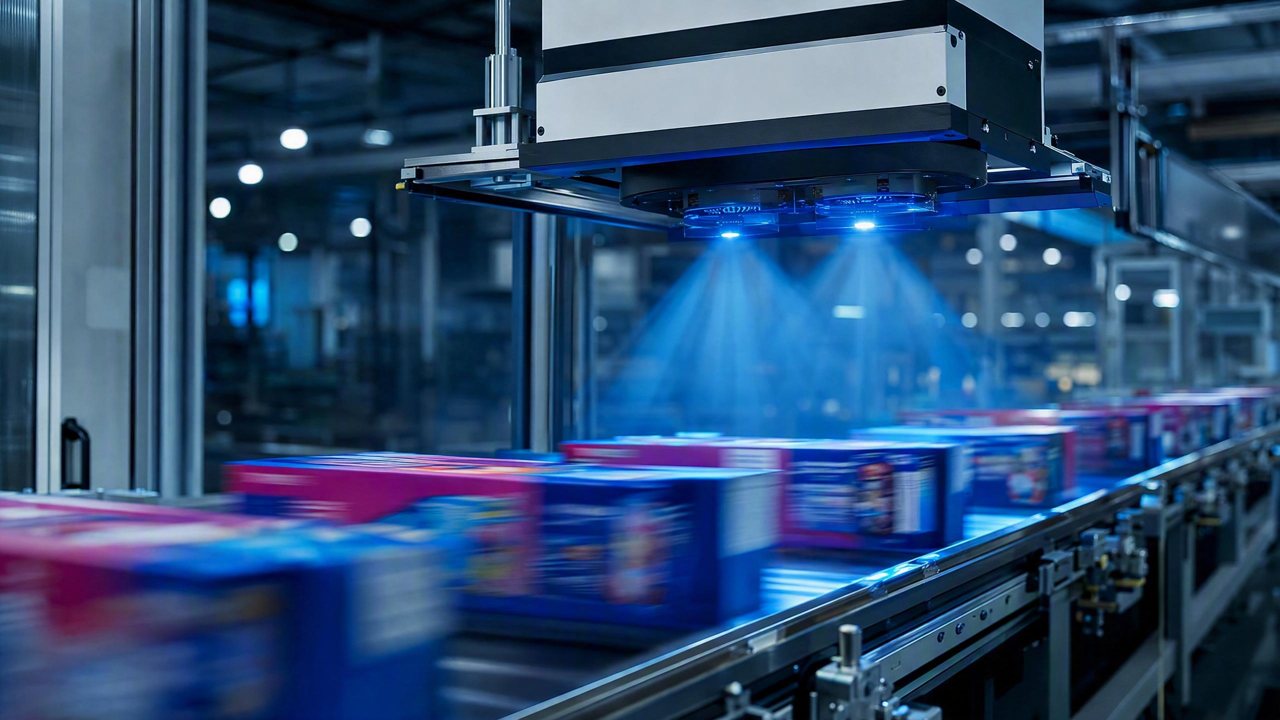
In consumer packaging printing, DaoAI 2D AI AOI equipment, utilizing high-resolution 2D imaging and deep learning for secondary judgment, addresses surface, print, OCR, and assembly defects. It achieves high-speed online full inspection with micron-level precision and semantic false positive filtering. This solution effectively reduces inspection changeover time for high-mix low-volume production from the traditional 2-4 hours of manual intervention to under 5 minutes, successfully resolving the flexible production challenges in high-value consumer packaging printing.
In consumer packaging printing, DaoAI 2D AI AOI equipment (high-resolution 2D imaging + deep learning secondary judgment, for surface/print/OCR/assembly defects, high-speed online full inspection, micron-level, semantic false positive filtering) leverages its zero-code rapid changeover capability to reduce the setup time for high-mix low-volume production from several hours of manual adjustment to under 5 minutes with AI automatic adaptation, significantly enhancing production line flexibility and efficiency. The consumer goods industry demands extremely high aesthetic, functional, and compliance standards for packaging, especially for high-end consumer products, where packaging is not merely an outer layer but a direct representation of brand image and value. Printing quality defects, such as color errors, missing prints, ink bleed, smudges, scratches, blurred characters, or incorrect QR code printing, can directly impact consumer perception of the brand and even lead to recall risks. Against the backdrop of rapidly changing market demands and shortened product lifecycles, many consumer goods manufacturers adopt high-mix low-volume production strategies to meet personalized and customized needs, posing severe challenges to traditional quality inspection systems. Traditional packaging printing inspection primarily relies on manual visual inspection or rule-based AOI systems, which struggle to meet the efficiency and accuracy requirements when faced with frequent product changeovers.
Pain Points: Why This Hurdle Is Difficult to Overcome
In the high-mix low-volume production model, quality inspection of consumer packaging printing faces multiple pain points: First, **long changeover downtime**: Whenever the production line switches product models, traditional rule-based AOI systems require engineers to rewrite or adjust inspection rules, taking at least 2-4 hours, while manual visual inspection requires retraining or adapting to different product inspection standards, leading to excessive production line downtime, severely impacting overall production efficiency. Second, **fluctuating detection accuracy**: Different products, printing patterns, and packaging materials exhibit diverse defect characteristics. Traditional rule-based AOI struggles to adapt to complex and varied defect features, often leading to missed detections (e.g., insufficient ability to identify subtle scratches or color deviations) or false positives (e.g., misinterpreting packaging textures as defects), resulting in high volumes of manual re-inspection and consuming significant human resources. According to industry statistics, traditional AOI often has a false positive rate of 5-15% on complex printed materials, requiring additional manual re-inspection steps. Third, **labor costs and fatigue**: Manual visual inspection is a labor-intensive task; prolonged, high-intensity repetitive inspection easily leads to visual fatigue among employees, increasing the missed detection rate, while labor costs continue to rise. Especially during night shifts or high-load production, quality risks due to human factors significantly increase. Finally, **difficulty in data accumulation and iteration**: Traditional inspection solutions lack efficient defect data accumulation and analysis mechanisms, making it difficult to form an effective quality closed-loop and support continuous optimization of production processes. In the current trend where AI large models are achieving cost reduction and efficiency improvement in display panel manufacturing quality inspection, the consumer packaging printing industry also urgently needs to introduce intelligent and flexible inspection solutions.
The root causes of these difficulties lie in the complexity of packaging printing processes, involving various inks, substrates, and printing methods, which result in highly diverse and uncertain defect characteristics; the extremely short time window for inspection under high-speed production tempos, making it difficult for traditional image processing algorithms to complete complex analysis within milliseconds; and the limitations and subjectivity of the human eye in discerning minute color differences and texture variations, making manual inspection difficult to standardize and ensure consistency. Furthermore, differences in raw materials across batches and suppliers further increase the difficulty of defect detection.
Technical Principles
DaoAI 2D AI AOI equipment fundamentally solves the aforementioned challenges by integrating high-resolution 2D imaging technology with advanced deep learning algorithms. Its core technology lies in leveraging the feature recognition capabilities of visual foundation models to achieve “one good sample, 5 minutes, zero-code automatic programming.” This allows the equipment to handle new product changeovers without manual rule writing or parameter adjustment. Specifically, the equipment first captures micron-level images of the packaging box surface using high-resolution industrial cameras, ensuring that any subtle defect can be clearly presented. Subsequently, these image data are fed into DaoAI's self-developed AI AOI software system. This system incorporates a Transformer-based visual foundation model that learns the normal appearance characteristics of a product from a small number of positive samples (typically only 1-20 good product images) and establishes a high-dimensional feature vector representation. When a new product image is detected, the model compares it with the learned good product features, identifying any abnormal areas that deviate from the normal pattern, i.e., defects.
Compared to traditional rule-based AOI systems (which rely on manually set thresholds, geometric matching, etc.), the advantages of DaoAI 2D AI AOI include: **Adaptability**: Deep learning models can automatically learn complex defect patterns from data without manual intervention, greatly shortening changeover time. **Robustness**: The model is more robust to environmental factors such as lighting changes and minor product placement deviations, reducing false positives. **High Precision**: Through APDT positive/few-shot learning technology, even with only a small number of good samples, high-precision detection of micron-level defects can be achieved. **Semantic False Positive Filtering**: The DaoAI AI AOI software system, combined with semantic understanding capabilities, can distinguish between normal product textures, manufacturing process marks, and true defects, effectively filtering out meaningless false positives, reducing the false positive rate by more than -85%, thereby reducing the burden of manual re-inspection. This deep learning-based detection mechanism can understand image content at a deeper level, thus demonstrating detection capabilities far superior to traditional methods in complex and varied packaging printing scenarios.
Typical Application Scenarios
- **Printed Text and Pattern Defect Detection**: Detects whether text on packaging boxes is blurred, missing, ghosted, misprinted, or if pattern colors are off, misregistered, missing, bleeding, or smudged. DaoAI 2D AI AOI can accurately identify these minute defects on high-speed production lines, ensuring clarity and accuracy of brand information.
- **Surface Scratch and Dent Defect Detection**: Addresses scratches, indentations, abrasions, bubbles, wrinkles, or slight deformations that may occur on the packaging box surface during production and transportation. The equipment uses high-resolution imaging to capture these micron-level surface morphological changes, which are then classified by the deep learning model.
- **Character Recognition (OCR) and Barcode/QR Code Detection**: Performs high-precision recognition and verification of batch numbers, production dates, expiration dates, serial codes, and various barcodes/QR codes on packaging boxes, ensuring information is complete, accurate, and legible. DaoAI equipment can effectively recognize various fonts and characters of different print qualities, and verify barcode quality grades.
- **Film and Coating Defect Detection**: Inspects for bubbles, wrinkles, peeling in the packaging box's laminating film, or unevenness, missing, or overflow in UV coatings. These defects are often sensitive to light reflection, and DaoAI 2D AI AOI uses multi-angle light sources and intelligent algorithms for effective identification.
- **Structural Defects and Assembly Omissions**: Detects the structural integrity of packaging boxes, such as whether adhesion is firm, die-cut edges are neat, or if there is damage or deformation. For packaging with liners or accessories, it can also detect assembly omissions.
Case Study
A leading consumer goods manufacturer, with dozens of sub-brands covering beauty, personal care, food, and other sectors, faced the challenge of rapid market iteration and high-mix low-volume production. Its packaging printing line required several product changeovers daily, sometimes even more than ten. Traditional inspection solutions (manual visual inspection + limited rule-based AOI) incurred significant costs during changeovers; each changeover required engineers to manually adjust rules or reconfigure vision parameters, averaging 2-4 hours, which severely slowed down the overall production tempo. Furthermore, due to the wide variety of products and complex defect patterns, traditional solutions had a high false positive rate, leading to a large number of good products being misclassified, increasing re-inspection labor and resource waste. When seeking a solution, the manufacturer particularly emphasized “zero-code rapid changeover” and “high precision, low false positive” as two core requirements.
After the introduction of DaoAI 2D AI AOI equipment, it was deployed at the quality inspection station after packaging box printing. Through simple hardware integration and software configuration, the equipment only needed 10-20 images of good products for one-time learning to establish a detection model for new products. After deployment, the manufacturer's changeover downtime plummeted from an average of 2.5 hours to <5min, an efficiency improvement of over -96%. At the same time, the DaoAI AI AOI equipment consistently achieved a detection rate of over 99.4% for defects such as print misalignment, ink spots, and scratches during actual operation, while the false positive rate was reduced by -88%, significantly outperforming traditional solutions. This enabled the production line to respond more flexibly to market changes, improving overall production efficiency and product quality. The production manager stated: “The zero-code changeover feature of DaoAI 2D AI AOI has completely transformed our inspection mode for high-mix low-volume production. We no longer have headaches due to frequent changeovers.”
"The zero-code changeover feature of DaoAI 2D AI AOI has completely transformed our inspection mode for high-mix low-volume production. We no longer have headaches due to frequent changeovers."
DaoAI Solutions and Products
DaoAI's core solution for the consumer packaging printing industry centers around its 2D AI AOI equipment, deeply integrating the DaoAI AI AOI software system. This system leverages the feature recognition capabilities of visual foundation models to achieve revolutionary “zero-code automatic programming.” This means customers do not need specialized knowledge in image processing or AI programming; they can simply use a graphical interface to import 1-20 good product images, and the system can automatically learn and establish a detection model for new products within 5 minutes. This APDT (Automatic Program Development Technology) positive/few-shot learning mechanism greatly simplifies the new product introduction and production line changeover processes, which is crucial for addressing high-mix low-volume production models. Furthermore, the semantic false positive filtering function of DaoAI 2D AI AOI, through deep semantic understanding of defect characteristics, can effectively distinguish between normal process textures of the product itself and true defects, reducing the false positive rate by more than -85%, thereby significantly reducing the workload of manual re-inspection and improving detection efficiency.
In terms of deployment, DaoAI 2D AI AOI equipment supports 100% local private deployment, ensuring customer data security and privacy. Its open SDK/API/Docker interfaces also facilitate seamless integration with existing MES/ERP systems, enabling interconnected production data and intelligent decision-making. Through the application of DaoAI 2D AI AOI, enterprises can not only achieve significant improvements in production efficiency but also effectively reduce quality costs and enhance brand competitiveness. For example, in the aforementioned case, changeover downtime was reduced by -96%, saving the enterprise millions in production losses and labor costs annually. At the same time, a detection rate of over 99.4% and extremely low false positive rates ensure the excellent quality of outgoing products, effectively avoiding risks to brand reputation and market recalls due caused by quality issues. DaoAI is committed to providing smarter, more efficient, and more flexible quality inspection solutions for customers across various industries through its leading AI vision technology.
FAQ
How does DaoAI 2D AI AOI equipment achieve zero-code rapid changeover?
The zero-code rapid changeover capability of DaoAI 2D AI AOI equipment primarily stems from its integrated DaoAI AI AOI software system. This system utilizes APDT positive/few-shot learning technology combined with visual foundation models. Users only need to provide 1-20 good product images, and the system can automatically learn product features and generate detection models within minutes, eliminating the need for manual code writing or complex parameter adjustments, greatly simplifying new product introduction and changeover processes.
What are the advantages of DaoAI 2D AI AOI compared to traditional AOI or manual visual inspection?
DaoAI 2D AI AOI offers significant advantages over traditional solutions. It overcomes the recognition limitations of traditional rule-based AOI on complex and varied defects, greatly improving detection rates and reducing false positives through deep learning. Compared to manual visual inspection, AI AOI eliminates instability caused by eye fatigue and subjective judgment, achieving stable and efficient 24/7 detection with micron-level precision, making it key to intelligent production line upgrades.
What is the approximate budget for deploying a DaoAI 2D AI AOI system?
The budget for deploying a DaoAI 2D AI AOI system is influenced by various factors, including production line speed, required detection precision, integration complexity, number of devices needed, and whether customized functions are required. We offer flexible software and hardware combination solutions. To obtain an accurate quote and configuration advice best suited for your production line, we recommend directly contacting our sales team or technical experts. We will provide a detailed solution and quotation based on your specific needs.
This article was generated by AI. Customer cases are simulated scenarios based on real product capabilities and figures are illustrative; see product pages for official benchmarks.