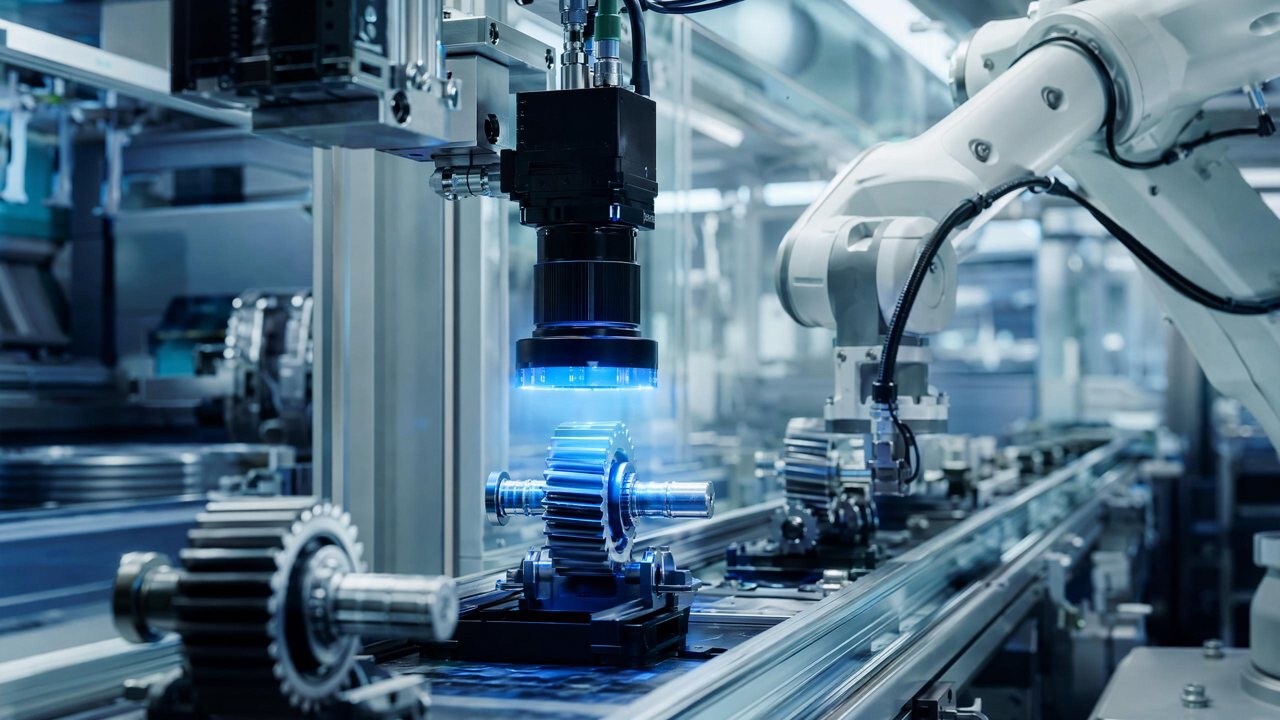
In the field of automotive parts manufacturing, the surface quality of gears and shafts is crucial to the overall performance of vehicles. WeLinkirt's advanced AI vision technology brings an efficient surface defect inspection solution to this industry.
Industry Background and User Scenario: The automotive industry is an important pillar of the global economy, and the quality and efficiency of automotive parts manufacturing directly affect the development of the entire industry. Among automotive parts, gears and shafts are the core components of key parts such as engines and transmissions. Their surface quality is directly related to the power transmission, handling performance, and service life of vehicles. On the gear/shaft production line of a leading automotive parts manufacturer, a large number of automotive gears and shafts of various specifications are produced every day. The surface quality requirements of these products are extremely high, and any minor defect may lead to serious consequences. Therefore, accurately detecting defects such as surface scratches, cracks, sand holes, and dents on the surface of these products has become a crucial link in the production process.
Pain Points: Why is it Difficult?
Traditional manual inspection methods face many challenges in the surface defect inspection of automotive gears and shafts. In terms of efficiency, manual inspection is slow and difficult to meet the needs of large-scale production. Within the production line cycle, it is difficult for manual inspection to ensure 100% full inspection, and the missed-detection rate is about 3%. This is because manual inspection is limited by human visual fatigue and attention span, and the inspection accuracy will decline significantly after long-time work. From the cost perspective, manual inspection requires a large amount of manpower input, resulting in high labor costs. Moreover, once there are missed detections and false alarms, the products need to be reinspected, which further increases the production time and cost. In terms of the false-alarm rate, the traditional manual inspection reaches 15%, which means that a large number of qualified products also need to be additionally inspected, wasting a lot of manpower and time. In terms of changeover flexibility, when the product specifications change, manual inspection requires retraining workers, and the changeover time is as long as 30 minutes. This is because the surface characteristics of different-specification products are different, and workers need to re-learn the inspection standards and methods, which seriously affects the production efficiency.
The root cause of the difficulty of manual inspection lies in human physiological and cognitive limitations. The human visual resolution is limited, and it is difficult to accurately identify micron-level small defects. Moreover, human judgment is easily affected by subjective factors, and different inspectors may make different judgments on the same defect. In addition, the consistency of manual inspection is poor, and it is difficult to ensure the same inspection standard throughout the long-time inspection process.
Technical Principle
WeLinkirt uses advanced AI algorithms and imaging technologies to solve the problems of traditional inspection methods. In terms of algorithms, a deep-learning - based visual basic model is used. This model has a strong feature-recognition ability. By learning a small number of positive samples (1-20 images), the model can quickly understand the characteristics of good products and accurately distinguish between good products and defective products. Different from traditional algorithms that require manual design of features, deep-learning algorithms can automatically extract defect features, avoiding the limitations of manual feature design and improving the accuracy and generalization ability of detection. For example, traditional algorithms may not be able to identify some complex-shaped or hidden-position defects, while deep-learning models can have good recognition ability for various types of defects through learning a large amount of data.
In terms of imaging, WeLinkirt's self-developed 3D camera can obtain the three-dimensional topography information of the surface of gears and shafts, achieving high-precision imaging at the micron level. 3D imaging can more comprehensively reflect the surface characteristics of objects, and can clearly detect defects hidden under the surface, such as sand holes. Traditional 2D imaging can only obtain the planar information of the object surface, and may not be able to accurately identify some concave or convex defects. The 3D camera can process and analyze the obtained three-dimensional data through the three-dimensional topography reconstruction technology, thereby accurately identifying various types of defects. In addition, the semantic false-alarm filtering technology can filter false alarms according to the semantic information of defects, reducing the false-alarm rate.
Typical Application Scenarios
- Surface scratch detection: In the production process of gears and shafts, surface scratches are one of the common defects. WeLinkirt's 3D camera can clearly capture the three-dimensional information of scratches. Through the deep-learning algorithm, the length, width, depth and other characteristics of scratches are analyzed to accurately judge whether the scratches meet the product quality standards. The difficulty lies in that some subtle scratches may be similar to the surface texture of the product, and the algorithm needs to have a high resolution ability.
- Crack detection: Cracks are a serious defect that may cause the product to break during use. WeLinkirt's technology can detect the location and size of cracks through the analysis of 3D images. Since cracks may be hidden under the surface texture or other defects of the product, the detection is quite difficult, and the algorithm needs to accurately identify the characteristics of cracks.
- Sand hole detection: Sand holes are usually formed due to the incomplete discharge of gas during the casting process. The 3D camera can obtain the three-dimensional topography information of sand holes, and through the three-dimensional topography reconstruction technology, the size and depth of sand holes can be clearly displayed. The difficulty lies in that the shapes and sizes of sand holes vary, and the algorithm needs to adapt to different types of sand holes for accurate detection.
- Dent detection: During the handling and processing of products, dents may occur. WeLinkirt can detect the location and degree of dents by comparing the 3D images of good products and defective products. Since the shapes and damage degrees of dents vary greatly, the algorithm needs to have a strong generalization ability during detection.
Implementation Case
A large-scale automotive parts manufacturing enterprise faced problems such as low efficiency, high false-alarm rate, and long changeover time in traditional manual inspection on its gear and shaft product production line. The enterprise produces a large number of gears and shafts of different specifications every day, and manual inspection can no longer meet the production needs. WeLinkirt provided it with an AI vision inspection solution. During the implementation process, WeLinkirt's technical team first conducted a detailed investigation and evaluation of the production line to determine the inspection plan and equipment installation location. Then, the equipment was installed and debugged, and the relevant personnel of the enterprise were trained. Before the implementation, the missed-detection rate of the enterprise's inspection was about 3%, the false-alarm rate reached 15%, and the changeover time was as long as 30 minutes. After the implementation, the detection rate increased to 99.4%, the missed-detection rate decreased to <0.6%, the false-alarm rate decreased by -63%, and the product changeover time was shortened from 30 minutes to 5 minutes.
WeLinkirt's AI vision inspection technology brings an efficient and accurate surface defect inspection solution to automotive parts manufacturing enterprises.
WeLinkirt's Solutions and Products
WeLinkirt provides the DaoAI AI AOI software system and the DaoAI 2D / 3D AI AOI equipment. The DaoAI AI AOI software system has the ability of rapid programming. Zero - code automatic programming can be completed in 5 minutes for one good product, and it supports APDT positive-sample/few-sample learning. Only 1-20 good-product images are needed for model training. The system also has a semantic false-alarm filtering function, which can effectively reduce false alarms. The DaoAI 2D / 3D AI AOI equipment uses a self-developed 3D camera to realize three-dimensional topography reconstruction and can detect hidden solder joints, coplanarity, and micron-level topography. In practical applications, the equipment is installed on the production line to conduct online inspection of gears and shafts. The software system analyzes and processes the collected images and data to determine whether the products have defects in real-time.
Quantitative Results: After using WeLinkirt's solution, the detection rate increased to 99.4%, and the missed-detection rate decreased to <0.6%. The false-alarm rate decreased by -63%, greatly reducing the reinspection volume. At the same time, the product changeover time was shortened from 30 minutes to 5 minutes, significantly improving the production efficiency.
FAQ
What problems can WeLinkirt solve for automotive parts manufacturers?
WeLinkirt provides an efficient surface defect inspection solution for automotive parts manufacturers with advanced AI vision technology. It solves the problems of low efficiency and high cost of traditional manual inspection, reduces missed detections and false alarms, shortens the product changeover time, and improves the overall production efficiency.
What is the technical principle of WeLinkirt?
WeLinkirt uses a deep-learning - based visual basic model combined with a self-developed 3D camera. The model distinguishes good products from defective products by learning a small number of positive samples. The 3D camera obtains the three-dimensional topography information of objects and accurately identifies various types of defects through processing and analysis, improving the accuracy and generalization ability of detection.
What products and solutions does WeLinkirt provide?
WeLinkirt provides the DaoAI AI AOI software system and the DaoAI 2D / 3D AI AOI equipment. The software system can be programmed quickly, supports few-sample learning and semantic false-alarm filtering. The equipment uses a self-developed 3D camera to realize three-dimensional topography reconstruction for online inspection of product defects.
This article was generated by AI. Customer cases are simulated scenarios based on real product capabilities and figures are illustrative; see product pages for official benchmarks.