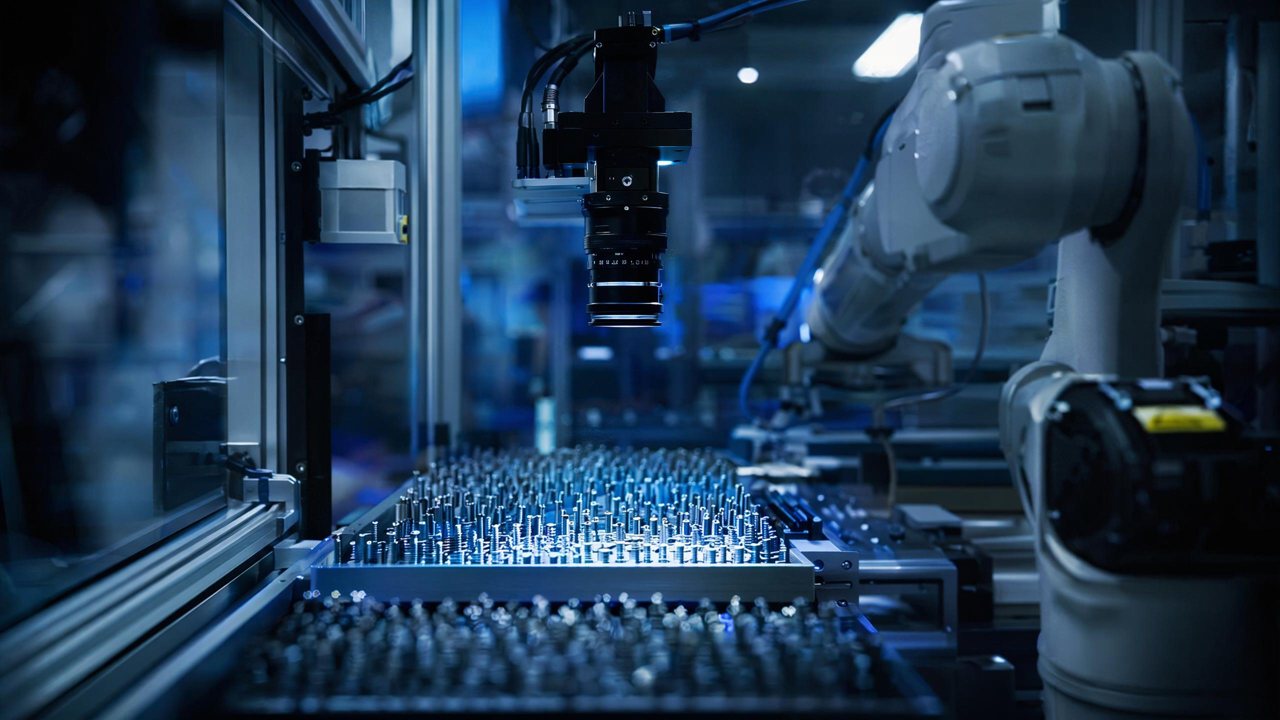
In the production of automotive parts, the quality inspection of the fastener tightening process is a key link to ensure product performance and safety. WeLinkirt provides an efficient and accurate inspection solution for the automotive industry with advanced AI vision technology.
Industry background and user scenario: The automotive industry is an important pillar of modern manufacturing, and the quality and efficiency of its parts production directly affect the performance of the whole vehicle and market competitiveness. In the production process of automotive parts, the fastener tightening process is a crucial link. On the fastener tightening production line of a leading automotive parts manufacturer, it is necessary to detect the tightening state of fasteners on various automotive parts. The products cover a variety of key parts such as engine blocks and gearbox housings. The main detection objects are fasteners such as bolts and nuts after tightening to ensure that their tightening degree meets the production standards. The quality of these key parts is directly related to the safety and reliability of the vehicle, so the requirements for the detection of the fastener tightening state are extremely high.
In - depth analysis of pain points: Why is it difficult?
Traditional detection methods mainly rely on manual labor, which has serious deficiencies in efficiency. The speed of manual detection is far behind the production rhythm of high-speed production lines, and the number of parts that can be detected per hour is limited. Moreover, manual detection is prone to fatigue, resulting in a further decline in detection speed. At the same time, the missed detection rate of manual detection is as high as 5%, and the false alarm rate is about 3%. For example, when detecting the tightening state of a large number of bolts, manual labor may miss some untightened bolts due to negligence or misjudge a normally tightened bolt as unqualified.
Labor cost is also a major pain point of traditional detection methods. Enterprises need to hire a large number of inspectors and pay them salaries, benefits, etc. In addition, manual detection has a high labor intensity. Inspectors need to concentrate for a long time to conduct inspections, which is prone to cause physical and mental fatigue. This not only affects the work efficiency and quality of inspectors but also may lead to a series of health problems.
During model-changing production, the disadvantages of traditional detection methods are more obvious. It takes about 1 hour to debug the detection equipment, which seriously affects production efficiency. Because during the debugging process, the production line needs to stop production, resulting in a waste of time and resources. Moreover, manual detection is difficult to meet the real-time full inspection requirements of high-speed production lines and cannot guarantee the stability and consistency of product quality. Due to the subjectivity and uncertainty of manual detection, different inspectors may get different detection results, which leads to fluctuations in product quality.
Technical principle
WeLinkirt uses advanced AI algorithms and high-precision imaging technology to solve the above problems. In terms of AI algorithms, through the deep convolutional neural network (DCNN), a large number of fastener tightening images are trained and learned. The deep convolutional neural network has a powerful feature extraction ability and can extract subtle features such as the angle of the bolt head and the position of the nut from the image. For example, if the angle of the bolt head does not meet the standard, it may mean that the bolt is not tightened properly. Through the analysis of these subtle features, the system can accurately identify the tightening state of fasteners of different types and specifications.
In terms of imaging technology, a self-developed 3D camera is used for image acquisition. The 3D camera can obtain the three-dimensional topography information of fasteners. Compared with traditional 2D imaging, it can more comprehensively and accurately reflect the actual state of fasteners. Traditional 2D imaging can only obtain the planar information of objects and is difficult to accurately identify some hidden defects or complex shapes. The 3D camera processes the collected three-dimensional data through the three-dimensional topography reconstruction technology to generate a clear and accurate three-dimensional model, providing more abundant information for subsequent detection and analysis. The reason why this technical principle combining AI algorithms and 3D imaging is effective is that it makes full use of the intelligent analysis ability of AI and the high-precision information of 3D imaging, and can accurately identify the tightening state of fasteners in a complex production environment, greatly improving the accuracy and reliability of detection.
Typical application scenarios
- Bolt tightening angle detection: On the engine block, the tightening angle of bolts is crucial to the performance and reliability of the engine. WeLinkirt can accurately detect whether the tightening angle of bolts meets the standard through AI algorithms and 3D imaging technology. The difficulty lies in that the shape and surface texture of the bolt head may affect the detection accuracy of the angle, and the algorithm needs to have strong anti-interference ability.
- Nut tightening torque detection: The tightening torque of nuts on the gearbox housing needs to be strictly controlled. During detection, the system judges whether the tightening torque is appropriate by analyzing the position and deformation of the nut. The difficulty lies in that the tightening state of the nut may be affected by the surrounding environment and other parts, and the 3D imaging technology needs to accurately capture the subtle changes of the nut.
- Hidden solder joint detection: There may be hidden solder joints at the connection of some automotive parts. WeLinkirt's 3D camera can detect the quality of these hidden solder joints, and the shape and size of the solder joints can be clearly seen through three-dimensional topography reconstruction. The difficulty lies in that the position of hidden solder joints is relatively hidden, and the camera needs to have high resolution and sensitivity.
- Coplanarity detection: For some parts that need to be closely matched, such as the joint surface between the engine cylinder head and the cylinder block, coplanarity detection is very important. The system judges whether the coplanarity meets the requirements by detecting the three-dimensional topography of the joint surface. The difficulty lies in that the surface roughness and small deformation of the joint surface may affect the detection results, and the algorithm needs to accurately distinguish normal surface features from defects.
- Micron - level topography detection: For some high-precision automotive parts, micron-level topography detection is required. WeLinkirt's 3D camera and AI algorithms can meet this requirement and accurately detect small defects on the part surface. The difficulty lies in that micron-level defects are very difficult to detect, and the system needs to have extremely high accuracy and sensitivity.
Implementation case
A large-scale automotive parts manufacturer, with a large production scale, needs to detect a large number of automotive parts every day. Before introducing WeLinkirt's solution, the enterprise used the traditional manual detection method and faced problems such as low efficiency, high missed detection rate, high false alarm rate, high labor cost, and long model-changing debugging time. During the implementation process, WeLinkirt's technical team conducted a detailed investigation and analysis of the enterprise's production line, carried out customized development of the system and installation and debugging of the equipment according to the actual needs of the enterprise. After a period of trial operation and optimization, the system was officially launched.
After adopting WeLinkirt's solution, the fastener tightening detection of the enterprise has changed significantly.
Before the launch, the detection rate of fastener tightening in the enterprise was only about 90%, the missed detection rate was 10%, the false alarm rate was 3%, and the model-changing debugging time was about 1 hour. After the launch, the detection rate increased to over 98%, the missed detection rate decreased to < 2%, the false alarm rate decreased by -70%, and the model-changing time was shortened from about 1 hour to 5 minutes. This not only greatly improved production efficiency, met the real-time full inspection requirements of high-speed production lines, but also ensured the stability of product quality.
WeLinkirt's solution and products
WeLinkirt provides the DaoAI AI AOI software system and the DaoAI 2D / 3D AI AOI equipment. The DaoAI AI AOI software system has a powerful feature recognition ability. Using the visual basic model, it can complete 0-code automatic programming in only 5 minutes with one piece of good product. Through the APDT positive-sample/few-sample learning function, model training can be completed with only 1-20 pieces of good-product images, greatly shortening the model training time. At the same time, the semantic false-alarm filtering function can effectively reduce false-alarm situations and improve the accuracy of detection.
The DaoAI 2D / 3D AI AOI equipment is equipped with a self-developed 3D camera, which can perform three-dimensional topography reconstruction and can detect hidden solder joints, coplanarity, and micron-level topography. In fastener tightening detection, the equipment can clearly obtain the three-dimensional information of fasteners and accurately judge the tightening state. The equipment supports SDK / API / Docker deployment and can achieve 100% local privatization deployment to ensure that data does not leave the factory and guarantee data security.
Quantitative results: After adopting WeLinkirt's solution, the detection rate of fastener tightening increased to over 98%, the missed detection rate decreased to < 2%, and the false alarm rate decreased by -70%. The model-changing time was shortened from about 1 hour to 5 minutes, greatly improving production efficiency and meeting the real-time full inspection requirements of high-speed production lines.
FAQ
What pain points can WeLinkirt solve for the inspection of fastener tightening of automotive parts?
WeLinkirt solves the problems of low efficiency, high missed-detection rate, high false-alarm rate, high labor cost, and long model-changing debugging time of traditional manual inspection. Through advanced technology, it meets the real-time full-inspection requirements of high-speed production lines, ensures the stability of product quality, and improves production efficiency.
What is the detection technical principle of WeLinkirt?
WeLinkirt uses a deep convolutional neural network to train and learn fastener images, combined with a self-developed 3D camera to collect three-dimensional topography information. It uses AI intelligent analysis and 3D high-precision information to accurately identify the tightening state, which is more comprehensive and accurate than traditional methods.
What solutions and products does WeLinkirt provide?
WeLinkirt provides the DaoAI AI AOI software system and the DaoAI 2D / 3D AI AOI equipment. The software system can perform 0-code automatic programming and shorten the model training time. The equipment can perform three-dimensional topography reconstruction, support multiple deployment methods, and guarantee data security.
This article was generated by AI. Customer cases are simulated scenarios based on real product capabilities and figures are illustrative; see product pages for official benchmarks.