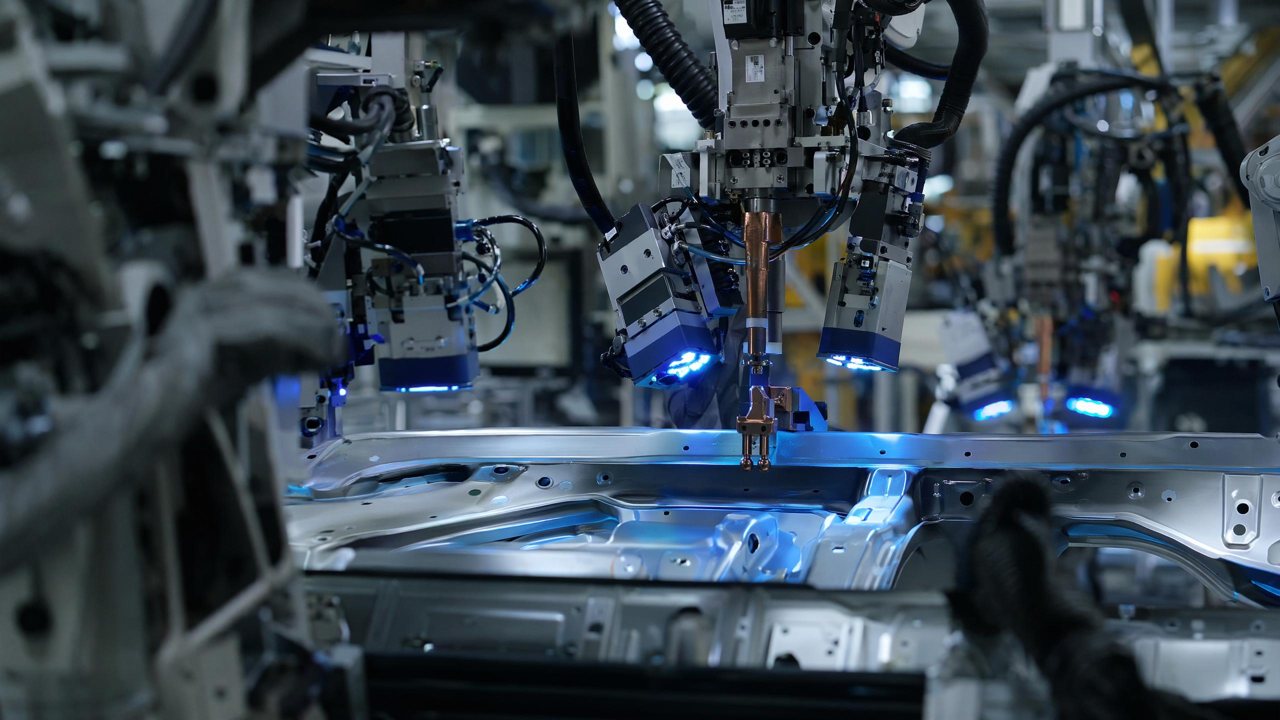
In the automotive manufacturing industry, the quality detection of resistance spot welding nuggets is a crucial step in ensuring the safety and performance of vehicle bodies. WeLinkirt's advanced AI vision technology has brought new breakthroughs to this detection challenge.
In the automotive manufacturing industry, resistance spot welding is a widely used joining process. Especially in the manufacturing of vehicle body structural parts, it can efficiently connect different metal components. The resistance spot welding production line of a leading automotive parts manufacturer is mainly responsible for producing vehicle body structural parts. The quality of the resistance spot welding nuggets directly affects the strength and safety of the vehicle body. Therefore, accurate detection of the nugget quality is the core link of this production process. If the quality of the nuggets does not meet the standards, it may lead to problems such as loosening and deformation of the vehicle body structure during use, seriously threatening driving safety.
Pain Points: Why is it Difficult?
Traditional nugget detection methods have various quantification difficulties. Firstly, manual detection is extremely inefficient. The detection time for each spot is relatively long. On average, it may take a worker several seconds or even dozens of seconds to detect a single spot, which makes the rhythm of the entire production line very slow. Moreover, manual detection requires a large amount of labor input, resulting in high labor costs. In addition, manual detection is prone to missed detections and false alarms. According to statistics, the missed-detection rate of manual detection is about 3%, and the false-alarm rate is as high as 15%. This is because human visual and judgment abilities are limited, and fatigue is easily generated after long-term work, which leads to missed judgments of some minor defects or false judgments of normal situations. This situation not only affects product quality but also greatly increases the re-inspection volume, further reducing production efficiency.
Traditional 2D optical detection methods also have obvious deficiencies. They have detection blind spots and can only obtain the two-dimensional image information of the nugget surface, unable to accurately acquire the 3D morphology of the nugget. This means that for some spots hidden under the package or internal defects of the nugget, 2D optical detection methods are difficult to detect. Under the strict quality compliance requirements of automotive manufacturing, this lack of detection ability is unacceptable. Moreover, 2D images cannot fully reflect the real situation of the nugget. For some nuggets with complex shapes or tiny internal defects, 2D optical detection may produce false judgments, thus affecting the final product quality.
Technical Principle
WeLinkirt uses self-developed 3D cameras and three-dimensional morphology reconstruction technology to solve the above problems. The self-developed 3D camera can emit special structured light with a specific coding method. When the structured light is projected onto the surface of the nugget, the reflected light will carry the morphological information of the nugget surface and return to the camera. By analyzing the information of the reflected light, the camera can accurately obtain the three-dimensional morphological data of the nugget. Compared with traditional 2D optical detection methods, this method breaks through the limitation of only obtaining two-dimensional information and can comprehensively capture the characteristic information of the nugget.
The three-dimensional morphology reconstruction algorithm reconstructs the real 3D model of the nugget based on the three-dimensional morphological data collected by the camera. To improve the accuracy of data collection and the integrity of the model, multiple technologies are adopted. Structured light coding enables the camera to more accurately analyze the information of the reflected light, improving the accuracy of 3D data collection. The multi-view fusion technology captures the nugget from multiple angles and then fuses the 3D data from different views to obtain a more complete and accurate 3D model. Finally, deep learning algorithms are used to analyze the reconstructed 3D model and identify various defect features of the nugget, such as cracks and holes. Deep learning algorithms have strong feature learning ability and can learn the characteristic patterns of different defects from a large amount of 3D model data, thus more accurately determining whether the nugget has defects.
Typical Application Scenarios
- Nugget size detection: By obtaining the 3D morphological data of the nugget, the diameter, height and other size parameters of the nugget can be accurately measured. The difficulty lies in the fact that some nuggets have irregular shapes, and traditional measurement methods may produce relatively large errors. 3D detection needs to accurately identify the boundary of the nugget.
- Crack detection: Cracks are one of the common and dangerous defects in nuggets. Using deep learning algorithms to analyze the 3D model can detect tiny cracks. The difficulty is that cracks may be hidden inside the nugget or in the surface texture and are not easy to find.
- Hole detection: Holes can affect the strength of the nugget. 3D detection can observe the nugget from different angles to find internal holes. The difficulty is that some tiny holes may be similar to normal surface textures and need to be accurately distinguished.
- Nugget position deviation detection: Detect whether the nugget is in the correct position. By comparing the actual 3D model with the standard model, the position deviation is judged. The difficulty is to consider some reasonable tolerance ranges in the manufacturing process.
Implementation Case
A large-scale automotive parts manufacturer has a large-scale resistance spot welding production line and needs to detect a large number of vehicle body structural parts every day. Before introducing WeLinkirt's solution, it used traditional detection methods, which had low detection efficiency, high missed-detection and false-alarm rates, and long production line change-over time. During the implementation process, WeLinkirt's technical team first conducted a detailed investigation and analysis of the production line to determine the detection requirements and parameters. Then, the DaoAI 2D / 3D AI AOI equipment was installed and debugged and calibrated. At the same time, the DaoAI AI AOI software system was configured and optimized to ensure that it could accurately analyze and process the detection data. After a period of trial operation and optimization, the system was officially launched.
WeLinkirt's solution has brought a qualitative leap to the detection of resistance spot welding nuggets in the automotive industry, significantly improving the detection efficiency and accuracy.
WeLinkirt's Solution and Products
WeLinkirt provides the DaoAI 2D / 3D AI AOI equipment and the DaoAI AI AOI software system. The DaoAI 2D / 3D AI AOI equipment integrates the self-developed 3D camera and three-dimensional morphology reconstruction technology, which can quickly and accurately obtain the 3D morphological information of the nugget. This equipment has the characteristics of high precision and high speed and is suitable for large-scale production detection. The DaoAI AI AOI software system is based on the feature recognition of the visual basic model, supports 5-minute zero-code automatic programming for one good product, uses APDT positive-sample/few-sample learning (only 1-20 good products are required), and has the semantic false-alarm filtering function. In practical applications, the DaoAI 2D / 3D AI AOI equipment is first used to collect the 3D data of the nugget, and then the collected data is transmitted to the DaoAI AI AOI software system for analysis and processing. The software system quickly determines whether the nugget has defects according to the preset detection rules and outputs the detection results.
Quantitative results: After adopting WeLinkirt's solution, the detection effect has been significantly improved. The detection rate has increased from about 97% to 99.2%, and the missed-detection rate has been reduced to < 0.8%. The false-alarm rate has been reduced by -68%, greatly reducing the re-inspection volume. At the same time, the change-over time has been shortened from the original 30 minutes to 5 minutes, improving the flexibility and production efficiency of the production line.
FAQ
What advantages does WeLinkirt's solution offer for the detection of resistance spot welding nuggets in the automotive industry?
With advanced AI vision technology, WeLinkirt provides an efficient and accurate detection solution consisting of the DaoAI 2D / 3D AI AOI equipment and the DaoAI AI AOI software system. It has a detection rate of 99.2%, reduces the false-alarm rate by 68%, shortens the change-over time to 5 minutes, and can effectively detect the quality of the nuggets.
What are the pain points of traditional detection methods for resistance spot welding nuggets in the automotive industry?
Traditional methods have many difficulties. Manual detection is inefficient, with a missed-detection rate of about 3%, a false-alarm rate of 15%, and high labor costs. 2D optical detection has blind spots, cannot obtain the 3D morphology of the nugget, and is difficult to detect hidden spots, failing to meet strict quality requirements.
Where are the advantages of WeLinkirt's technical principle reflected?
WeLinkirt uses self-developed 3D cameras and three-dimensional morphology reconstruction technology, breaking through the limitations of 2D detection. It emits special structured light to obtain 3D data and combines structured light coding, multi-view fusion, and deep learning algorithms to comprehensively capture the characteristics of the nugget and accurately judge defects.
This article was generated by AI. Customer cases are simulated scenarios based on real product capabilities and figures are illustrative; see product pages for official benchmarks.