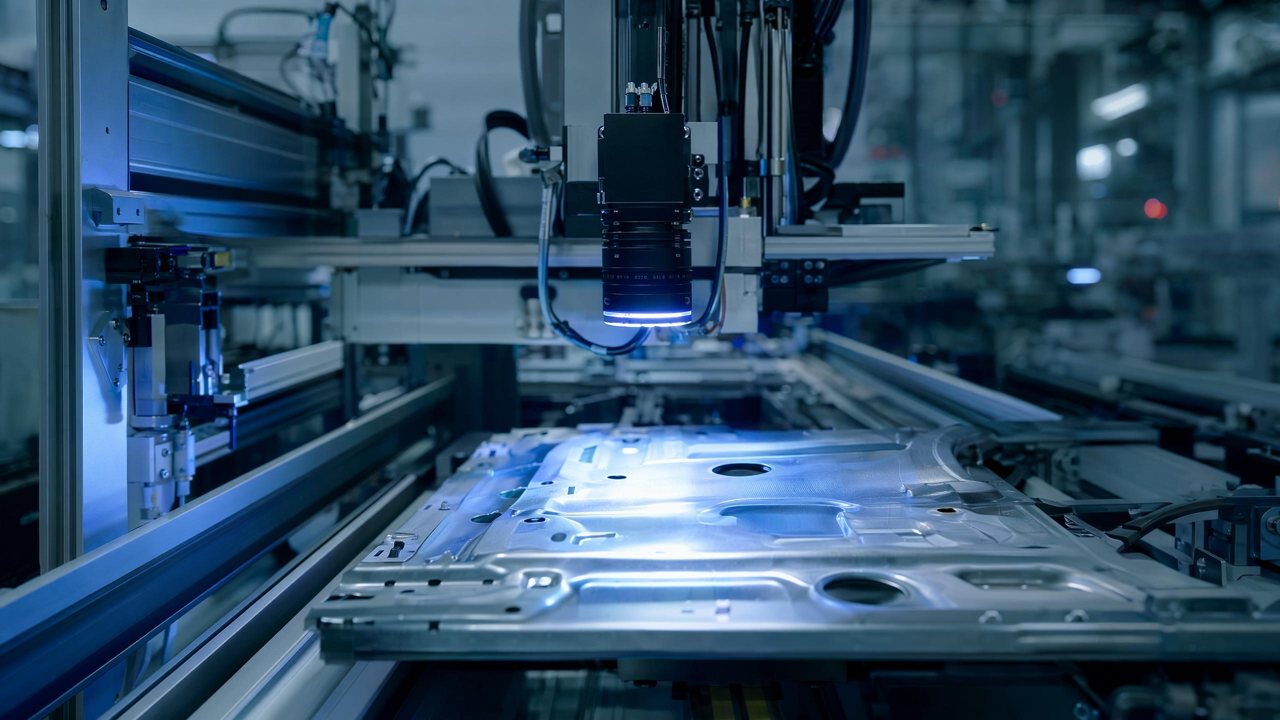
WeLinkirt brings innovation to the surface defect inspection of automotive stamped sheet metal with advanced AI vision technology. Its solution effectively addresses the pain points of traditional inspection methods and improves the quality and efficiency of automotive parts production.
In the automotive manufacturing industry, stamped sheet metal is an important component, and its surface quality is directly related to the overall quality and safety of the vehicle. The stamped sheet metal production line of a leading automotive parts manufacturer is mainly responsible for the production of various automotive stamped sheet metal parts. These sheet metal parts have a thickness of 0.3mm, and during the production process, there may be minor defects such as scratches, dents, and cracks on the surface. The automotive manufacturing industry has extremely strict quality requirements for parts, and any minor defect may affect the performance and safety of the vehicle. Therefore, it is necessary to accurately inspect the surface of these stamped sheet metal parts to ensure that the products meet high-quality standards.
Pain Points: Why Is It Difficult?
Traditional inspection methods face many dilemmas in this scenario. From the efficiency dimension, manual inspection is extremely inefficient, with only about 30 products being inspected per hour. This is because manual inspection mainly relies on the naked-eye observation of inspectors. During long-working hours, inspectors are prone to visual fatigue, and the recognition speed of minor defects is slow. In addition, the accuracy of manual inspection is difficult to guarantee, and the missed-detection rate is as high as 15%. This is because 0.3mm minor defects are difficult to detect, and due to the subjective judgment differences of inspectors, some defects are easily missed.
In terms of the false-alarm rate, the false-alarm rate of manual inspection is about 20%. This is because manual judgment is somewhat subjective. For some normal surface textures or slight stains similar to defects, inspectors may misjudge them as defects. A large number of false alarms lead to a large number of products needing re-inspection, which not only increases production costs but also prolongs production time. In addition, when changing the production line model, traditional methods face great challenges. Manually readjusting inspection standards and processes takes about 30 minutes. This is because different stamped sheet metal parts may have different shapes, sizes, and surface characteristics. Manually resetting inspection parameters and adjusting inspection processes is a complex and error-prone process, seriously affecting the production rhythm.
Technical Principle
WeLinkirt uses advanced AI algorithms and imaging technologies to solve the above problems. In terms of algorithms, deep-learning algorithms are used to learn and train a large number of stamped sheet metal surface images. Through the convolutional neural network (CNN), the feature information of the images can be automatically extracted to accurately identify different types of surface defects. Deep - learning algorithms have powerful feature-learning capabilities. They can extract representative features from complex images and automatically adjust model parameters to adapt to different defect features and image backgrounds through learning a large number of images.
In terms of imaging, WeLinkirt's self-developed 3D camera plays an important role. It can acquire the three-dimensional topography information of the sheet-metal surface. Combined with the three-dimensional topography reconstruction technology, it can clearly present the three-dimensional features of minor defects. Compared with traditional 2D inspection methods, the 3D camera can acquire the depth information of the object surface and can accurately detect some minor defects hidden under the surface. The three-dimensional topography reconstruction technology processes and analyzes the point-cloud data acquired by the 3D camera to generate an intuitive three-dimensional model, which is convenient for inspectors to make judgments. The combination of this algorithm and imaging technology is effective because it makes up for the deficiencies of traditional 2D inspection and provides more comprehensive surface information.
Typical Application Scenarios
- Scratch detection: The scratches on the surface of stamped sheet metal are usually very thin, and some even have a width close to 0.3mm. Traditional methods have difficulty accurately identifying these fine scratches, while WeLinkirt's 3D camera can acquire the depth information of the scratches. Combined with the deep-learning algorithm to extract and analyze the features of the scratches, it can accurately detect scratches. The difficulty lies in that the scratches may be similar to the normal texture of the sheet-metal surface, and the algorithm needs high recognition accuracy.
- Dent detection: Dents generally have a certain depth and area and may not be obvious in 2D images. WeLinkirt's 3D camera can clearly present the three-dimensional topography of the dents and generate a three-dimensional model of the dents through the three-dimensional topography reconstruction technology. The algorithm makes judgments based on the depth, area, and other features of the dents to accurately detect dents. The difficulty is that some shallow dents have unobvious features and are easily confused with the normal small undulations on the surface.
- Crack detection: Cracks come in various shapes, such as straight, curved, or branched. Traditional inspection methods have difficulty judging the direction and depth of cracks. WeLinkirt uses deep-learning algorithms to learn the image features of cracks, and the 3D camera acquires the depth information of the cracks to achieve accurate crack detection. The difficulty lies in that the image features of some minor cracks are not clear, and the algorithm needs strong feature-extraction capabilities.
- Hidden - solder-joint detection: Hidden solder joints are usually located inside the sheet-metal parts, and there may only be slight traces on the surface. WeLinkirt's 3D camera can acquire the three-dimensional topography information of these slight traces. Combined with the algorithm to analyze the features of the solder joints, it can judge whether there are defects in the solder joints. The difficulty is that the features of hidden solder joints are weak, and high-precision imaging and algorithms are required for recognition.
Implementation Case
A large-scale automotive parts manufacturer has multiple stamped sheet-metal production lines and produces a large number of automotive stamped sheet-metal parts every day. Before introducing WeLinkirt's solution, the enterprise faced problems such as low inspection efficiency, high missed-detection rate, high false-alarm rate, and long production-line change-over time, which seriously affected production efficiency. During the implementation process, WeLinkirt's technical team first conducted a comprehensive investigation and evaluation of the production line, determined the installation position of the equipment and the parameter settings of the software system. Then, the DaoAI 2D / 3D AI AOI equipment was installed on the stamped sheet-metal production line and connected to the production-line control system. At the same time, the software system was debugged and optimized to ensure that the system could accurately analyze and process the inspection data.
WeLinkirt's solution has brought significant improvements to the enterprise, improving production quality and efficiency and reducing production costs.
Before the implementation, the enterprise could only inspect about 30 products per hour, with a missed-detection rate as high as 15%, a false-alarm rate of about 20%, and a production-line change-over time of about 30 minutes. After the implementation, the inspection efficiency has been greatly improved, and about 120 products can be inspected per hour, a three-fold increase. The missed-detection rate has been reduced to <0.6%, the false-alarm rate has been reduced by -63%, and the production-line change-over time has been shortened from 30 minutes to 5 minutes.
WeLinkirt's Solution and Products
WeLinkirt provides the DaoAI AI AOI software system and the DaoAI 2D / 3D AI AOI equipment. The DaoAI AI AOI software system has the feature-cognition ability of the visual basic model. With only 1-20 good samples, through APDT positive-sample/few-sample learning, it can achieve zero-code automatic programming within 5 minutes. The system can also perform semantic false-alarm filtering, effectively reducing the false-alarm rate. The DaoAI 2D / 3D AI AOI equipment uses a self-developed 3D camera and three-dimensional topography reconstruction technology, which can detect hidden solder joints, coplanarity, and micron-level topography, and the detection accuracy for 0.3mm surface defects can reach the micron level. During the implementation process, the equipment is installed on the stamped sheet-metal production line to conduct online inspections on products. The software system analyzes and processes the inspection data in real-time and feeds the results back to the production-line control system.
Quantitative results: After adopting WeLinkirt's solution, the inspection efficiency has been greatly improved, with about 120 products being inspected per hour, a three-fold increase compared with before. The missed-detection rate has been reduced to <0.6%, the false-alarm rate has been reduced by -63%, effectively reducing the re-inspection workload. The production-line change-over time has been shortened from 30 minutes to 5 minutes, significantly improving production flexibility and efficiency.
FAQ
What pain points can WeLinkirt's AI vision inspection solution for 0.3mm surface defects in automotive stamped sheet metal solve?
This solution can solve many pain points of traditional inspection. Traditional manual inspection is inefficient, with only about 30 products inspected per hour, a missed-detection rate of 15%, a false-alarm rate of about 20%, and a long production-line change-over time of about 30 minutes. This solution has a 99.4% detection rate, reduces the false-alarm rate by -63%, and only takes 5 minutes for change-over, greatly improving inspection efficiency and production flexibility.
What is the technical principle of WeLinkirt's inspection solution?
WeLinkirt uses advanced AI algorithms and imaging technologies. The deep-learning algorithm combined with CNN extracts image features to identify defects and can automatically adjust parameters to adapt to different situations. The self-developed 3D camera acquires three-dimensional topography information, and the three-dimensional topography reconstruction technology generates an intuitive model, making up for the deficiencies of traditional 2D inspection and providing more comprehensive surface information.
What are the quantitative results of WeLinkirt's solution?
After adopting this solution, the inspection efficiency has been greatly improved, with about 120 products being inspected per hour, a three-fold increase. The missed-detection rate has been reduced to <0.6%, the false-alarm rate has been reduced by -63%, and the re-inspection workload has been reduced. The production-line change-over time has been shortened from 30 minutes to 5 minutes, improving production flexibility and efficiency.
This article was generated by AI. Customer cases are simulated scenarios based on real product capabilities and figures are illustrative; see product pages for official benchmarks.